
Physician Assistant Resume: Examples, Skills & Keywords
Build a physician assistant resume with clear clinical experience, PA skills, job-specific keywords, clinical rotation guidance, credentials, and ATS-friendly formatting.
Quick answer
A strong physician assistant resume separates training, credentials, and paid PA experience clearly.
Start with the PA job you are applying for. Primary care, emergency medicine, surgery, orthopedics, psychiatry, and other specialties can ask for very different evidence. Your resume should make the relevant patient population, clinical work, procedures, systems, and credentials easy to find.
Current U.S. labor data also shows why setting matters. The Bureau of Labor Statistics reported about 168,900 physician assistant jobs in 2025. About 53% were in physicians' offices, 26% in hospitals, and 9% in outpatient care centers. Employment is projected to grow 21% from 2025 to 2035, with about 11,500 openings per year on average.
That demand does not remove the need for a focused application. Use the job description to decide what deserves space. Then support important terms with work you actually performed. Keep supervised clinical rotations separate from paid post-graduation PA employment.
- Match the resume to the specialty, setting, patient population, and responsibilities in the job posting.
- List your state license, PA-C status, and other credentials exactly as they currently apply.
- Show clinical skills in context instead of relying on a long keyword list.
- Label PA school clinical rotations as supervised training, not independent employment.
- Use clear ATS-friendly formatting and keep job titles, dates, credentials, and experience easy to scan.
What a physician assistant resume needs to show first
A PA resume should answer a few basic questions quickly. What setting have you worked in? Which patient populations have you cared for? What clinical work did you perform? Which credentials are current? How close is that experience to the job in front of you?
The Bureau of Labor Statistics says PAs work across physician offices, hospitals, outpatient centers, and other healthcare settings. It also notes that duties change by specialty. A surgical PA may support perioperative care. A pediatric PA may focus on children and routine preventive care. That is why one generic resume is rarely enough for every PA opening.
O*NET lists core PA work such as patient histories, physical exams, diagnostic testing, treatment decisions, patient counseling, referrals, documentation, procedures, and monitoring. Those are occupational examples. They are not a checklist to copy. Your resume should include only the responsibilities that fit your actual role and legal scope.
- If the job emphasizes
- Primary care
- Evidence you may prioritize
- Patient histories, physical exams, preventive care, chronic-condition follow-up, patient education, diagnostic review, referrals, and care coordination when accurate
- If the job emphasizes
- Emergency or urgent care
- Evidence you may prioritize
- Rapid assessment, acute complaints, diagnostic testing, procedures, wound care, escalation, discharge instructions, and follow-up within your scope
- If the job emphasizes
- Surgery
- Evidence you may prioritize
- Preoperative evaluation, perioperative support, surgical assisting, wound care, rounds, postoperative follow-up, and specialty procedures you actually perform
- If the job emphasizes
- Specialty clinic
- Evidence you may prioritize
- Relevant patient population, conditions, specialty procedures, diagnostics, medications, documentation, and interdisciplinary care
- If the job emphasizes
- New-graduate PA role
- Evidence you may prioritize
- Supervised clinical rotations, PA education, current certification status, prior patient-care experience, and skills relevant to the target setting
| If the job emphasizes | Evidence you may prioritize |
|---|---|
| Primary care | Patient histories, physical exams, preventive care, chronic-condition follow-up, patient education, diagnostic review, referrals, and care coordination when accurate |
| Emergency or urgent care | Rapid assessment, acute complaints, diagnostic testing, procedures, wound care, escalation, discharge instructions, and follow-up within your scope |
| Surgery | Preoperative evaluation, perioperative support, surgical assisting, wound care, rounds, postoperative follow-up, and specialty procedures you actually perform |
| Specialty clinic | Relevant patient population, conditions, specialty procedures, diagnostics, medications, documentation, and interdisciplinary care |
| New-graduate PA role | Supervised clinical rotations, PA education, current certification status, prior patient-care experience, and skills relevant to the target setting |
Physician assistant vs physician associate on your resume
You may see both physician assistant and physician associate in current healthcare materials. AAPA uses physician associate as the profession's updated title, but implementation is still happening across states and organizations.
Some jurisdictions have changed the legal title. Others still use physician assistant or recognize both. AAPA advises PAs to follow state law, licensing-board rules, employer policies, facility rules, payer requirements, and other legal obligations.
For your resume, use the professional title that is accurate for your license, jurisdiction, employer, and current role. Do not change an official past job title just to match a newer term. You can use PA where that keeps the wording clear.
A clear physician assistant resume structure
PA resumes can become crowded. You may need to show a license, PA-C certification, clinical experience, rotations, prior healthcare work, education, procedures, systems, and specialty skills. A simple order makes those details easier to verify.
- 1
Contact information and current credentials
Keep your name, phone, email, location, and relevant professional links easy to find. Use credentials accurately.
- 2
Professional summary
Use a short summary when it helps explain your specialty, setting, patient population, experience level, or transition from PA school into practice.
- 3
Licensure and certification
Make your current state license, PA-C status, and job-relevant certifications easy to verify. Include other registrations only when they apply.
- 4
Clinical experience
Show paid PA work first when you have it. Use clear bullets for patient care, procedures, documentation, teamwork, and outcomes.
- 5
Clinical rotations
For new graduates, use a separate section for supervised PA school rotations. Label the setting, specialty, dates, and student status clearly.
- 6
Prior healthcare experience
Include earlier patient-care roles when they add relevant evidence, but keep the original title and level of responsibility accurate.
- 7
Education and skills
List PA education, relevant prior degrees, and a focused skills section that matches the job and your real experience.
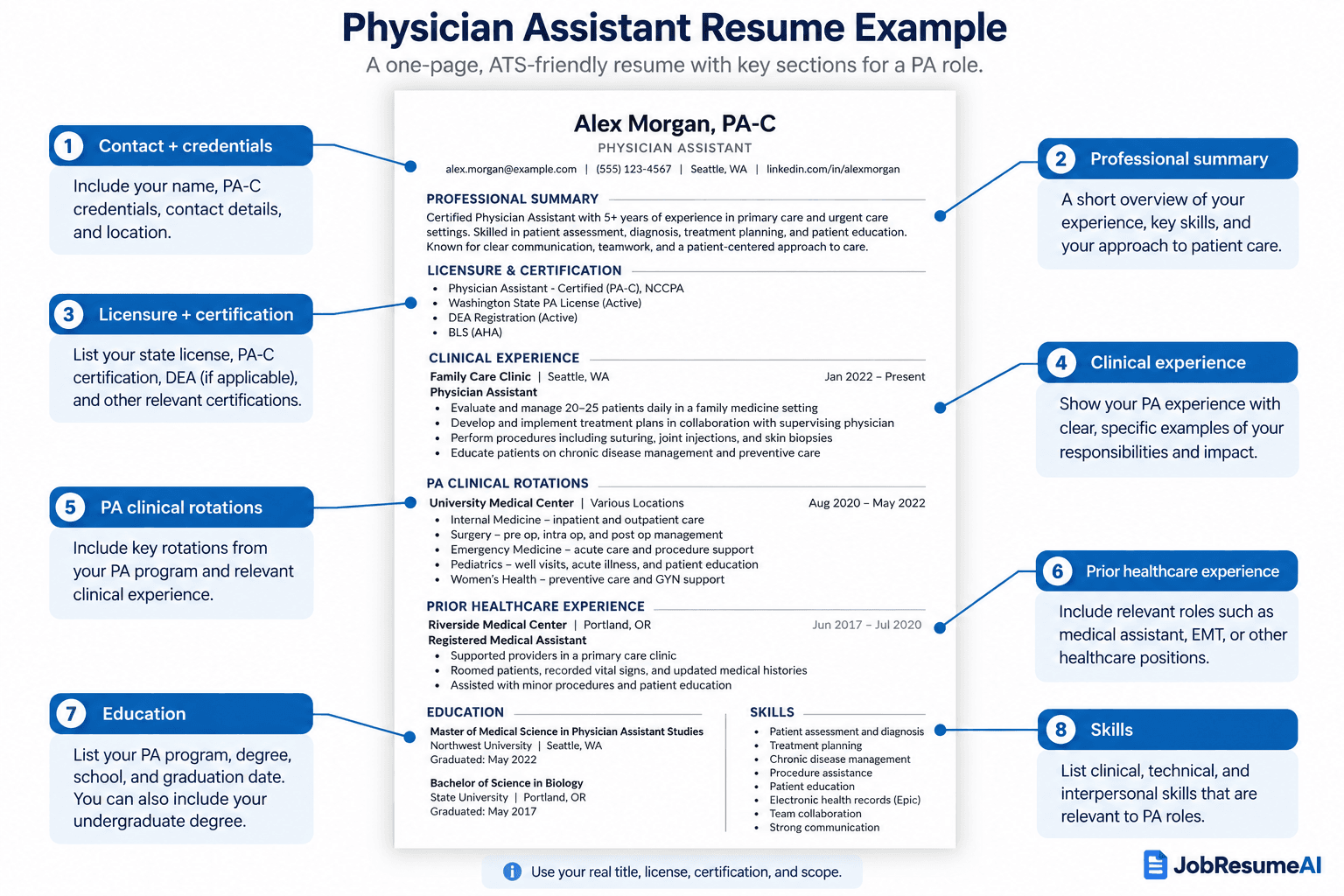
A clean PA resume layout showing where credentials, paid PA experience, supervised rotations, earlier healthcare work, education, and skills can fit.
Physician assistant resume example
The example below is fictional. It shows how a PA resume can connect clinical work, credentials, and specialty fit without reading like a copied job description.
Illustrative example
Physician Assistant, Primary Care
Use the structure as a reference. Replace every patient population, procedure, credential, system, and result with information that is true for you.
Professional summary
PA-C with outpatient primary-care experience in patient assessment, diagnostic review, treatment planning, chronic-condition follow-up, preventive care, patient education, and EHR documentation. Experienced in team-based care and clear follow-up planning.
Selected skills
- Medical history and physical examination
- Diagnostic test review
- Treatment and follow-up planning
- Patient education
- EHR documentation
- Referral and care coordination
Experience bullet example
Evaluated adult patients in an outpatient setting, documented histories and physical findings, reviewed available test results, and developed treatment and follow-up plans within clinic protocols and state practice requirements.
Another experience bullet
Coordinated referrals and follow-up with physicians, nursing staff, pharmacy, and specialty services when patients needed further evaluation or ongoing care.
Physician assistant resume skills to prioritize
Choose skills from the target role and your real practice, not from a general healthcare list.
O*NET lists critical thinking, active listening, speaking, writing, monitoring, science, and judgment among relevant PA skills. It also lists medical software such as Epic, eClinicalWorks, and MEDITECH in employer-posting data.
Those sources show the range of work. They do not mean every PA should list the same software, procedures, or clinical skills. A surgery role and a psychiatry role can need very different evidence.
Use a short skills section for scanning. Then show the important skills again inside experience bullets where the reader can see how you used them.
- Skill area
- Assessment and clinical reasoning
- Examples when they are accurate for you
- Medical histories, physical examination, diagnostic review, clinical decision making, recognizing red flags, consultation and referral
- Skill area
- Treatment and procedures
- Examples when they are accurate for you
- Treatment planning, wound care, suturing, injections, immunizations, perioperative support, chronic-condition management, or specialty procedures within your scope
- Skill area
- Documentation and systems
- Examples when they are accurate for you
- EHR documentation, progress notes, orders, referrals, care plans, chart review, Epic, eClinicalWorks, MEDITECH, or other systems you actually use
- Skill area
- Patient communication
- Examples when they are accurate for you
- Patient education, counseling, shared decision making, treatment instructions, follow-up planning, family communication
- Skill area
- Team-based care
- Examples when they are accurate for you
- Collaboration with physicians, nurses, pharmacists, therapists, specialists, and other healthcare professionals
- Skill area
- Specialty knowledge
- Examples when they are accurate for you
- Patient populations, conditions, procedures, workflows, and clinical knowledge specific to your actual specialty
| Skill area | Examples when they are accurate for you |
|---|---|
| Assessment and clinical reasoning | Medical histories, physical examination, diagnostic review, clinical decision making, recognizing red flags, consultation and referral |
| Treatment and procedures | Treatment planning, wound care, suturing, injections, immunizations, perioperative support, chronic-condition management, or specialty procedures within your scope |
| Documentation and systems | EHR documentation, progress notes, orders, referrals, care plans, chart review, Epic, eClinicalWorks, MEDITECH, or other systems you actually use |
| Patient communication | Patient education, counseling, shared decision making, treatment instructions, follow-up planning, family communication |
| Team-based care | Collaboration with physicians, nurses, pharmacists, therapists, specialists, and other healthcare professionals |
| Specialty knowledge | Patient populations, conditions, procedures, workflows, and clinical knowledge specific to your actual specialty |
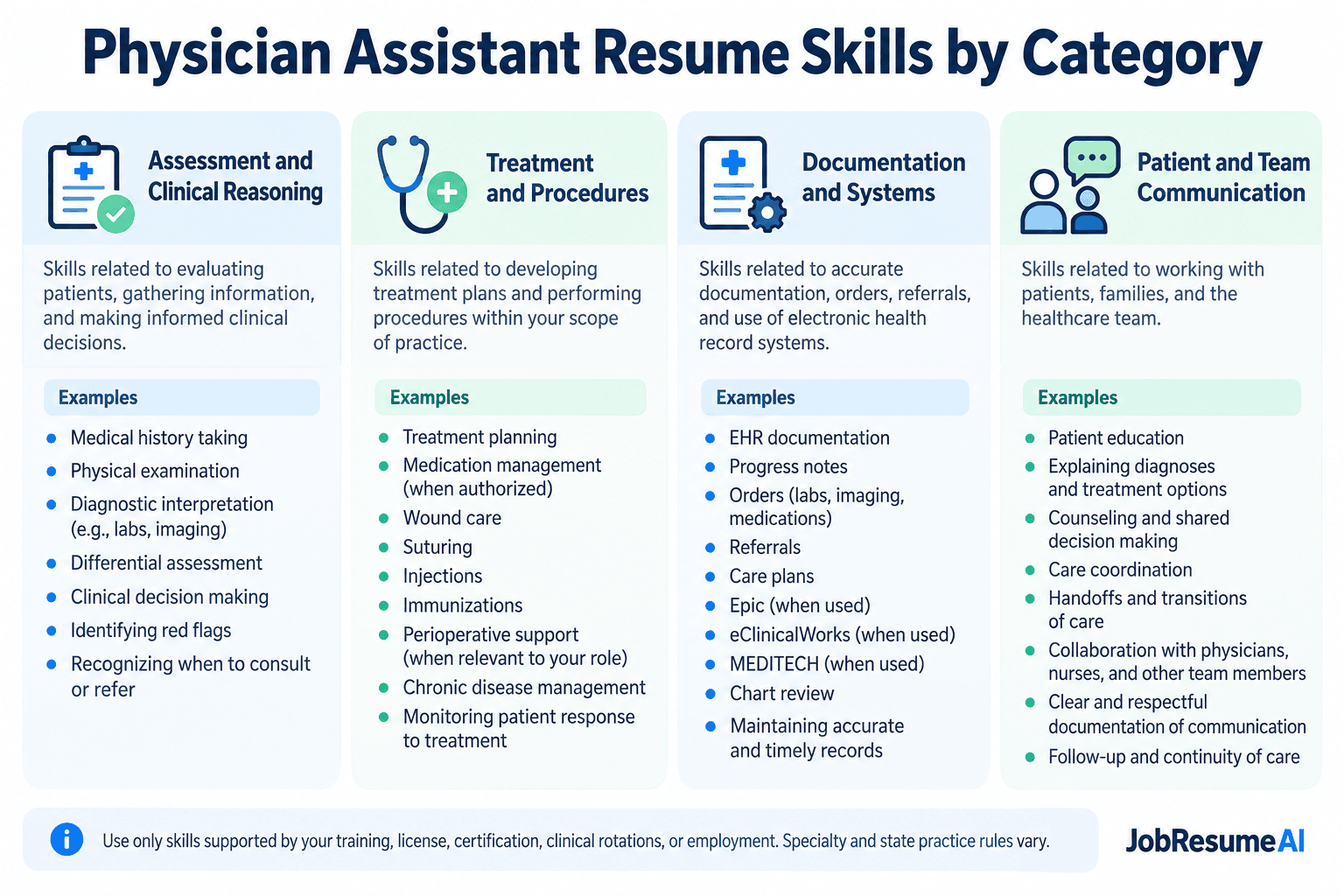
Choose PA skills that match the target role and that are supported by your training, license, certification, rotations, or employment.
How to choose physician assistant resume keywords
The strongest resume keywords come from the specific PA posting. Look for the specialty, patient population, setting, required credentials, procedures, systems, and responsibilities that appear central to the role.
Do not copy every term. A keyword is useful only when it describes something you can support. If a job asks for Epic and you used Epic, name it. If it asks for central-line placement and you have never performed that procedure, leave it out.
Also watch how the employer describes seniority. Terms such as independent clinic coverage, surgical first assist, inpatient rounding, call coverage, or leadership can imply a level of experience that needs real evidence.
- Keyword area
- Specialty and patient population
- What to look for
- Primary care, emergency medicine, orthopedics, surgery, pediatrics, psychiatry, cardiology, geriatrics
- Resume action
- Use the specialty or population when it matches your real background
- Keyword area
- Clinical responsibilities
- What to look for
- Assessment, diagnosis, treatment planning, procedures, follow-up, patient education, referrals
- Resume action
- Connect central responsibilities to real clinical evidence
- Keyword area
- Credentials
- What to look for
- State license, PA-C, BLS, ACLS, DEA registration, specialty credentials
- Resume action
- List only current credentials or registrations you actually hold and that are relevant
- Keyword area
- Systems
- What to look for
- Epic, eClinicalWorks, MEDITECH, telehealth systems, practice-specific software
- Resume action
- Name the exact system only when you have used it
- Keyword area
- Practice expectations
- What to look for
- Call, rounding, first assist, clinic coverage, team leadership, quality work
- Resume action
- Use these terms only when your real responsibilities support them
| Keyword area | What to look for | Resume action |
|---|---|---|
| Specialty and patient population | Primary care, emergency medicine, orthopedics, surgery, pediatrics, psychiatry, cardiology, geriatrics | Use the specialty or population when it matches your real background |
| Clinical responsibilities | Assessment, diagnosis, treatment planning, procedures, follow-up, patient education, referrals | Connect central responsibilities to real clinical evidence |
| Credentials | State license, PA-C, BLS, ACLS, DEA registration, specialty credentials | List only current credentials or registrations you actually hold and that are relevant |
| Systems | Epic, eClinicalWorks, MEDITECH, telehealth systems, practice-specific software | Name the exact system only when you have used it |
| Practice expectations | Call, rounding, first assist, clinic coverage, team leadership, quality work | Use these terms only when your real responsibilities support them |
Physician assistant resume summary examples
A short summary can help when it tells the employer what kind of PA you are, which setting you know, and what evidence matters for the job. It should not become a list of every clinical term on your resume.
For an experienced PA, lead with specialty and relevant scope. For a new graduate, make the training level clear. Do not make rotations sound like post-graduation employment.
Illustrative examples
PA summary directions for different backgrounds
Adapt the wording to your own license, certification, specialty, setting, and experience.
Experienced primary-care PA
PA-C with outpatient primary-care experience in patient assessment, diagnostic review, treatment planning, chronic-condition follow-up, preventive care, patient education, and EHR documentation.
New graduate PA
New graduate physician assistant with supervised clinical rotations in family medicine, internal medicine, emergency medicine, and surgery, plus prior direct patient-care experience as an EMT. PA-C status and state license listed according to current credentialing status.
Specialty transition
PA-C with adult outpatient experience and prior orthopedic clinical training, bringing musculoskeletal assessment, patient education, follow-up care, and team-based clinical experience to an orthopedic practice.
When a physician assistant resume objective may help
Most experienced PAs do not need a resume objective. A short summary is usually more useful because it focuses on the experience you already bring.
An objective can help a new graduate or a PA making a major specialty change when the direction is not obvious from the experience section. Keep the focus on relevant evidence, not only on what you want from the employer.
Too general
“Seeking a physician assistant position where I can grow, learn, and use my skills in a supportive environment.”
Clearer direction
“New graduate PA seeking an outpatient primary-care role, with supervised clinical training in family medicine and internal medicine plus prior direct patient-care experience in emergency medical services.”
How to write a new grad physician assistant resume
A new grad physician assistant resume has a simple challenge. You need to show meaningful clinical evidence without making supervised training look like paid PA employment.
BLS notes that PA education includes supervised clinical training in several specialties, such as family medicine, internal medicine, and emergency medicine. Those rotations can be useful resume evidence, especially when the target job matches the patient population or specialty.
Use a separate section such as PA Clinical Rotations or Graduate Clinical Experience. Include the site, specialty, dates, and student status. Add short bullets only for rotations that matter to the role. You do not need to describe every rotation in equal detail.
- Label rotations as supervised clinical training.
- Use PA Student, Clinical Rotation, or another accurate title instead of Physician Assistant if you were not employed as one.
- Prioritize rotations that match the target specialty or patient population.
- Show procedures or responsibilities only when you actually performed them under appropriate supervision.
- Keep post-graduation paid PA work in a separate Professional or Clinical Experience section.
- List current certification and licensure status exactly as it stands on the day you apply.
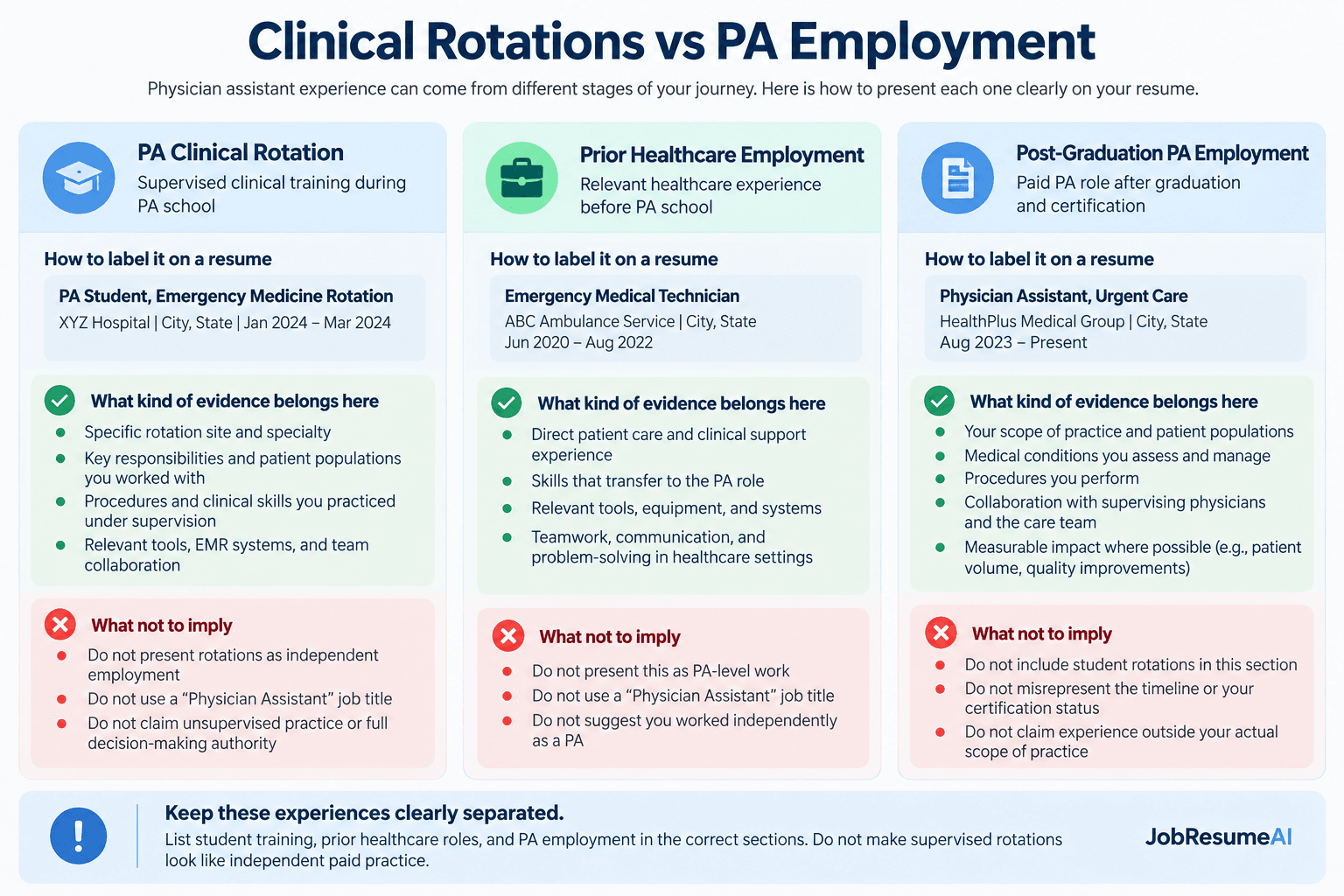
Keep student rotations, earlier healthcare roles, and paid PA employment in clearly labeled sections so the reader can see the level of each experience.
How to use prior healthcare experience on a PA resume
Many PA students enter training with direct patient-care experience. BLS notes that PA program applicants often have healthcare experience, and some programs may accept backgrounds such as medical assistant, EMT, paramedic, or other patient-care work.
That earlier experience can help a new graduate resume. It may show patient communication, triage support, clinical workflow, documentation, emergency response, or specialty familiarity. Keep the old job title accurate.
Do not rewrite medical assistant, EMT, RN, paramedic, or technician duties using PA-level language. Show the transferable value without changing the level of authority you held.
- Earlier experience
- EMT or paramedic
- Relevant PA resume value
- Direct patient contact, acute assessment support, emergency response, handoffs, communication, and field care context
- Earlier experience
- Medical assistant
- Relevant PA resume value
- Patient intake, vital signs, scheduling, documentation, clinical support, and outpatient workflow
- Earlier experience
- Registered nurse
- Relevant PA resume value
- Patient monitoring, education, care coordination, documentation, specialty exposure, and team-based care
- Earlier experience
- Clinical technician or other patient-care role
- Relevant PA resume value
- Hands-on patient support, safety, communication, equipment, workflow, and setting-specific experience
| Earlier experience | Relevant PA resume value |
|---|---|
| EMT or paramedic | Direct patient contact, acute assessment support, emergency response, handoffs, communication, and field care context |
| Medical assistant | Patient intake, vital signs, scheduling, documentation, clinical support, and outpatient workflow |
| Registered nurse | Patient monitoring, education, care coordination, documentation, specialty exposure, and team-based care |
| Clinical technician or other patient-care role | Hands-on patient support, safety, communication, equipment, workflow, and setting-specific experience |
Write physician assistant resume bullets around real clinical evidence
Generic duty lists make it hard to understand your actual work. A stronger bullet names the action, the setting or patient group, and the useful clinical context. Add a result or scale when you know it and when it helps.
You do not need a number in every bullet. Clinical scope, patient population, procedure type, care setting, teamwork, and follow-up can all provide useful detail without a forced metric.
Primary-care example
Instead of: Managed chronic conditions.
Stronger direction: Conducted follow-up visits for adults with chronic conditions, reviewed symptoms and available clinical data, updated care plans within practice protocols, and reinforced patient education and follow-up.
Urgent-care example
Instead of: Treated urgent-care patients.
Stronger direction: Evaluated patients with acute complaints, documented histories and examination findings, ordered or reviewed indicated testing within scope, and provided treatment and discharge instructions.
Surgical example
Instead of: Assisted in surgery.
Stronger direction: Supported perioperative care for orthopedic cases, including preoperative review, first-assist duties within role, postoperative rounds, wound assessment, and patient follow-up.
Too broad
“Saw patients, ordered tests, prescribed medications, and worked with doctors.”
More specific
“Evaluated adult patients in an outpatient clinic, reviewed diagnostic results, documented assessment and treatment plans, and coordinated follow-up with physicians and specialty services.”
Use PA resume metrics only when they add real context
Metrics can help when they show scale. Examples may include average patient volume, panel size, quality measures, follow-up completion, procedure volume, wait-time changes, or project results. Use a number only when you know it is accurate and appropriate to share.
A good PA resume does not need a percentage in every bullet. A clear statement of patient population, setting, procedure, clinical responsibility, or process improvement can be more useful than an estimated number.
- Useful context
- Patient volume
- What it can show
- The size or pace of your clinical workload when accurate
- Useful context
- Procedure volume
- What it can show
- The frequency of a procedure you actually perform, when relevant to the job
- Useful context
- Quality or workflow measure
- What it can show
- A verified improvement in follow-up, documentation, access, throughput, or another process
- Useful context
- No reliable metric
- What it can show
- Use clear scope, patient population, clinical contribution, or teamwork instead of inventing a number
| Useful context | What it can show |
|---|---|
| Patient volume | The size or pace of your clinical workload when accurate |
| Procedure volume | The frequency of a procedure you actually perform, when relevant to the job |
| Quality or workflow measure | A verified improvement in follow-up, documentation, access, throughput, or another process |
| No reliable metric | Use clear scope, patient population, clinical contribution, or teamwork instead of inventing a number |
List PA education, licensure, and certification accurately
BLS says physician assistants typically need a master's degree from an accredited PA program. It also says all states and the District of Columbia require PA licensure.
NCCPA states that graduates of an entry-level PA program accredited by ARC-PA are eligible to apply for PANCE. A person who earns NCCPA certification may use the PA-C credential while the certification is current.
NCCPA also states that the PA-C designation is only for PAs who are currently certified. If you are a student or graduate waiting to take or pass PANCE, do not use PA-C yet.
- Item
- PA education
- How to list it
- Degree, PA program, school, graduation date, and honors when relevant
- Item
- State license
- How to list it
- Current state PA license or license status in wording that is accurate at the time of application
- Item
- PA-C
- How to list it
- Use only when you currently hold NCCPA certification
- Item
- BLS, ACLS, PALS, or other certifications
- How to list it
- List current job-relevant credentials exactly as issued
- Item
- DEA registration or other registration
- How to list it
- List only when applicable, current, and relevant to the role
| Item | How to list it |
|---|---|
| PA education | Degree, PA program, school, graduation date, and honors when relevant |
| State license | Current state PA license or license status in wording that is accurate at the time of application |
| PA-C | Use only when you currently hold NCCPA certification |
| BLS, ACLS, PALS, or other certifications | List current job-relevant credentials exactly as issued |
| DEA registration or other registration | List only when applicable, current, and relevant to the role |
Tailor a physician assistant resume to the specialty job
Two PA jobs can share the same title and need very different evidence. A cardiology practice may care about cardiovascular assessment and testing. Orthopedics may care about musculoskeletal exams and procedures. Emergency medicine may care about acute presentations, procedures, and pace.
Tailoring does not mean changing your history. It means moving the most relevant proof higher and using accurate language from the posting where it fits your work.
- 1
Read the specialty job description
Identify the patient population, practice setting, core responsibilities, required credentials, procedures, and systems.
- 2
Mark the requirements that matter most
Separate central responsibilities and required qualifications from supporting or preferred items.
- 3
Match them to your real experience
Use paid PA work first when available. Add relevant supervised rotations or earlier healthcare experience when they strengthen the fit.
- 4
Move the strongest evidence higher
Prioritize the summary, skills, and bullets that explain your fit for this specialty.
- 5
Review scope and accuracy
Check titles, certification, license status, procedures, systems, and clinical claims before you submit.
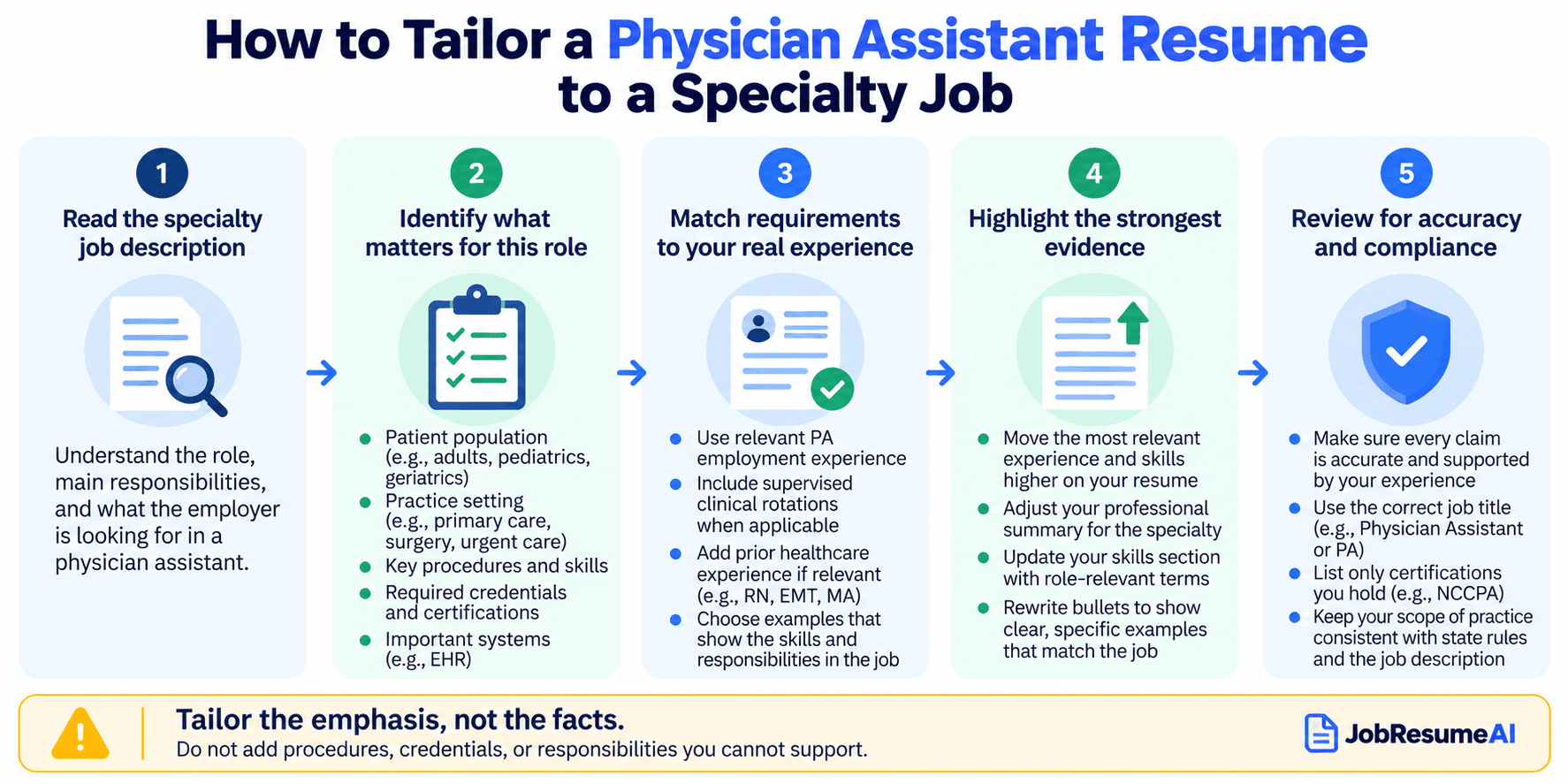
Change the emphasis around the target PA role while keeping your titles, credentials, procedures, and clinical history accurate.
Keep your physician assistant resume ATS-friendly
Clinical experience is already complex. The layout does not need to be. Use normal selectable text, clear section headings, consistent dates, and a reading order that works from top to bottom.
Keep credentials, job titles, employers, rotations, and dates in text. Avoid placing important information only inside icons, graphics, or skill bars.
There is no universal ATS score or format that guarantees an interview. The safer goal is a readable document that uses accurate job language and makes relevant evidence easy to find.
- Use standard headings such as Summary, Licensure and Certification, Clinical Experience, Clinical Rotations, Skills, and Education.
- Keep employer, job title, location, dates, and bullets together.
- Write PA-C, EHR names, procedures, and certifications as normal text.
- Use a simple one-column reading order when possible.
- Follow the employer's requested file format.
- Avoid keyword stuffing or hidden text.
Physician assistant resume vs CV
Most standard clinical job applications ask for a resume. A resume is usually focused on the experience, credentials, skills, and education that matter for the role.
A physician assistant CV can be longer. It may be useful when an employer, academic program, fellowship, teaching role, research position, or credentialing process specifically asks for a curriculum vitae.
A CV may include more detail on teaching, research, publications, presentations, committees, leadership, professional service, and continuing work. Follow the document type requested by the employer instead of sending a longer CV by default.
Common physician assistant resume mistakes
- Presenting supervised PA school rotations as independent paid PA employment.
- Using PA-C before currently holding NCCPA certification.
- Changing an earlier healthcare title to make it look like PA-level work.
- Listing procedures or prescribing responsibilities that do not match your real scope.
- Using every clinical term from the job description without evidence.
- Sending the same resume to specialties with very different needs.
- Listing EHR systems you have never used.
- Using a generic summary that does not identify specialty, setting, patient population, or relevant scope.
- Inventing patient volumes, quality metrics, or procedure counts.
- Hiding license, certification, dates, or clinical experience inside a decorative layout.
- Using physician associate or physician assistant without checking which title is correct for your jurisdiction and role.
Common questions about physician assistant resumes
What should a physician assistant put on a resume?
Show the clinical experience, patient population, specialty, credentials, procedures, systems, and responsibilities that matter for the target role. Keep paid PA work, supervised rotations, and earlier healthcare experience clearly separated.
How should a new graduate list clinical rotations?
Use a separate PA Clinical Rotations or Graduate Clinical Experience section. Include the site, specialty, dates, and student status. Give more detail to the rotations that are most relevant to the job.
Can I use PA-C before passing PANCE?
No. NCCPA states that PA-C can only be used by PAs who are currently certified. A graduate who has not yet earned the credential should state their real certification status instead.
Should I include every PA school rotation?
Not always. New graduates may list all major rotations when space allows, but the most relevant rotations deserve the most detail. Experienced PAs can usually reduce or remove old rotation detail as paid practice becomes more important.
What are good physician assistant resume keywords?
Use terms from the target job that accurately match your background. These may include the specialty, patient population, procedures, clinical responsibilities, credentials, and EHR. Do not add a term just because it appears in the posting.
Should a PA resume be one or two pages?
Use one page when it fits your strongest relevant evidence clearly. Use two when a second page is needed for useful clinical experience, specialty work, credentials, or earlier relevant healthcare experience. Do not compress the document just to meet a one-page rule.
Should I use physician assistant or physician associate?
Use the title that is correct for your license, jurisdiction, employer, and current role. AAPA supports physician associate, but legal and organizational implementation is still different across jurisdictions.
Physician assistant resume checklist
- Does the resume clearly fit the specialty and setting of the target PA job?
- Are your current license and certification status written accurately?
- Can the reader separate paid PA work, supervised clinical rotations, and earlier healthcare employment?
- Are the most relevant patient populations, procedures, systems, and clinical responsibilities easy to find?
- Do important skills appear in experience, not only in a skills list?
- Are your job titles and dates accurate?
- Did you remove unsupported procedures, credentials, software, and scope claims?
- Are any patient-volume or quality metrics accurate and defensible?
- Is the document easy to scan and ATS-friendly?
- Can you explain every important clinical claim clearly in an interview or credentialing review?
Published by JobResumeAI
Further reading
Sources and references
These references were reviewed while preparing this guide. JobResumeAI may interpret or organize the guidance differently; the links below let you check the underlying advice yourself.
- U.S. Bureau of Labor StatisticsPhysician Assistants, Occupational Outlook Handbook
- O*NET OnLinePhysician Assistants, 29-1071.00
- National Commission on Certification of Physician AssistantsBecome Certified
- National Commission on Certification of Physician AssistantsMaintain Certification
- American Academy of Physician AssociatesPA Title Change
- American Academy of Physician AssociatesState Advocacy and PA Practice Laws