
Data Analyst Resume: Skills, ATS Keywords, and Examples
Build a stronger data analyst resume with relevant SQL, BI, visualization, reporting, and analytical evidence tailored to the job you want.
Quick answer
A strong data analyst resume connects tools to decisions and outcomes.
Start with the exact analyst role you are targeting. A reporting-heavy business analyst, product analyst, BI analyst, marketing analyst, or operations analyst may use overlapping tools but emphasize different questions, stakeholders, and outcomes.
List relevant tools clearly, then prove how you used them inside experience or project bullets. SQL, BI platforms, spreadsheets, Python or R, data cleaning, visualization, reporting, and stakeholder communication matter only when they reflect the work you actually did.
- Match the resume to the type of analysis the job actually requires.
- Show how you queried, cleaned, analyzed, visualized, or communicated data.
- Connect dashboards and reports to decisions, monitoring, or business questions.
- Use tools and keywords only when you can support them with real evidence.
- Keep the document readable for both ATS parsers and human reviewers.
On this page
Start with the exact data analyst role
Data analyst is a broad label. Some roles focus heavily on recurring reporting and dashboards, others on product behavior, marketing performance, finance, operations, experimentation, data quality, or stakeholder decision support.
Before editing the resume, identify the questions the analyst is expected to answer, the systems they will work with, the stakeholders they support, and the level of ownership expected.
- Role direction
- Business intelligence
- Evidence you may prioritize
- SQL, dashboards, recurring reporting, data models, KPI definitions, stakeholder reporting
- Role direction
- Product analytics
- Evidence you may prioritize
- User behavior, funnels, experimentation, product metrics, event data, cross-functional work
- Role direction
- Marketing analytics
- Evidence you may prioritize
- Campaign measurement, attribution, acquisition, conversion, segmentation, reporting
- Role direction
- Operations analytics
- Evidence you may prioritize
- Process metrics, forecasting, capacity, quality, service levels, operational reporting
- Role direction
- Entry-level analyst
- Evidence you may prioritize
- Projects, internships, SQL, spreadsheets, visualization, analytical reasoning, communication
| Role direction | Evidence you may prioritize |
|---|---|
| Business intelligence | SQL, dashboards, recurring reporting, data models, KPI definitions, stakeholder reporting |
| Product analytics | User behavior, funnels, experimentation, product metrics, event data, cross-functional work |
| Marketing analytics | Campaign measurement, attribution, acquisition, conversion, segmentation, reporting |
| Operations analytics | Process metrics, forecasting, capacity, quality, service levels, operational reporting |
| Entry-level analyst | Projects, internships, SQL, spreadsheets, visualization, analytical reasoning, communication |
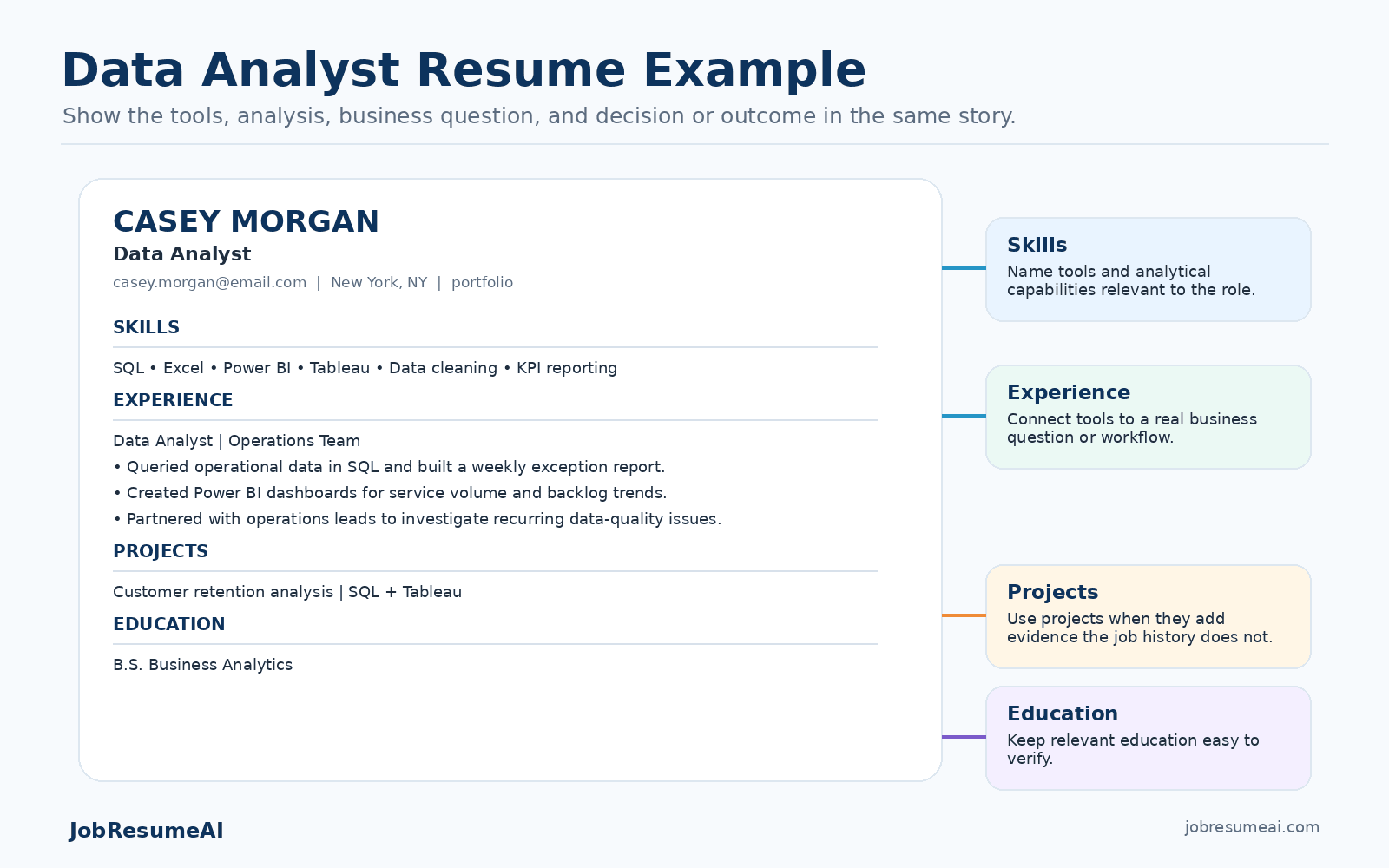
Show the tools you used, the analysis you performed, and the business question or workflow the work supported.
Build the skills section around the tools the role actually uses
O*NET's 2026 information for Business Intelligence Analysts shows employer postings frequently mentioning SQL, Power BI, Python, Tableau, Excel, R, cloud platforms, and other analytical software. That is useful market context, but it is not a list every candidate should copy.
The strongest skills section reflects the target role and your real proficiency. If SQL is central to the posting and you have used it meaningfully, make it easy to find. If you have never used a requested tool, do not add it simply because it appears in a market list.
- Skill group
- Querying and analysis
- Examples when relevant
- SQL, Python, R
- Skill group
- BI and visualization
- Examples when relevant
- Power BI, Tableau
- Skill group
- Spreadsheets
- Examples when relevant
- Excel or equivalent spreadsheet tools
- Skill group
- Data platforms
- Examples when relevant
- Snowflake, BigQuery, Redshift, databases or warehouses you actually used
- Skill group
- Methods
- Examples when relevant
- Data cleaning, validation, exploratory analysis, reporting, forecasting, experimentation
- Skill group
- Communication
- Examples when relevant
- Dashboards, presentations, stakeholder reporting, requirements gathering
| Skill group | Examples when relevant |
|---|---|
| Querying and analysis | SQL, Python, R |
| BI and visualization | Power BI, Tableau |
| Spreadsheets | Excel or equivalent spreadsheet tools |
| Data platforms | Snowflake, BigQuery, Redshift, databases or warehouses you actually used |
| Methods | Data cleaning, validation, exploratory analysis, reporting, forecasting, experimentation |
| Communication | Dashboards, presentations, stakeholder reporting, requirements gathering |
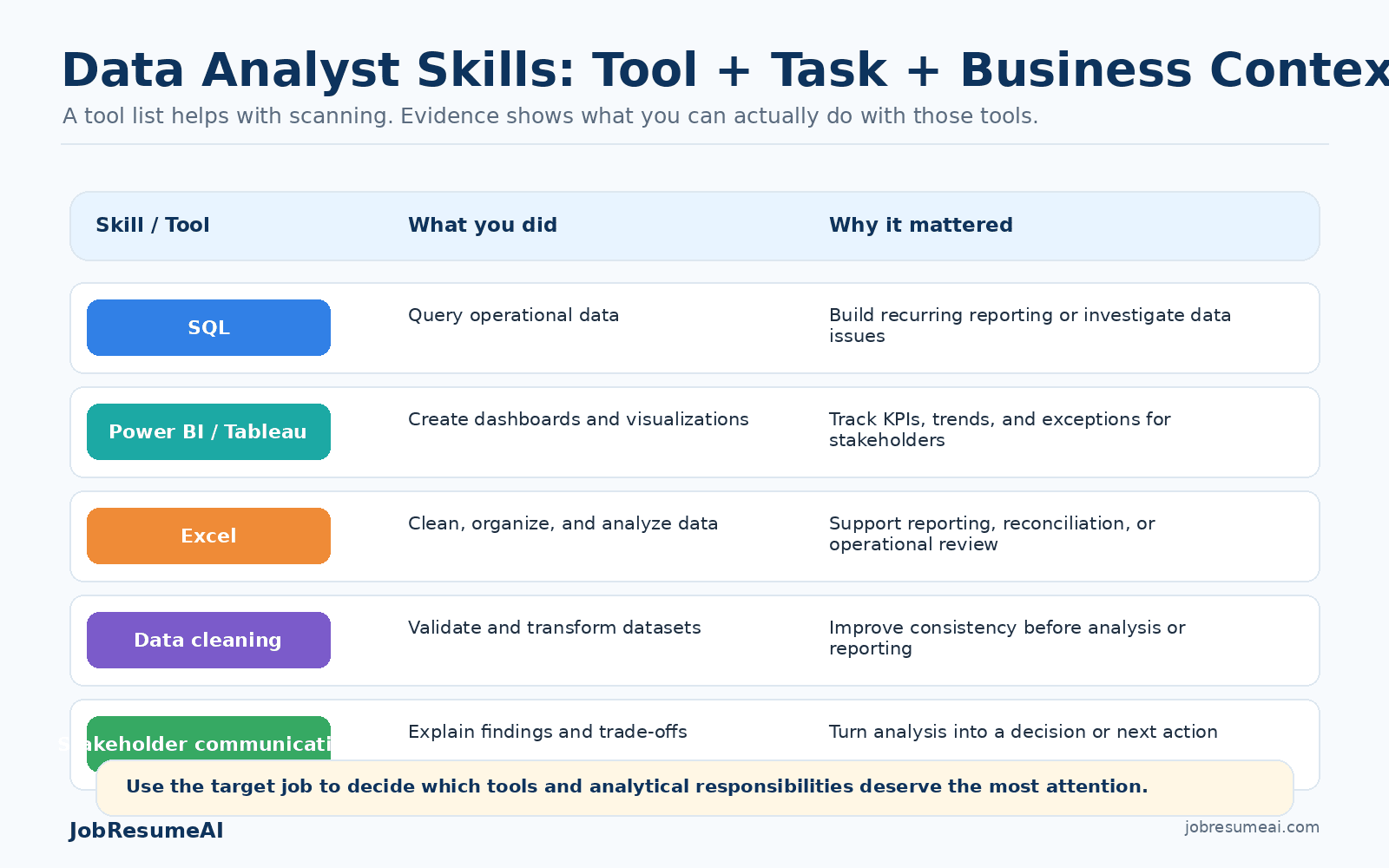
A tool list helps with scanning, but evidence shows what you can actually do with those analytical skills.
Write data analyst bullets around the question, analysis, and outcome
A tool list does not show analytical judgment. Stronger bullets explain what data you worked with, what question or process you supported, what analysis you performed, and what the output enabled.
The outcome does not always need to be revenue. A useful result might be a recurring dashboard, faster reporting, a quality issue identified, a decision supported, a process standardized, or an operational problem made visible.
Tool list disguised as experience
“Used SQL, Excel, and Power BI to create reports.”
Analytical evidence
“Queried operational data in SQL, validated weekly totals in Excel, and built a Power BI dashboard for team leads to review backlog and volume trends.”
Use projects to prove analytical skills when work experience is limited
Projects can be especially useful for students, career changers, and early-career analysts. A strong project should show more than a finished dashboard screenshot.
Explain the question you investigated, the data source, the cleaning or transformation work, the analysis, the visualization or output, and the conclusion or limitation.
- State the business or analytical question.
- Name the relevant dataset or source when you are allowed to.
- Describe meaningful cleaning, transformation, or validation work.
- Explain the analysis or model you used without overstating complexity.
- Show the output: dashboard, report, analysis, recommendation, or documented finding.
- Link to a portfolio or repository only when the work is presentable and does not expose confidential data.
Show business context, not only technical execution
Analysts are often valuable because they turn data into information someone can use. A resume should therefore show who consumed the analysis, what decision or process it supported, and how you communicated the result when that context is known.
Coursera's current data-analyst resume guidance similarly emphasizes showing relevant skills, experience, credentials, and fit for the specific position rather than presenting a generic technical profile.
Technical activity only
“Created a churn dashboard in Tableau.”
Technical activity with business context
“Built a Tableau dashboard that grouped customer churn by plan and onboarding stage for use in monthly retention reviews.”
Adjust the evidence for your level of experience
Entry-level
Prioritize internships, substantial projects, SQL and spreadsheet work, data cleaning, visualization, and evidence that you can explain analytical choices clearly.
Mid-level
Show independent analysis, recurring reporting ownership, stakeholder requirements, data-quality work, dashboard maintenance, and the ability to translate ambiguous questions into useful outputs.
Senior analyst
Make scope visible: metric definitions, analytical strategy, complex stakeholder work, mentoring, cross-functional influence, data governance, decision support, and ownership of important reporting or analysis systems.
Tailor the data analyst resume to the actual job description
Do not give every analyst job the same technical emphasis. A Power BI-heavy operations role should not receive the same resume as a product analytics role centered on experiments and event data.
Map the job's responsibilities to evidence you already have, then move the strongest matching projects and bullets forward. Keep the facts stable while changing emphasis.
Illustrative decision example
Operations analyst role emphasizing SQL and recurring reporting
The candidate already has the experience below. The tailoring step only changes what receives priority.
Job emphasizes
- SQL
- Weekly KPI reporting
- Data quality
- Stakeholder dashboards
Resume already contains
- SQL reporting queries
- Excel validation workflow
- Power BI operations dashboard
- Monthly product-analysis project
Tailoring action
Move the SQL reporting and data-validation bullets higher, make the recurring KPI context clear, and reduce space spent on the less relevant product-analysis project.
Do not do
Do not add Python, forecasting, machine learning, or experimentation simply because another analyst role might value them.
Keep the data analyst resume easy for ATS parsers and humans to read
Use clear section headings, consistent job and date formatting, and normal selectable text for important skills and experience. Avoid making a sidebar, chart, icon, or visual skill rating the only place where a key qualification appears.
- Use recognizable headings such as Experience, Skills, Projects, and Education.
- Write tools such as SQL, Power BI, Tableau, Python, or Excel as text when they are relevant and truthful.
- Keep company, title, dates, and related bullets together.
- Avoid graphical skill bars that imply proficiency without evidence.
- Follow the employer's requested file format.
Data analyst resume checklist
- Does the resume clearly fit the type of analyst role you want?
- Are the most relevant analytical tools easy to find?
- Do important tools appear in context, not only in a skills list?
- Do your bullets explain the question, analysis, output, or outcome?
- Do projects show real analytical work rather than only screenshots?
- Is the business or stakeholder context visible where relevant?
- Are all metrics, tools, and claims accurate?
- Can you explain every technical and analytical decision in an interview?
Published by JobResumeAI
Further reading
Sources and references
These references were reviewed while preparing this guide. JobResumeAI may interpret or organize the guidance differently; the links below let you check the underlying advice yourself.