
Common ATS Resume Problems in 2026: What 2,226 Checks Found
Original analysis of 2,226 JobResumeAI resume checks found that formatting flags were uncommon while job-description alignment gaps appeared far more often.
Quick answer
The clearest pattern was not broken formatting. It was incomplete job alignment.
We reviewed 2,226 JobResumeAI resume checks completed between October 19, 2025 and September 21, 2026. Among the 2,225 checks with full diagnostic fields, 96.2% were marked ATS-safe for formatting, while 96.5% had at least one item in JobResumeAI's keyword comparison marked as missing.
The median keyword match was 25%, and the middle half of checks fell between 15% and 40%. That does not mean candidates should copy every missing term into their resumes. A missing skill, tool, qualification, or keyword should only be added when it accurately reflects the candidate's real experience, training, projects, or credentials.
The useful takeaway is narrower: in this self-selected JobResumeAI sample, formatting warnings were uncommon while job-description alignment gaps were widespread. The data does not show which resumes were rejected by employers, and a JobResumeAI score is not an employer ATS score.
- 96.2% of detailed checks were marked ATS-safe for formatting.
- 96.5% had at least one item in the keyword comparison's Missing list.
- The median check had 5 missing items in that comparison.
- 36.0% had no quantifiable impact detected.
- 15.0% had at least one grammar or spelling error detected.
Methodology: what we analyzed
A self-selected dataset of 2,226 JobResumeAI resume checks, analyzed as checks rather than unique candidates.
This report is based on 2,226 JobResumeAI resume checks created between October 19, 2025 and September 21, 2026. Each row in the export represents a completed check, not necessarily a unique person or a unique resume.
That distinction matters. Some users may have checked the same resume more than once while making changes, and the export does not contain a reliable content fingerprint for every historical record. We therefore describe the dataset as resume checks rather than 2,226 unique resumes.
One record did not contain the full set of detailed diagnostic fields, so most percentages below use 2,225 detailed checks. The certifications field was available for 2,224 checks.
JobResumeAI's analysis system also evolved during the period. Because scoring calibration can change when a diagnostic system changes, this report does not use the overall JobResumeAI score as a headline statistic. We focus instead on explicit fields such as keyword match, missing-term counts, ATS-safe formatting, quantified impact, section presence, and grammar or spelling flags.
All findings in this report are descriptive. We calculated frequencies, medians, and percentile ranges from the available diagnostic fields. We did not infer employer decisions, interview probability, or a universal ATS threshold from the data.
The main findings from 2,226 resume checks
The data points to a simple pattern: most checks did not trigger JobResumeAI's ATS-unsafe formatting flag, but job alignment was often incomplete. In other words, the resume could be structurally readable and still fail to represent the target role strongly.
- Finding
- ATS-safe formatting
- Result
- 96.2%
- What it means
- Most detailed checks were not flagged as ATS-unsafe on formatting by JobResumeAI
- Finding
- At least one missing item in keyword comparison
- Result
- 96.5%
- What it means
- Almost every check had at least one term or requirement that JobResumeAI did not detect in the resume
- Finding
- Median keyword match
- Result
- 25%
- What it means
- Half of the checks scored at or below a 25% keyword match in JobResumeAI's comparison
- Finding
- Middle 50% of keyword match results
- Result
- 15% to 40%
- What it means
- The central half of checks sat inside this range
- Finding
- No quantifiable impact detected
- Result
- 36.0%
- What it means
- More than one in three detailed checks did not show quantified impact according to the diagnostic
- Finding
- At least one grammar or spelling error detected
- Result
- 15.0%
- What it means
- Writing errors appeared, but they were less common than alignment gaps
| Finding | Result | What it means |
|---|---|---|
| ATS-safe formatting | 96.2% | Most detailed checks were not flagged as ATS-unsafe on formatting by JobResumeAI |
| At least one missing item in keyword comparison | 96.5% | Almost every check had at least one term or requirement that JobResumeAI did not detect in the resume |
| Median keyword match | 25% | Half of the checks scored at or below a 25% keyword match in JobResumeAI's comparison |
| Middle 50% of keyword match results | 15% to 40% | The central half of checks sat inside this range |
| No quantifiable impact detected | 36.0% | More than one in three detailed checks did not show quantified impact according to the diagnostic |
| At least one grammar or spelling error detected | 15.0% | Writing errors appeared, but they were less common than alignment gaps |
External recruiter data helps explain why alignment matters
JobResumeAI's dataset measures resume checks and job-description comparisons. It does not measure recruiter behavior directly, so external research should be used as context rather than as a benchmark for our 25% median match.
In Jobscan's 2025 State of the Job Search report, 384 recruiters were surveyed in February and March 2025. Jobscan reported that 99.7% used filters in an ATS or similar system to find candidates, and 76.4% filtered by skills. The same survey also reported filtering by education, job titles, certifications or licenses, years of experience, and location.
Those recruiter-survey percentages are not directly comparable with JobResumeAI's keyword-match percentages because the studies measure different things. They do, however, provide useful context for why clearly representing relevant skills and qualifications can matter once a resume enters a recruiting system.
Formatting was not the most common problem in this sample
A lot of ATS advice starts with formatting, and there is a good reason for that. Some applicant tracking systems parse resumes into structured candidate records, and poor document structure can interfere with that process. Greenhouse, for example, documents parsing problems related to graphics, images, complex tables, headers, footers, text boxes, columned layouts, and unclear sections.
But in our dataset, only 3.8% of detailed checks were marked ATS-unsafe for formatting. The other 96.2% passed JobResumeAI's formatting safety check.
That does not mean formatting no longer matters. It means formatting was not the dominant warning in this particular sample. A resume can be easy to parse and still be weak for the job because the relevant skills, responsibilities, tools, or evidence are missing or hard to find.
- Formatting result
- Marked ATS-safe for formatting
- Share of detailed checks
- 96.2%
- Formatting result
- Marked ATS-unsafe for formatting
- Share of detailed checks
- 3.8%
| Formatting result | Share of detailed checks |
|---|---|
| Marked ATS-safe for formatting | 96.2% |
| Marked ATS-unsafe for formatting | 3.8% |
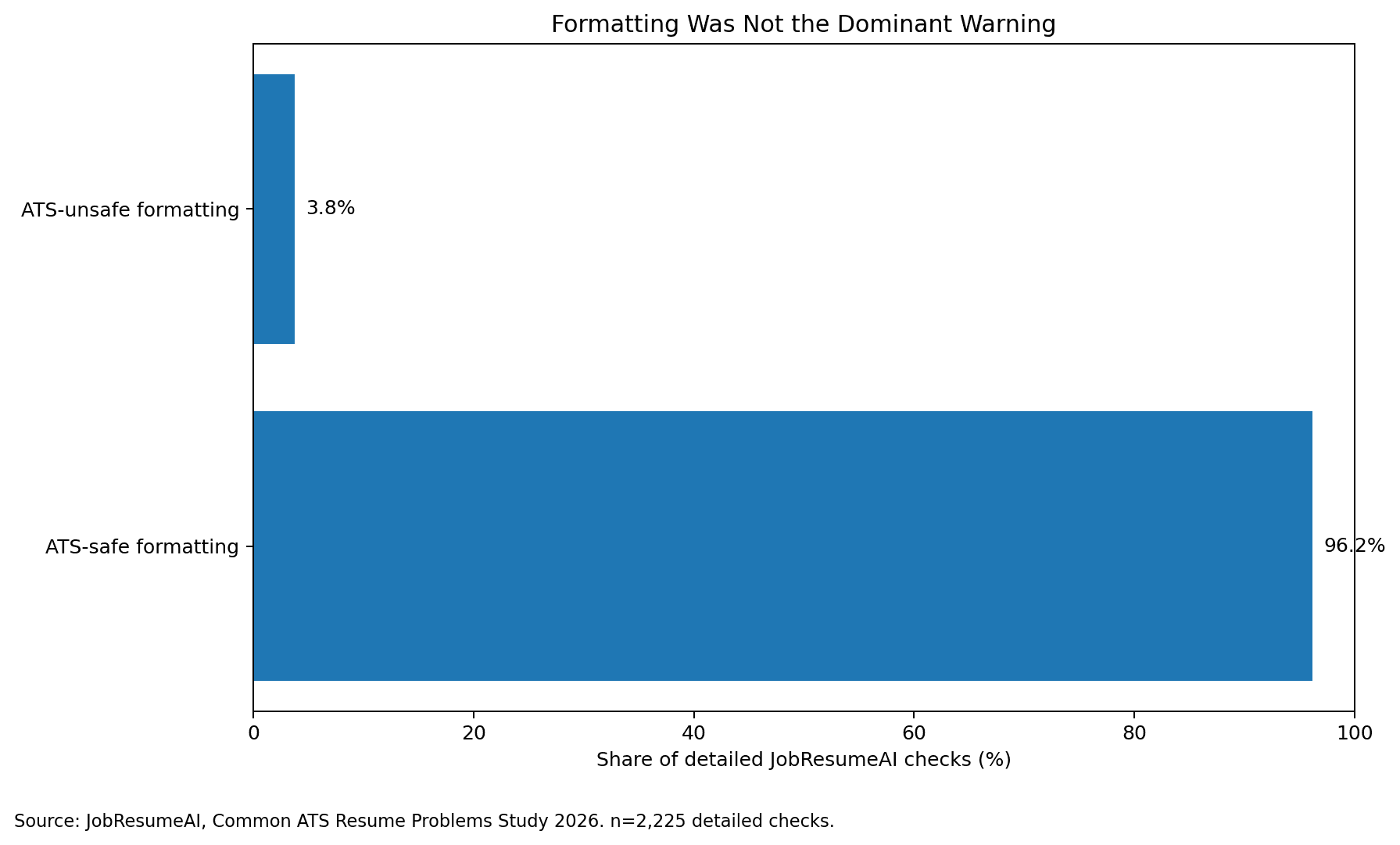
Among 2,225 detailed JobResumeAI checks, 96.2% were marked ATS-safe for formatting and 3.8% were marked ATS-unsafe.
Source: JobResumeAI, Common ATS Resume Problems Study 2026
You may republish this chart with attribution to JobResumeAI and a link to this study.
Keyword alignment was a much more common gap
The median JobResumeAI keyword match was 25%. The 25th percentile was 15%, and the 75th percentile was 40%, which means the middle half of all detailed checks landed between 15% and 40%.
JobResumeAI's Missing list also contained at least one item in 96.5% of checks. The median check contained 5 missing items, and 59.5% contained 5 or more.
Those numbers should not be read as a target keyword density or a recommended ATS score. They tell us that many resumes did not mirror the full language or requirement set used in the comparison. Some of those gaps may be worth fixing. Others may represent skills, tools, credentials, or responsibilities the candidate simply does not have.
- Keyword-match point
- 25th percentile
- Result
- 15%
- Keyword-match point
- Median
- Result
- 25%
- Keyword-match point
- 75th percentile
- Result
- 40%
- Keyword-match point
- At least one item in Missing list
- Result
- 96.5%
- Keyword-match point
- Median number of missing items
- Result
- 5
- Keyword-match point
- Checks with 5 or more missing items
- Result
- 59.5%
| Keyword-match point | Result |
|---|---|
| 25th percentile | 15% |
| Median | 25% |
| 75th percentile | 40% |
| At least one item in Missing list | 96.5% |
| Median number of missing items | 5 |
| Checks with 5 or more missing items | 59.5% |
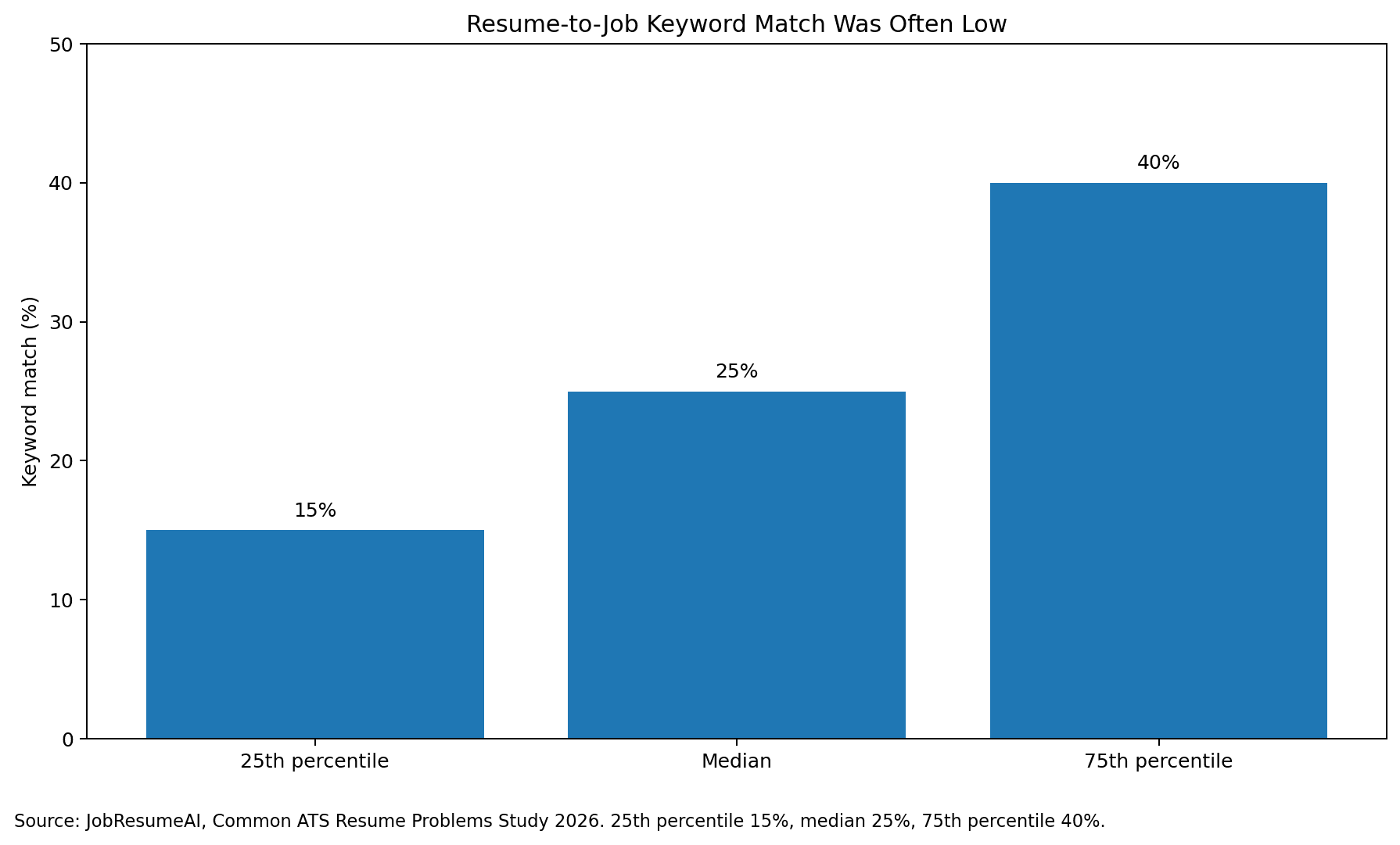
The 25th percentile keyword match was 15%, the median was 25%, and the 75th percentile was 40% across the detailed JobResumeAI checks.
Source: JobResumeAI, Common ATS Resume Problems Study 2026
You may republish this chart with attribution to JobResumeAI and a link to this study.
A missing keyword is only useful when it connects to real evidence
Keyword matching becomes harmful when candidates treat every missing term as an instruction to copy. The purpose of a job-description comparison is to find possible gaps, not to manufacture qualifications.
Suppose a posting asks for Salesforce and your experience is entirely in HubSpot. Adding Salesforce to the skills section would create a false impression. A better approach is to show the CRM experience you actually have and let the employer decide whether that background transfers.
The same rule applies to leadership, certifications, programming languages, clinical procedures, financial systems, and every other resume keyword. If you can support the term with real work, training, projects, or credentials, make the evidence clear. If you cannot, do not add it just to raise a score.
Keyword added without evidence
“Skills: Salesforce, HubSpot, CRM administration”
Relevant evidence stated truthfully
“Managed customer records, lifecycle stages, and pipeline updates in HubSpot for the sales team.”
More than one in three checks had no quantifiable impact detected
JobResumeAI detected some form of quantifiable impact in 64.0% of detailed checks. The remaining 36.0% did not show quantified impact under the diagnostic.
That does not mean every resume bullet needs a percentage. Numbers are useful when they show scale, volume, time, money, quality, speed, customers, transactions, users, or another result the candidate genuinely knows.
When there is no reliable metric, a concrete outcome still helps. A bullet can explain what was delivered, what problem was resolved, what process changed, or what decision the work supported without inventing a number.
Responsibility only
“Responsible for weekly reporting.”
Clearer evidence without a fake metric
“Prepared the weekly operations report and highlighted unresolved order exceptions for the team review.”
Grammar and spelling errors were present, but they were not the dominant issue
At least one grammar or spelling error was detected in 15.0% of detailed checks. In 85.0%, the diagnostic reported zero errors.
That is still worth fixing. A typo in a job title, certification, technology name, email address, or achievement can make a resume harder to trust or understand. But the data suggests that proofreading alone would not solve the bigger alignment problem visible across the dataset.
A polished resume can still be generic. A job-specific resume can still contain a typo. Strong applications need both relevance and clean writing.
What sections appeared most often in the checks
Section presence is descriptive, not a quality score. A resume does not automatically need a headline, projects section, certifications section, or professional summary. The right structure depends on the candidate and the job.
The useful question is not whether your resume contains every possible section. It is whether the sections you use make the strongest job-relevant evidence easy to find. Projects can be valuable for students, engineers, analysts, designers, and career changers, but they are not mandatory for every experienced candidate. A professional summary can help with positioning, but a generic summary may add very little.
- Section or signal
- Education
- Present in detailed checks
- 94.4%
- Section or signal
- Skills
- Present in detailed checks
- 91.0%
- Section or signal
- Experience
- Present in detailed checks
- 74.2%
- Section or signal
- Professional summary
- Present in detailed checks
- 71.9%
- Section or signal
- Projects
- Present in detailed checks
- 55.3%
- Section or signal
- Portfolio links
- Present in detailed checks
- 53.9%
- Section or signal
- Headline
- Present in detailed checks
- 48.9%
- Section or signal
- Certifications
- Present in detailed checks
- 43.5%
- Section or signal
- Achievements section
- Present in detailed checks
- 28.2%
| Section or signal | Present in detailed checks |
|---|---|
| Education | 94.4% |
| Skills | 91.0% |
| Experience | 74.2% |
| Professional summary | 71.9% |
| Projects | 55.3% |
| Portfolio links | 53.9% |
| Headline | 48.9% |
| Certifications | 43.5% |
| Achievements section | 28.2% |
Are these common ATS resume rejection reasons?
People often search for common ATS resume rejection reasons in 2026, but that wording suggests more certainty than a resume-check dataset can provide. We can measure what JobResumeAI flagged. We cannot see the private decision rules, recruiter actions, or hiring outcomes inside every employer's applicant tracking system.
An ATS is also more than a single automatic rejection engine. Workday describes applicant tracking systems as platforms that collect applications, parse resume information, organize candidate profiles, support search and filtering, and help teams manage candidates through the hiring process. Different employers can configure their workflows differently.
Some resume formatting can genuinely interfere with parsing. Greenhouse documents cases where graphics, complex tables, headers, footers, text boxes, columns, and unclear sections can contribute to incomplete or unsuccessful parsing. But a parsed resume can still be rejected for reasons unrelated to parsing, and a well-matched resume can still lose out to stronger candidates.
What to fix first before you apply
The data does not support chasing one magic ATS trick. A better workflow is to remove obvious document risk, then spend most of your effort on truthful job alignment and evidence.
- 1
Make sure the document is readable
Use clear sections, normal selectable text, consistent job and date formatting, and the file type requested by the employer.
- 2
Compare the resume with the actual job description
Identify the responsibilities, skills, tools, qualifications, and terminology that matter for this specific application.
- 3
Separate real gaps from wording gaps
If you have the experience but the resume hides it behind vague wording, make it clearer. If you do not have the qualification, do not pretend that you do.
- 4
Strengthen the most relevant bullets
Show action, useful context, and a real outcome or scope when you know it. Do not invent numbers just to make the resume look stronger.
- 5
Proofread the final version
Check names, dates, job titles, tools, credentials, grammar, and spelling after tailoring so last-minute edits do not create new errors.
What does a low ATS score actually mean?
There is no universal ATS score shared by every employer. Recruiting platforms, employers, screening rules, and matching features differ.
A JobResumeAI score is JobResumeAI's own diagnostic score. It is designed to help you find areas to review, not to reproduce an employer's private screening logic or predict an interview outcome.
That is also why this report does not publish a claim such as 'you need an 80 ATS score.' We do not have evidence for a universal hiring threshold, and presenting one would create false precision.
Does file format matter for ATS parsing?
File format can matter, but there is no single format rule for every applicant tracking system. Follow the instructions in the application first.
Greenhouse currently supports DOC, DOCX, PDF, RTF, and TXT candidate uploads. Its parsing guidance also shows that document structure can matter independently of the extension. A PDF made from selectable text is different from a resume uploaded as an image.
If the employer asks for PDF, submit PDF. If it asks for DOCX, submit DOCX. If multiple formats are accepted, use a clean text-based version and verify the exported document before sending it.
How to cite or reuse this research
Writers, career educators, researchers, and journalists may cite the aggregate findings in this report. When possible, link to the original JobResumeAI study so readers can review the methodology and limitations behind the number.
For a statistic in running text, a simple attribution such as 'According to JobResumeAI's 2026 analysis of 2,226 resume checks...' is sufficient. Do not shorten that attribution into a claim that 2,226 unique job seekers were studied, because repeat checks may be present.
- Use case
- Article or newsletter
- Suggested attribution
- According to JobResumeAI's 2026 analysis of 2,226 resume checks...
- Use case
- Formal citation
- Suggested attribution
- Ahmed, Abid. "Common ATS Resume Problems in 2026: What 2,226 Checks Found." JobResumeAI, 2026.
- Use case
- Chart or presentation
- Suggested attribution
- Source: JobResumeAI, Common ATS Resume Problems Study 2026
| Use case | Suggested attribution |
|---|---|
| Article or newsletter | According to JobResumeAI's 2026 analysis of 2,226 resume checks... |
| Formal citation | Ahmed, Abid. "Common ATS Resume Problems in 2026: What 2,226 Checks Found." JobResumeAI, 2026. |
| Chart or presentation | Source: JobResumeAI, Common ATS Resume Problems Study 2026 |
Research limitations
- The dataset contains 2,226 checks, not 2,226 verified unique people or unique resumes.
- Repeat checks may be present when a user analyzed a resume more than once.
- The sample is self-selected from people who used JobResumeAI and is not representative of every job seeker, occupation, geography, experience level, or applicant pool.
- JobResumeAI's analysis system evolved during the study period, so we avoid using the overall score as a cross-period benchmark.
- Diagnostic labels such as keyword match, missing terms, ATS-safe formatting, quantified impact, and grammar or spelling flags reflect JobResumeAI's own analysis rules and should not be treated as universal industry definitions.
- The keyword comparison can contain terms a candidate should not add because the underlying skill, tool, credential, or responsibility is not part of their real background.
- We do not have employer-side ATS logs, recruiter decisions, interview outcomes, application outcomes, or verified rejection reasons for these checks.
- The data shows associations and frequencies inside this dataset. It does not prove that any one issue caused an application outcome.
Common questions about ATS resume problems
Why do resumes get rejected by ATS?
There is no single universal answer. Some systems can have trouble parsing certain files or layouts, while employers can also use job requirements, knockout questions, filters, searches, matching features, and human review. A rejection can happen for many reasons that are not visible from the resume alone.
Is a low keyword match an automatic rejection?
No. A JobResumeAI keyword match is a diagnostic comparison, not an employer rejection rule. Use it to find terms and requirements worth reviewing, then add or clarify them only when they are supported by your real background.
Should I add every missing keyword to my resume?
No. Add a missing term only when it accurately describes your experience, skills, training, credentials, or projects. If the job requires something you do not have, leave the gap rather than creating a false claim.
What ATS score is considered good?
There is no universal ATS score that guarantees an interview or applies across all employers. JobResumeAI's score is its own diagnostic measure. Focus on the evidence and issues behind the score rather than treating one number as a hiring threshold.
Are formatting mistakes the main ATS problem?
Not in this JobResumeAI dataset. Only 3.8% of detailed checks were marked ATS-unsafe for formatting, while missing terms in the keyword comparison were far more common. Formatting still matters because some layouts can interfere with parsing, but clean formatting does not replace job relevance.
Do I need a professional summary for ATS?
No universal ATS rule requires a professional summary. In our checks, 71.9% had one. Use a summary when it helps position your experience for the target role, and skip or rewrite it when it only repeats generic adjectives.
ATS resume checklist before you submit
- Is the resume built from normal selectable text?
- Are the main sections easy to identify and read in order?
- Did you follow the employer's requested file format?
- Are the most important job requirements visible when you genuinely meet them?
- Do important keywords connect to real evidence rather than a copied list?
- Are your strongest job-relevant bullets specific and easy to understand?
- Did you use metrics only when they are accurate?
- Have you removed skills, tools, credentials, and claims you cannot support?
- Did you check grammar, spelling, dates, job titles, and contact information after the final edit?
- Can you explain every important claim naturally in an interview?
Published by JobResumeAI
Further reading
Sources and references
These references were reviewed while preparing this guide. JobResumeAI may interpret or organize the guidance differently; the links below let you check the underlying advice yourself.