
Professional Summary for Resume: Examples & How to Write One
Learn how to write a professional summary for your resume with a simple formula, strong examples, job-specific tailoring tips, and common mistakes to avoid.
Quick answer
A good professional summary tells the employer what you do, what you bring, and why it matters for this role.
A professional summary is a short, optional section near the top of a resume that highlights the experience, skills, and qualifications most relevant to the job you are targeting. It should help the reader understand your fit quickly without repeating the rest of the resume.
The strongest summaries are specific. Start with your professional identity or area of expertise, add the experience or background that matters for the role, mention a few relevant strengths, and include concrete value or evidence when it is useful and true.
Do not force a summary onto every resume. If your target, skills, and experience are already obvious from the top of the page, you can skip it. The section earns its space only when it adds useful context.
- Keep the summary concise and focused on the target role.
- Use job-description language naturally when it accurately describes your background.
- Lead with relevant experience, expertise, or specialization rather than generic adjectives.
- Include measurable results only when you can support them.
- Avoid repeating the same information that already appears clearly in your experience section.
What is a professional summary on a resume?
A professional summary is a brief introduction near the top of your resume. It gives the employer a quick view of the experience, expertise, and strengths that are most relevant to the position.
UCLA Career Center describes professional summaries as short, tailored descriptions of your qualifications for a specific job and notes that they are not a required resume element. CareerOneStop also treats the summary as optional and recommends using it to highlight top skills and accomplishments related to the job.
That optional part matters. A professional summary should solve a communication problem. It can clarify your fit when your background is broad, when you are changing fields, when the connection between your experience and the target role is not immediately obvious, or when a few lines of context make the rest of the resume easier to understand.
If the top of your resume already makes your target and qualifications obvious, the summary may add little. In that case, starting with skills, education, or experience can be cleaner.
When should you use a professional summary?
A resume summary is most useful when it adds context that the job titles alone do not provide. Experienced professionals often use it to frame a specialization, industry background, leadership scope, or combination of skills. Career changers can use it to connect transferable experience to a new direction.
It can also help when your degree, previous title, or industry does not immediately explain why you fit the role. UCLA specifically points to this kind of situation as one reason a professional summary can be useful.
- Situation
- Experienced professional with a clear specialty
- Is a summary useful?
- Often useful
- Why
- It can frame your experience, strongest capabilities, and value before the reader reaches the work history
- Situation
- Career changer
- Is a summary useful?
- Often useful
- Why
- It can connect transferable experience to the new role without changing your actual job history
- Situation
- Candidate with a broad or mixed background
- Is a summary useful?
- Often useful
- Why
- It can explain which part of your background is most relevant to this application
- Situation
- Recent graduate with relevant projects, internships, or clinical experience
- Is a summary useful?
- Sometimes useful
- Why
- It can summarize evidence that is spread across education, projects, and early experience
- Situation
- Resume already makes the target and fit obvious
- Is a summary useful?
- Optional
- Why
- A summary may repeat information the reader can already see immediately
| Situation | Is a summary useful? | Why |
|---|---|---|
| Experienced professional with a clear specialty | Often useful | It can frame your experience, strongest capabilities, and value before the reader reaches the work history |
| Career changer | Often useful | It can connect transferable experience to the new role without changing your actual job history |
| Candidate with a broad or mixed background | Often useful | It can explain which part of your background is most relevant to this application |
| Recent graduate with relevant projects, internships, or clinical experience | Sometimes useful | It can summarize evidence that is spread across education, projects, and early experience |
| Resume already makes the target and fit obvious | Optional | A summary may repeat information the reader can already see immediately |
Professional summary vs resume objective
A professional summary and a resume objective both appear near the top of a resume, but they usually answer different questions. A summary focuses on what you already bring to the employer. An objective focuses more on the role or direction you are seeking.
UConn describes both as optional. Its guidance treats summaries as more flexible and useful for highlighting specific experience requirements, while objectives are more focused on what the candidate is looking for and the skills they want to highlight.
For most candidates with relevant experience, a summary is usually the stronger choice because it keeps the focus on evidence. An objective can still make sense for some students, recent graduates, or career changers when the target needs to be explained. Even then, it should not be a paragraph about what you hope the employer will do for you.
- Professional summary
- Highlights relevant experience, skills, and value you already bring
- Resume objective
- Explains the role or direction you are seeking
- Professional summary
- Works well for experienced candidates and career changers with transferable evidence
- Resume objective
- Can work for some entry-level candidates or major career transitions
- Professional summary
- Should be supported by the rest of the resume
- Resume objective
- Should still emphasize useful skills and contribution, not only personal goals
- Professional summary
- Optional
- Resume objective
- Optional
| Professional summary | Resume objective |
|---|---|
| Highlights relevant experience, skills, and value you already bring | Explains the role or direction you are seeking |
| Works well for experienced candidates and career changers with transferable evidence | Can work for some entry-level candidates or major career transitions |
| Should be supported by the rest of the resume | Should still emphasize useful skills and contribution, not only personal goals |
| Optional | Optional |
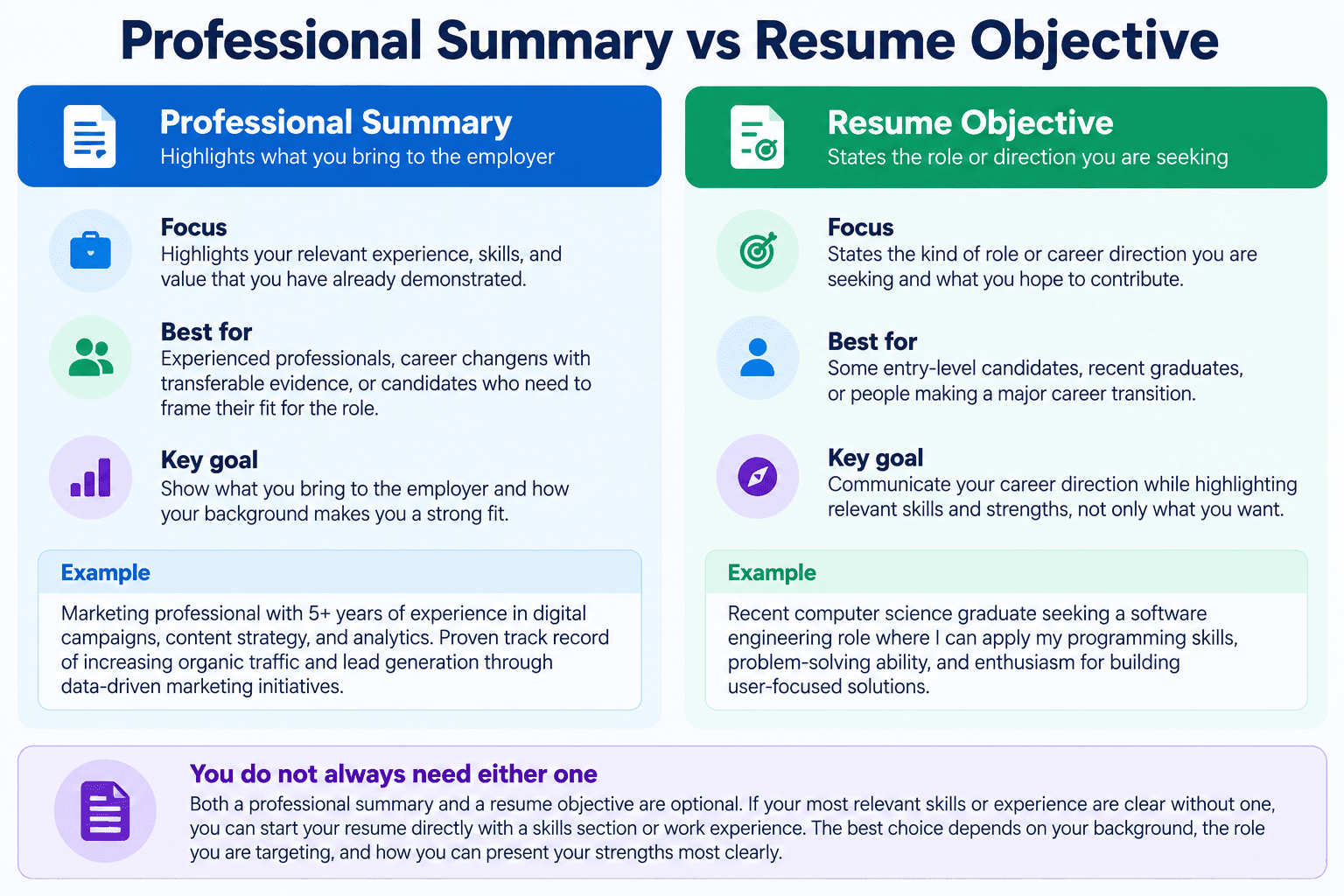
A summary emphasizes what you already bring to the employer, while an objective explains the direction you are seeking. Neither section is mandatory.
A simple professional summary formula
You do not need a complicated template. A useful summary usually combines four pieces of information: who you are professionally, the experience or background that matters for the role, a small number of relevant strengths, and the value or evidence that makes those strengths believable.
Not every summary needs all four pieces in equal detail. A licensed healthcare professional may need to foreground a credential and patient population. A software engineer may need to foreground technical specialization. An operations candidate may need to foreground process ownership and scale.
- 1
Start with your professional identity
Use a current role, target role when it truthfully describes your professional direction, specialty, credential, or area of expertise. Avoid vague openings such as dedicated professional.
- 2
Add relevant experience or background
Mention years of experience only when they are accurate and useful. You can also describe the setting, industry, customer type, patient population, or functional background that matters for the job.
- 3
Choose two or three job-relevant strengths
Prioritize skills, tools, methods, or responsibilities that the employer actually needs and that your resume can support with evidence.
- 4
Add value or proof when it helps
Use a real result, scope, achievement, or contribution when it strengthens the summary. Do not invent a metric simply because numbers sound impressive.
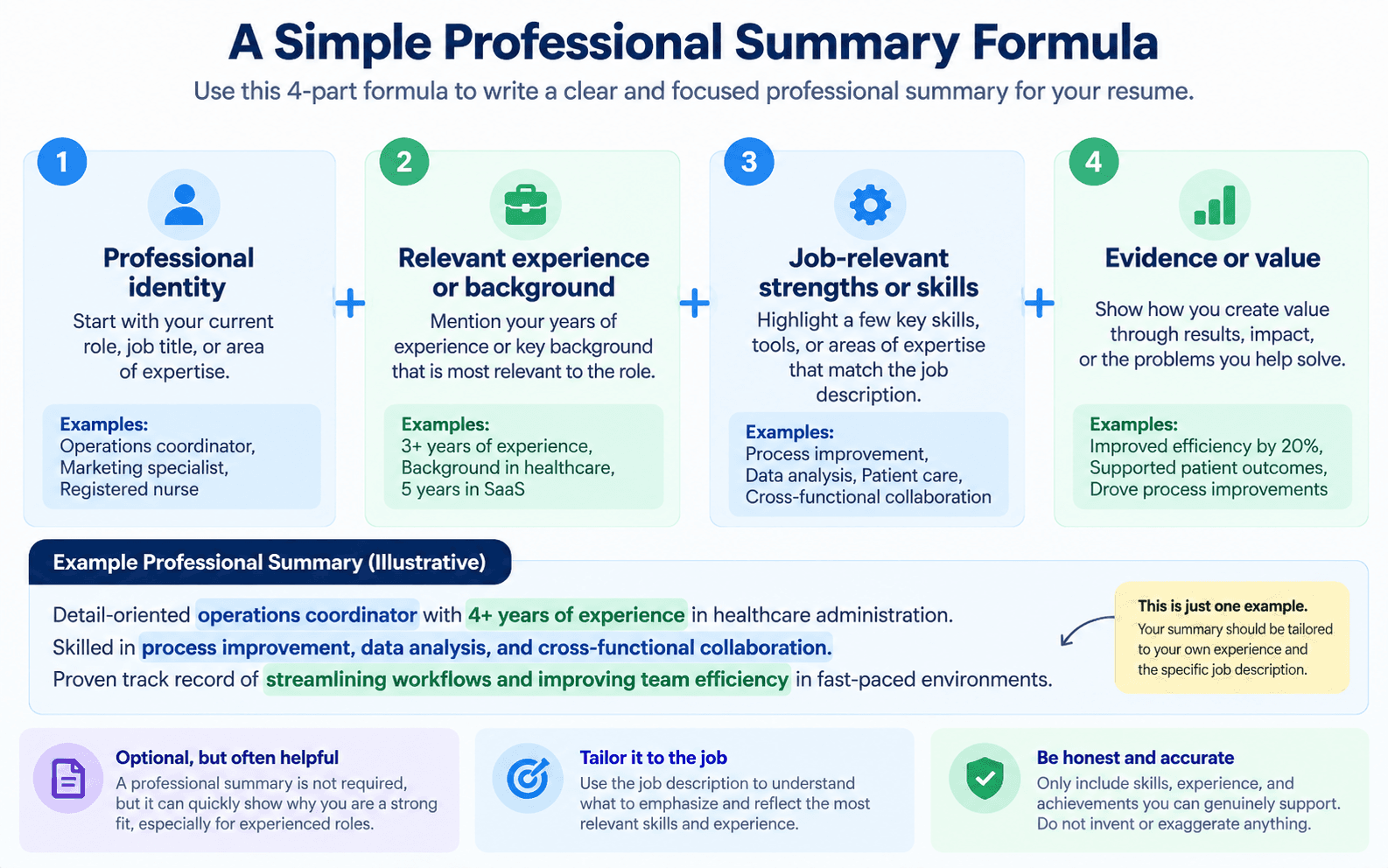
Build the summary around your professional identity, relevant background, strongest job-matched skills, and real evidence or value.
Illustrative formula
Identity + relevant background + strengths + value
Use the structure, not the facts. Replace every detail with information you can support.
Professional identity
Operations coordinator
Relevant background
4+ years supporting healthcare operations
Job-relevant strengths
Excel reporting, process coordination, cross-functional communication
Value
Experience improving recurring workflows and keeping operational information accurate and visible
Weak vs strong professional summary examples
Weak summaries often sound positive but tell the employer almost nothing. Phrases such as hardworking professional, excellent communicator, proven leader, and results-driven self-starter are not automatically wrong, but they become empty when they are not tied to a specific role, skill, responsibility, or result.
A stronger summary gives the reader something they can verify elsewhere on the resume. It names the professional focus, relevant background, useful capabilities, and concrete value without trying to describe the candidate as exceptional in every possible way.
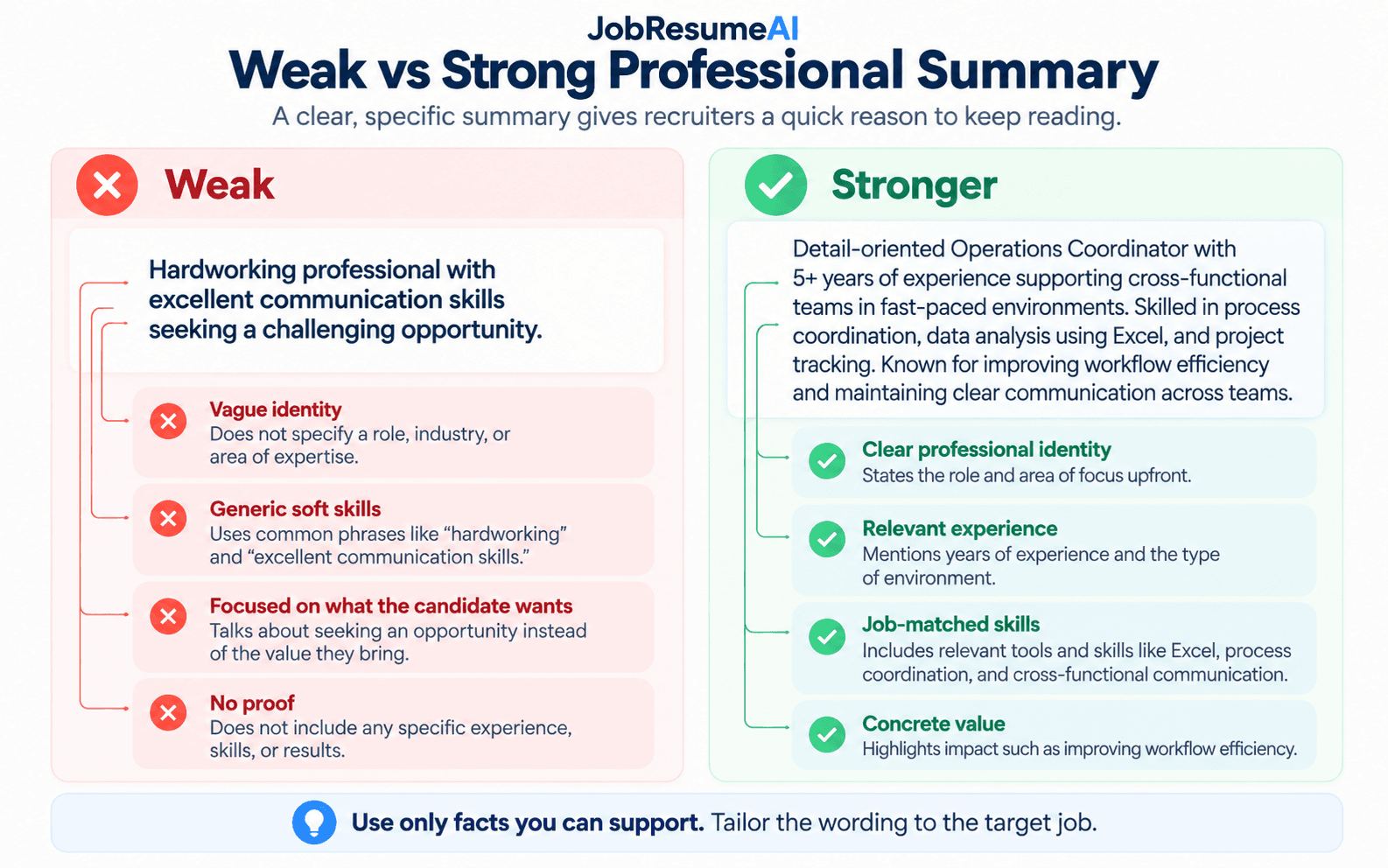
Specific role context and verifiable evidence are more useful than generic claims about being hardworking or motivated.
Too generic
“Hardworking professional with excellent communication skills seeking a challenging opportunity where I can grow and make an impact.”
More specific and useful
“Operations coordinator with 4 years of experience supporting day-to-day healthcare operations, maintaining Excel reporting, coordinating recurring workflows, and keeping cross-functional teams aligned on priorities and follow-up.”
How long should a professional summary be?
Keep it short enough to scan quickly. UCLA recommends roughly 2 to 4 lines for a professional summary, while CareerOneStop suggests 3 to 4 sentences or 3 to 5 bullet points. Those are useful reference points, not rigid limits.
For most resumes, a few concise lines are enough. If the section turns into a large paragraph that repeats your work history, it is probably doing too much. The summary should orient the reader, then let the experience, projects, skills, education, and certifications provide the proof.
- Use a few lines rather than a full biography.
- Keep only details that help explain your fit for the target job.
- Do not list every tool, certification, responsibility, or achievement you have ever had.
- If the summary is taking valuable space from stronger experience evidence, shorten it or remove it.
What should you include in a resume professional summary?
The right details depend on the job, but most strong summaries pull from the same small set of ingredients. Choose only what helps the employer understand your fit faster.
- Possible element
- Professional identity
- When it helps
- When your role, specialty, or functional area quickly explains your background
- Example direction
- Data analyst, Family Nurse Practitioner, administrative assistant, software engineer
- Possible element
- Relevant experience
- When it helps
- When years, setting, industry, or scope are useful to the target role
- Example direction
- 5 years in B2B SaaS, outpatient primary-care experience, multi-site operations support
- Possible element
- Job-relevant skills
- When it helps
- When a few capabilities strongly define the role
- Example direction
- SQL and Power BI, calendar and meeting coordination, React and Node.js
- Possible element
- Credential or qualification
- When it helps
- When the employer specifically values or requires it
- Example direction
- FNP-BC, CPA, PMP, active state license
- Possible element
- Result or scope
- When it helps
- When a concrete outcome or scale strengthens the positioning
- Example direction
- Reduced recurring reporting time, supported a multi-location operation, led cross-functional launches
| Possible element | When it helps | Example direction |
|---|---|---|
| Professional identity | When your role, specialty, or functional area quickly explains your background | Data analyst, Family Nurse Practitioner, administrative assistant, software engineer |
| Relevant experience | When years, setting, industry, or scope are useful to the target role | 5 years in B2B SaaS, outpatient primary-care experience, multi-site operations support |
| Job-relevant skills | When a few capabilities strongly define the role | SQL and Power BI, calendar and meeting coordination, React and Node.js |
| Credential or qualification | When the employer specifically values or requires it | FNP-BC, CPA, PMP, active state license |
| Result or scope | When a concrete outcome or scale strengthens the positioning | Reduced recurring reporting time, supported a multi-location operation, led cross-functional launches |
How to tailor a professional summary to a job description
The summary should change when the reason you fit the job changes. You do not need to rewrite your identity for every application, but you should adjust the emphasis when different employers care about different responsibilities, tools, customers, settings, or qualifications.
Start with the job description and identify the requirements that matter most. Then map those requirements to evidence you already have. Use the employer's terminology when it accurately describes your work, but do not copy phrases simply to increase keyword overlap.
- 1
Read the job description for priorities
Look for central responsibilities, required qualifications, tools, credentials, seniority signals, and role-specific terminology.
- 2
Match those priorities to real experience
Find the roles, projects, training, credentials, or achievements that genuinely support the employer's requirements.
- 3
Choose the strongest two to four points
The summary should not try to cover every requirement. Lead with the evidence that explains your fit most clearly.
- 4
Rewrite using accurate job-specific language
Use recognizable terminology from the posting when it is true for your background and reads naturally.
- 5
Review against the rest of the resume
Make sure the summary is supported by the experience below and is not repeating the same phrases without adding context.
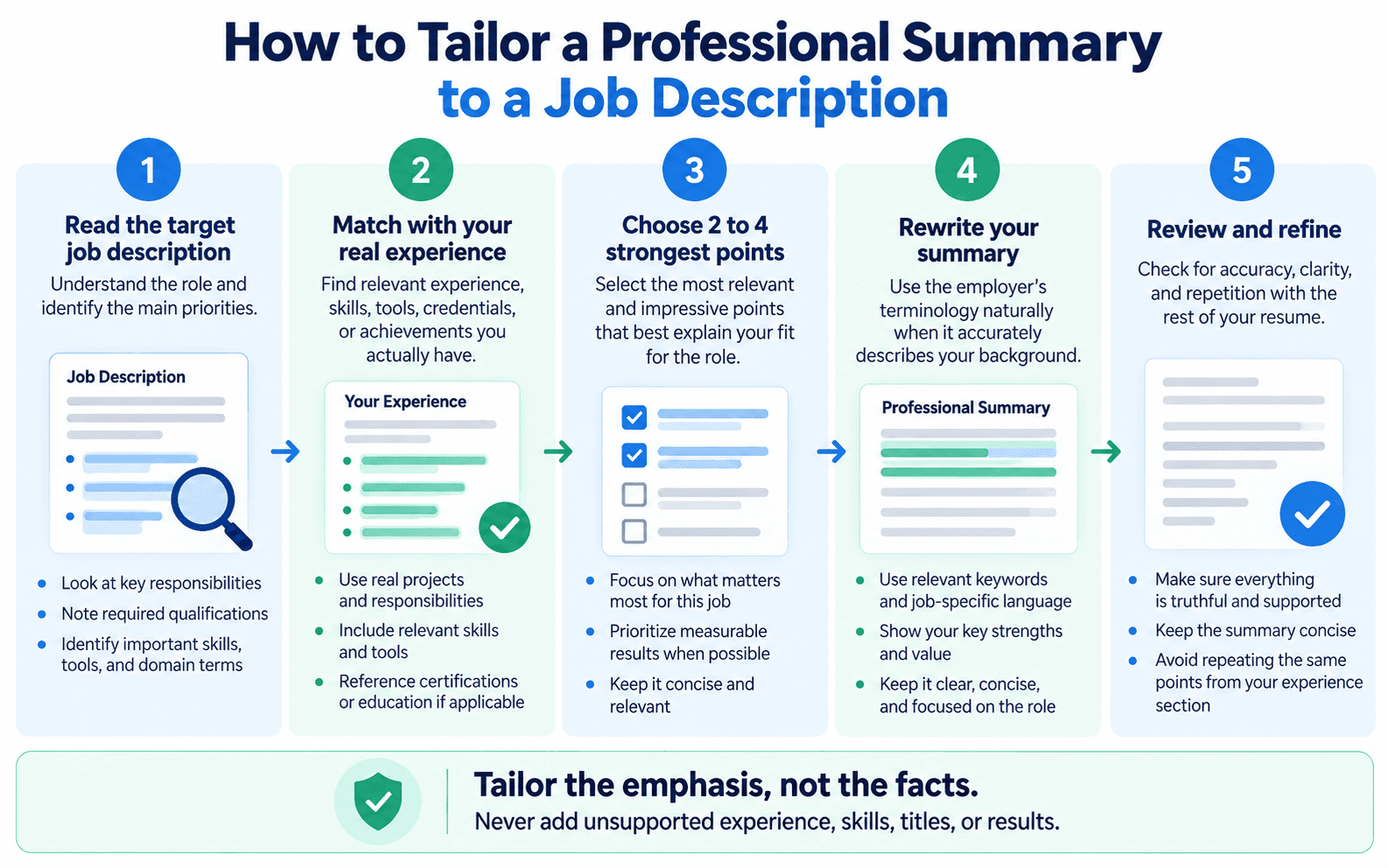
Use the job posting to change emphasis and wording while keeping your actual experience, skills, titles, and results unchanged.
How to use resume keywords in a professional summary
A professional summary can contain useful job-specific keywords, but it should not become a keyword block. If the employer asks for SQL, Salesforce, patient education, project management, or another specific capability that you genuinely have, the summary may be a natural place to mention it when the skill is central to your fit.
You do not need to repeat every important keyword at the top of the page. Some terms are better shown in the skills section, experience bullets, projects, education, or certifications. Use the summary for the few terms that help define your professional positioning.
There is also no universal ATS rule that requires a professional summary. Applicant tracking systems and employer workflows differ. Write the section for clarity and relevance, then keep the document easy to parse with normal text and recognizable structure.
Professional summary examples by experience level
The examples below are intentionally different because the most useful summary changes with the candidate's background. Treat them as writing directions, not text to copy.
Illustrative examples
Resume summary examples for different situations
Replace the years, responsibilities, tools, industries, and outcomes with details that are true for you.
Experienced professional
Operations manager with 8 years of experience leading service delivery and process improvement across multi-site teams. Experienced in workforce planning, KPI reporting, vendor coordination, and cross-functional implementation of operational changes.
Mid-career specialist
Digital marketing specialist with 5 years of experience across SEO, content strategy, email campaigns, and performance reporting. Skilled in turning search and campaign data into practical content and acquisition decisions.
Recent graduate with relevant evidence
Recent computer science graduate with internship and project experience building web applications with JavaScript, React, Node.js, and REST APIs. Comfortable working with Git, debugging application issues, and collaborating through code review and project documentation.
Career changer
Customer support professional transitioning into customer success after 6 years supporting B2B software users. Brings experience in onboarding, issue escalation, product education, CRM documentation, and long-term customer communication.
Professional summary examples by job
Role-specific examples are useful because the right summary language changes with the work. The examples below show how the focus can shift across job families while keeping the same evidence-first principle.
- Role
- Administrative assistant
- Illustrative summary direction
- Administrative assistant with experience coordinating calendars, preparing documents, maintaining records, and supporting day-to-day office communication. Skilled in Microsoft Office, scheduling, and organized follow-through on recurring administrative work.
- Role
- Medical assistant
- Illustrative summary direction
- Medical assistant with outpatient experience supporting patient intake, vital-sign collection, exam preparation, appointment scheduling, and EHR documentation. Known for accurate records and calm patient communication.
- Role
- Nurse practitioner
- Illustrative summary direction
- Family Nurse Practitioner with outpatient primary-care experience in patient assessment, chronic disease follow-up, preventive care, patient education, and clinical documentation, with a focus on clear follow-up and coordinated care.
- Role
- Software engineer
- Illustrative summary direction
- Software engineer with experience building and maintaining web applications using TypeScript, React, Node.js, and REST APIs, with a focus on reliable delivery, testing, and cross-functional product collaboration.
- Role
- Data analyst
- Illustrative summary direction
- Data analyst with experience using SQL, Excel, and Power BI to clean operational data, build recurring reports, and translate business questions into clear performance insights for stakeholders.
| Role | Illustrative summary direction |
|---|---|
| Administrative assistant | Administrative assistant with experience coordinating calendars, preparing documents, maintaining records, and supporting day-to-day office communication. Skilled in Microsoft Office, scheduling, and organized follow-through on recurring administrative work. |
| Medical assistant | Medical assistant with outpatient experience supporting patient intake, vital-sign collection, exam preparation, appointment scheduling, and EHR documentation. Known for accurate records and calm patient communication. |
| Nurse practitioner | Family Nurse Practitioner with outpatient primary-care experience in patient assessment, chronic disease follow-up, preventive care, patient education, and clinical documentation, with a focus on clear follow-up and coordinated care. |
| Software engineer | Software engineer with experience building and maintaining web applications using TypeScript, React, Node.js, and REST APIs, with a focus on reliable delivery, testing, and cross-functional product collaboration. |
| Data analyst | Data analyst with experience using SQL, Excel, and Power BI to clean operational data, build recurring reports, and translate business questions into clear performance insights for stakeholders. |
Should you include results or metrics in a resume summary?
A strong result can make a summary more concrete, but numbers are not required. Include a metric when it is accurate, relevant, and easy to understand without extra explanation.
For example, a sales leader may have a clear revenue result, an operations candidate may know the scale of a team or process, and a marketer may have a verified growth metric. Other roles may be better summarized through scope, specialization, patient population, project ownership, or another form of evidence.
Do not invent a percentage because a formula tells you every summary needs a number. A truthful statement about the work you owned is stronger than a fabricated result.
Make the summary agree with the rest of your resume
Every important claim in the summary should be supported somewhere else in the document or by a credential you can verify. If the summary says you lead cross-functional programs, the experience section should show where that leadership happened. If it names a technology, your work, projects, or skills section should make that experience believable.
The summary should also avoid repeating entire bullets. Its job is to frame the evidence, not duplicate it. Think of it as the headline for the argument your resume makes, while the sections below provide the proof.
- Check that titles and years of experience are accurate.
- Make sure named skills and tools appear naturally elsewhere when appropriate.
- Do not claim leadership, ownership, or scope that your experience does not support.
- Avoid copying an accomplishment word for word from a bullet into the summary.
- Keep the same target role and professional story throughout the document.
Common professional summary mistakes
- Opening with generic adjectives instead of a clear professional identity or area of expertise.
- Writing a paragraph that retells the entire resume.
- Using the same summary for jobs with meaningfully different priorities.
- Copying phrases from the job description without evidence from your own background.
- Stuffing the summary with tools and keywords until it stops reading naturally.
- Inventing years of experience, metrics, responsibilities, credentials, or seniority.
- Focusing mainly on what you want from the employer instead of what you bring to the role.
- Repeating the same skills in the summary, skills section, and every experience bullet without adding context.
- Using a summary when it adds nothing and pushes stronger evidence farther down the page.
- Trying to sound impressive instead of trying to be clear and specific.
Common questions about professional summaries for resumes
Do you need a professional summary on a resume?
No. A professional summary is optional. Use one when it helps frame relevant experience, explain a transition, or make your fit easier to understand. Skip it when the top of the resume is already clear without one.
What is a good summary for a resume?
A good summary is specific to the target role, grounded in your real background, and concise enough to scan quickly. It usually combines professional identity, relevant experience, a few job-matched strengths, and evidence or value when useful.
How many sentences should a resume summary be?
There is no universal sentence count. A few concise lines are usually enough. UCLA recommends roughly 2 to 4 lines, while CareerOneStop suggests 3 to 4 sentences or 3 to 5 bullet points. Use the shortest version that communicates your fit clearly.
Can an entry-level candidate use a professional summary?
Yes, when there is useful evidence to summarize. Internships, projects, education, clinical training, volunteer work, and relevant technical skills can all provide substance. Do not make the wording sound more experienced than the background actually is.
Should I write my professional summary in first person?
Most resumes omit first-person pronouns and use concise resume-style phrasing. The more important issue is clarity and consistency. Avoid turning the summary into a personal essay about yourself.
Should a resume summary include keywords?
It can include a few important job-specific terms when they accurately describe your background. Do not try to fit every keyword into the summary. Use the rest of the resume to show skills, tools, credentials, and responsibilities in the sections where they make sense.
Is a professional summary the same as a resume objective?
No. A summary focuses mainly on what you already bring to the employer, while an objective focuses more on the role or direction you are seeking. Both are optional, and a summary is often more useful when you already have relevant evidence to present.
Can I use the same professional summary for every job?
You can keep a strong base version for similar roles, but change the emphasis when employers prioritize different responsibilities, skills, industries, tools, or levels of ownership. Tailoring should change what you highlight, not the facts of your history.
Professional summary checklist before you apply
- Does the summary make your professional focus clear quickly?
- Is it tailored to the type of role you are applying for?
- Are the skills, tools, credentials, and responsibilities accurate?
- Can the important claims be supported elsewhere on the resume?
- Did you remove generic adjectives that do not add evidence?
- Did you avoid keyword stuffing and copied job-description language?
- Are any metrics or years of experience accurate and defensible?
- Is the summary short enough to leave room for stronger evidence below?
- Does it add context instead of repeating the experience section?
- Would the resume still be clear if you removed the summary? If yes, is the section earning its space?
Published by JobResumeAI
Further reading
Sources and references
These references were reviewed while preparing this guide. JobResumeAI may interpret or organize the guidance differently; the links below let you check the underlying advice yourself.