
Nurse Practitioner Resume: Examples, Skills & Keywords
Build a stronger nurse practitioner resume with job-specific skills, clinical experience, clear bullets, new-grad guidance, keywords, and ATS-friendly formatting.
Quick answer
A strong nurse practitioner resume makes your clinical judgment, patient-care scope, and credentials easy to understand.
Start with the nurse practitioner job you are actually applying for. A family practice role, urgent care position, specialty clinic, inpatient service, and new-graduate fellowship can prioritize very different experience even when the job title is similar.
Your resume should show what you are qualified to do, where you developed that experience, and how it connects to the target role. For new graduates, that often means separating prior RN experience from graduate-level nurse practitioner clinical experience instead of blending the two together.
- Match your resume to the population, setting, specialty, and responsibilities in the job description.
- List licensure and certification accurately and use the exact credentials you currently hold.
- Show clinical skills through real experience rather than a long unsupported keyword list.
- Keep RN responsibilities, NP clinical training, and post-graduate NP experience clearly distinguished.
- Use an ATS-friendly structure that keeps credentials, experience, and clinical evidence easy to find.
What a nurse practitioner resume needs to show
Nurse practitioners are advanced practice registered nurses who may provide primary or specialty care. The U.S. Bureau of Labor Statistics notes that APRNs must earn at least a master's degree in an APRN role, be licensed in their state, and pass a national certification exam. O*NET describes nurse practitioner work that can include patient assessment, diagnosis, treatment planning, health education, diagnostic testing, documentation, referrals, and collaboration with other healthcare professionals.
That does not mean every nurse practitioner performs the same duties. Practice authority and licensure rules vary by state, and responsibilities also change by specialty, setting, employer, population focus, and experience level. Your resume should reflect your actual scope instead of trying to include every duty associated with the occupation.
The strongest resume makes three things clear quickly: what kind of patients or setting you have worked with, what level of responsibility you have held, and which qualifications make you relevant to the job in front of you.
- If the job emphasizes
- Primary care
- Evidence you may prioritize
- Patient assessment, preventive care, chronic disease management, follow-up, patient education, care coordination, and documentation when they match your experience
- If the job emphasizes
- Acute or urgent care
- Evidence you may prioritize
- Rapid assessment, differential thinking, treatment planning, diagnostic testing, escalation, procedures, and follow-up within your actual role and scope
- If the job emphasizes
- Specialty practice
- Evidence you may prioritize
- Relevant patient population, specialty conditions, procedures, medications, diagnostics, education, and interdisciplinary collaboration you have genuinely handled
- If the job emphasizes
- New-graduate role
- Evidence you may prioritize
- Graduate clinical rotations, patient-care experience, prior RN background, certification status, precepted responsibilities, and readiness for the target population
| If the job emphasizes | Evidence you may prioritize |
|---|---|
| Primary care | Patient assessment, preventive care, chronic disease management, follow-up, patient education, care coordination, and documentation when they match your experience |
| Acute or urgent care | Rapid assessment, differential thinking, treatment planning, diagnostic testing, escalation, procedures, and follow-up within your actual role and scope |
| Specialty practice | Relevant patient population, specialty conditions, procedures, medications, diagnostics, education, and interdisciplinary collaboration you have genuinely handled |
| New-graduate role | Graduate clinical rotations, patient-care experience, prior RN background, certification status, precepted responsibilities, and readiness for the target population |
A clear nurse practitioner resume structure
Clinical resumes can become crowded because there is a lot to show: credentials, education, RN history, NP clinical experience, specialties, systems, and patient-care responsibilities. A simple structure helps the reader understand your path without searching for basic information.
- 1
Contact information and credentials
Keep your name, phone, email, location, and relevant professional links easy to find. Display credentials accurately and consistently.
- 2
Professional summary
Use a short summary when it helps explain your population focus, specialty, experience level, or transition into advanced practice.
- 3
Licensure and certification
Make current NP, APRN, RN, board certification, and other role-relevant credentials easy to verify without turning the top of the resume into a wall of abbreviations.
- 4
Clinical and professional experience
Separate post-graduate NP work, graduate clinical rotations, and prior RN employment so the reader can understand where each responsibility was performed.
- 5
Skills
Use a focused list for clinical capabilities, systems, and job-relevant tools that are supported by your training or experience.
- 6
Education and additional qualifications
List graduate nursing education, relevant prior degrees, certifications, training, and other qualifications that matter for the role.
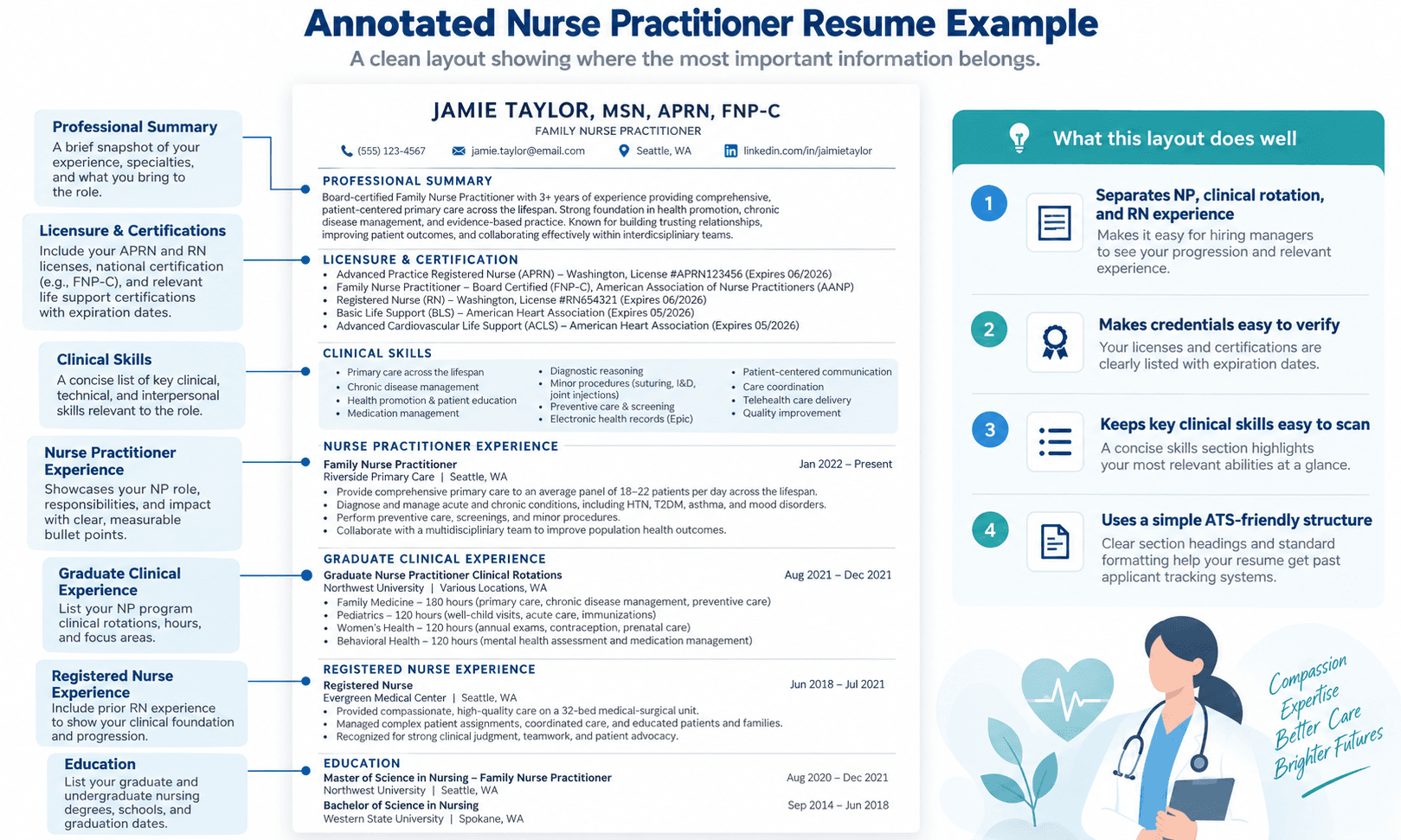
A clean one-page nurse practitioner resume layout showing where summary, credentials, experience, clinical rotations, and education belong.
Nurse practitioner resume example
The example below is fictional. It shows one way to connect clinical responsibilities, patient-care evidence, and credentials without turning the resume into a copied job description.
Illustrative example
Family Nurse Practitioner
Use the structure as a reference only. Replace every credential, patient population, responsibility, and system with information that is true for you.
Professional summary
Family Nurse Practitioner with outpatient primary-care experience in patient assessment, chronic disease follow-up, preventive care, patient education, and clinical documentation. Experienced working with interdisciplinary teams and maintaining clear follow-up plans across routine and higher-risk visits.
Selected skills
- Patient assessment and history taking
- Preventive and chronic-care follow-up
- Diagnostic review and care planning
- Patient and family education
- Electronic health record documentation
- Interdisciplinary care coordination
Experience bullet example
Conducted patient histories and physical assessments, reviewed available diagnostic information, and developed care plans with follow-up and education based on the patient's presentation and the practice's clinical protocols.
Another experience bullet
Coordinated referrals and follow-up with physicians, nursing staff, and specialty services for patients requiring additional evaluation or ongoing management.
Nurse practitioner resume skills to prioritize
Choose clinical and professional skills from the target role and your real background, not from a generic checklist.
O*NET lists nurse practitioner work involving patient histories, treatment planning, diagnostic information, patient education, referrals, collaboration, monitoring, documentation, and other advanced clinical activities. Those occupational examples are useful context, but your resume should only include capabilities you are trained, licensed, and experienced to perform.
The skills section is most useful when it helps the reader scan quickly. The experience section should then show where the most important skills were actually used.
- Skill area
- Assessment and clinical reasoning
- Examples when they are accurate for you
- Health histories, physical assessment, differential thinking, risk assessment, diagnostic review, clinical decision making
- Skill area
- Care planning
- Examples when they are accurate for you
- Treatment planning, follow-up planning, preventive care, chronic disease management, referrals, care coordination
- Skill area
- Patient communication
- Examples when they are accurate for you
- Patient education, shared decision making, health promotion, treatment instructions, family communication
- Skill area
- Documentation and systems
- Examples when they are accurate for you
- Electronic health records, clinical documentation, medication reconciliation, order review, care-plan documentation, systems you actually used
- Skill area
- Team-based care
- Examples when they are accurate for you
- Interdisciplinary collaboration, consultation, handoffs, specialty referrals, coordination with nursing and other healthcare professionals
- Skill area
- Specialty-specific care
- Examples when they are accurate for you
- Population, procedures, diagnostics, medications, and clinical workflows that match your specialty and actual scope
| Skill area | Examples when they are accurate for you |
|---|---|
| Assessment and clinical reasoning | Health histories, physical assessment, differential thinking, risk assessment, diagnostic review, clinical decision making |
| Care planning | Treatment planning, follow-up planning, preventive care, chronic disease management, referrals, care coordination |
| Patient communication | Patient education, shared decision making, health promotion, treatment instructions, family communication |
| Documentation and systems | Electronic health records, clinical documentation, medication reconciliation, order review, care-plan documentation, systems you actually used |
| Team-based care | Interdisciplinary collaboration, consultation, handoffs, specialty referrals, coordination with nursing and other healthcare professionals |
| Specialty-specific care | Population, procedures, diagnostics, medications, and clinical workflows that match your specialty and actual scope |
How to choose nurse practitioner resume keywords
The best nurse practitioner resume keywords come from the specific job description. Look for the population served, specialty, setting, required credentials, clinical responsibilities, systems, and the terminology the employer uses for the work.
A keyword is useful when it helps describe experience you actually have. If a posting asks for Epic and you have used Epic, name it clearly. If it asks for a procedure you have never performed, do not add the term just to look closer to the job.
- Keyword area
- Population and setting
- What to look for
- Family practice, adult-gerontology, pediatrics, urgent care, inpatient, specialty clinic, telehealth
- How to use it
- Use the setting or population when it genuinely matches your background
- Keyword area
- Clinical responsibilities
- What to look for
- Assessment, treatment planning, chronic care, preventive care, diagnostics, follow-up, patient education
- How to use it
- Connect important responsibilities to real clinical experience
- Keyword area
- Credentials
- What to look for
- State license, board certification, BLS or ACLS, specialty credentials, DEA registration when specifically relevant and accurate
- How to use it
- List the exact credential or registration you currently hold
- Keyword area
- Systems and documentation
- What to look for
- Epic, eClinicalWorks, MEDITECH, other EHR systems, documentation workflows
- How to use it
- Name the exact system only if you have actually used it
- Keyword area
- Specialty requirements
- What to look for
- Condition-specific management, procedures, diagnostics, patient education, medication management
- How to use it
- Use only terms supported by your training and actual practice
| Keyword area | What to look for | How to use it |
|---|---|---|
| Population and setting | Family practice, adult-gerontology, pediatrics, urgent care, inpatient, specialty clinic, telehealth | Use the setting or population when it genuinely matches your background |
| Clinical responsibilities | Assessment, treatment planning, chronic care, preventive care, diagnostics, follow-up, patient education | Connect important responsibilities to real clinical experience |
| Credentials | State license, board certification, BLS or ACLS, specialty credentials, DEA registration when specifically relevant and accurate | List the exact credential or registration you currently hold |
| Systems and documentation | Epic, eClinicalWorks, MEDITECH, other EHR systems, documentation workflows | Name the exact system only if you have actually used it |
| Specialty requirements | Condition-specific management, procedures, diagnostics, patient education, medication management | Use only terms supported by your training and actual practice |
Nurse practitioner resume summary examples
A professional summary can help an experienced nurse practitioner quickly explain population focus, setting, specialty, and the kind of care they provide. Keep it short and specific. Avoid packing it with every certification and clinical term you can fit.
A new graduate can also use a summary, but it should clearly distinguish graduate clinical training from independent post-graduate NP experience.
Illustrative examples
Summary directions for different nurse practitioner backgrounds
Adapt the wording to your own credentials, setting, and patient-care experience.
Experienced primary-care NP
Board-certified Family Nurse Practitioner with outpatient primary-care experience in assessment, chronic disease follow-up, preventive care, patient education, and care coordination. Comfortable managing a varied visit schedule while maintaining clear documentation and follow-up plans.
New graduate NP
New graduate Family Nurse Practitioner with graduate clinical training in primary care and prior RN experience in medical-surgical nursing. Clinical rotations included patient assessment, preventive care, chronic-condition follow-up, documentation, and patient education under preceptor supervision.
Specialty transition
Nurse Practitioner with experience in adult outpatient care and a background in oncology nursing, bringing patient education, symptom assessment, care coordination, and interdisciplinary communication to a specialty practice setting.
How to write a new grad nurse practitioner resume
A new grad nurse practitioner resume has a different challenge from an experienced NP resume: you may have years of nursing experience but little or no post-graduation NP employment. The solution is not to minimize your RN background or inflate your clinical rotations. It is to label each type of experience clearly and show how the pieces support the role you want next.
Graduate clinical rotations can provide strong evidence because they show the populations, settings, and responsibilities you practiced under supervision. Prior RN experience can also be highly relevant, especially when it demonstrates clinical judgment, patient communication, care coordination, specialty knowledge, or familiarity with the target setting.
- Create a dedicated Graduate Clinical Experience or Nurse Practitioner Clinical Experience section when the rotations deserve visibility.
- List the site, specialty or population, dates, and supervised clinical focus accurately.
- Keep prior RN employment under Professional Experience rather than rewriting the title to resemble NP work.
- Move relevant graduate education, certification status, and licensure where they are easy to find.
- Use the job description to decide which rotations and RN experience deserve the most detail.
- Do not describe student or precepted responsibilities as independent practice when they were supervised.
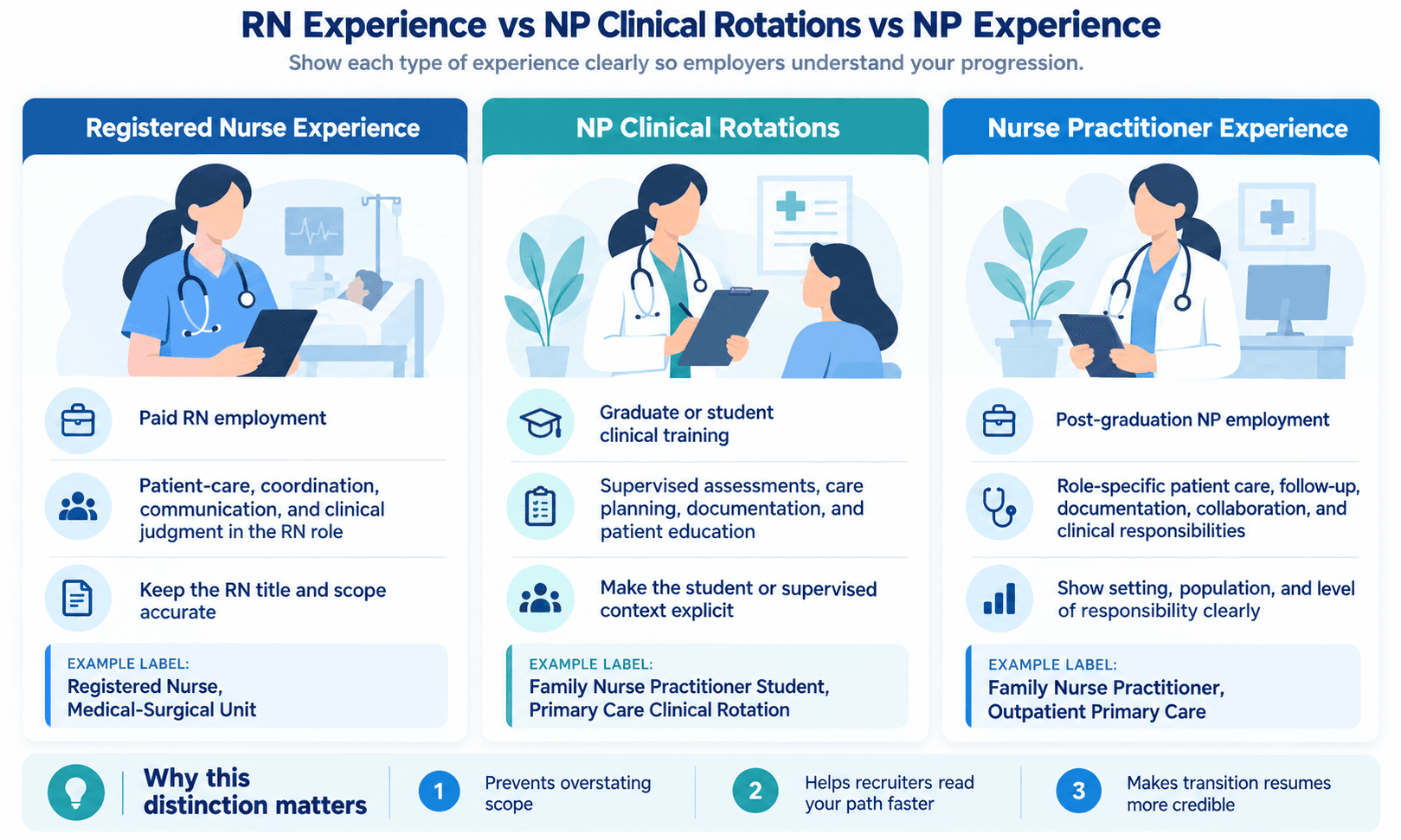
Use clear labels so employers can distinguish paid RN work, supervised NP clinical training, and post-graduation NP experience.
Blurs the experience level
“Family Nurse Practitioner, Primary Care Clinic. Managed patients with acute and chronic conditions.”
Keeps the transition clear
“Family Nurse Practitioner Student, Primary Care Clinical Rotation. Completed supervised patient histories and assessments, contributed to care planning, documented visits, and provided patient education under preceptor oversight.”
How to present RN experience when moving into an NP role
Prior RN experience can be one of the strongest parts of a new nurse practitioner's resume, but it should support the transition rather than compete with it. Keep the RN title accurate and select bullets that show knowledge, judgment, communication, coordination, and specialty experience relevant to the NP position.
For example, an RN applying to an adult-gerontology NP role may want to emphasize experience with complex adult patients, medication reconciliation, patient education, discharge planning, interdisciplinary communication, or chronic-condition monitoring when those duties were actually part of the RN role.
Avoid rewriting RN duties using advanced practice language that changes the level of responsibility. If you carried out a physician or NP order, do not rewrite the bullet to imply that you independently diagnosed or prescribed.
- RN experience can show
- Patient assessment and monitoring
- NP resume value
- Clinical observation, communication, escalation, and understanding of changing patient conditions
- RN experience can show
- Patient education
- NP resume value
- Ability to explain care plans, medications, follow-up, and self-management within the RN role
- RN experience can show
- Care coordination
- NP resume value
- Experience working across physicians, advanced practice clinicians, nursing, pharmacy, therapy, and other services
- RN experience can show
- Specialty nursing background
- NP resume value
- Relevant patient population and workflow knowledge that can support a specialty NP application
| RN experience can show | NP resume value |
|---|---|
| Patient assessment and monitoring | Clinical observation, communication, escalation, and understanding of changing patient conditions |
| Patient education | Ability to explain care plans, medications, follow-up, and self-management within the RN role |
| Care coordination | Experience working across physicians, advanced practice clinicians, nursing, pharmacy, therapy, and other services |
| Specialty nursing background | Relevant patient population and workflow knowledge that can support a specialty NP application |
Write nurse practitioner experience bullets around clinical evidence
A nurse practitioner job description can easily turn into a list of generic duties. Stronger bullets help the reader understand the patient population, setting, responsibility, clinical problem, collaboration, or outcome when that information is known.
You do not need to force a number into every clinical bullet. Patient volume, panel size, quality measures, follow-up rates, wait times, or other metrics can be useful when they are accurate and appropriate. When you do not know a reliable metric, clear clinical scope and contribution are still valuable.
Assessment and follow-up example
Instead of: Managed chronic patients.
Stronger direction: Conducted follow-up visits for patients with chronic conditions, reviewed symptoms and available clinical data, updated care plans as appropriate, and reinforced medication and self-management education.
Care coordination example
Instead of: Worked with the care team.
Stronger direction: Coordinated referrals and follow-up with physicians, nursing, pharmacy, and specialty services for patients requiring additional evaluation or ongoing management.
Documentation example
Instead of: Charted patient visits.
Stronger direction: Completed timely EHR documentation for histories, assessments, care plans, patient education, and follow-up instructions after outpatient visits.
Too generic
“Saw patients, diagnosed conditions, and created treatment plans.”
Clearer clinical evidence
“Evaluated adult patients in an outpatient setting, documented histories and physical findings, reviewed available diagnostic results, and developed care plans with follow-up and patient education within the practice's clinical protocols.”
How to tailor a family nurse practitioner resume
A family nurse practitioner resume should still be tailored to the actual position. Family practice jobs can differ in patient mix, visit types, schedule, chronic-care needs, preventive services, procedures, telehealth use, and collaboration model.
The phrase FNP resume can cover a wide range of settings, so avoid treating one generic family nurse practitioner skills list as the answer. Read the posting for the employer's priorities and move the most relevant evidence forward.
Illustrative tailoring example
Family practice role emphasizing chronic-care follow-up and preventive visits
The candidate already has the experience below. The tailoring step changes emphasis, not facts.
Job emphasizes
- Preventive care
- Chronic-condition follow-up
- Patient education
- EHR documentation
Resume already contains
- Preventive visits during graduate clinical training
- RN experience with chronic-disease education
- Outpatient EHR documentation
- Care coordination with specialty services
Tailoring action
Move preventive-care and chronic-follow-up evidence higher, keep the graduate clinical setting clearly labelled, and use the employer's terminology when it accurately describes the candidate's work.
Do not do
Do not add procedures, prescribing authority, patient-panel ownership, or independent practice that the candidate has not actually held.
How to list nurse practitioner education, licensure, and certification
Credentials are central to an NP resume, so write them in a way that is easy to verify. The Bureau of Labor Statistics states that APRNs need at least a master's degree in one of the APRN roles, state licensure, and a national certification exam. Specific requirements and practice authority vary by state and role.
Use the exact certification you hold rather than a generic label such as board certified when the credential can be named. For example, ANCC lists FNP-BC as the credential for its Family Nurse Practitioner board certification. Other certification boards and population focuses use their own credentials, so copy the exact designation from your certifying organization.
State practice environments also differ. AANP currently categorizes state NP practice environments as full, reduced, or restricted based on state practice and licensure laws. That is another reason a resume should not imply a level of independent practice that does not apply to your location or role.
- Credential area
- Graduate education
- What to show
- Degree, nurse practitioner population focus or specialty when appropriate, school, and completion date
- Credential area
- State licensure
- What to show
- Current state and relevant license or APRN designation using the wording that applies to you
- Credential area
- Board certification
- What to show
- Exact credential, certifying organization, and current status when relevant
- Credential area
- Additional certifications
- What to show
- BLS, ACLS, PALS, or other job-relevant credentials only when current and applicable
- Credential area
- Registrations or authorizations
- What to show
- Include only when relevant to the job and accurate for your current status
| Credential area | What to show |
|---|---|
| Graduate education | Degree, nurse practitioner population focus or specialty when appropriate, school, and completion date |
| State licensure | Current state and relevant license or APRN designation using the wording that applies to you |
| Board certification | Exact credential, certifying organization, and current status when relevant |
| Additional certifications | BLS, ACLS, PALS, or other job-relevant credentials only when current and applicable |
| Registrations or authorizations | Include only when relevant to the job and accurate for your current status |
Use an ATS-friendly nurse practitioner resume format
A clinical resume can be detailed without being complicated to read. Use recognizable section headings, normal selectable text, consistent job and date formatting, and a clear order for credentials and experience.
Do not hide important credentials or clinical skills inside graphics, icons, or rating bars. If a license, certification, specialty, EHR, or clinical responsibility matters for the job, write it as normal text where both a recruiter and a parser can find it.
- Use standard headings such as Summary, Licensure and Certification, Skills, Experience, Clinical Experience, and Education when relevant.
- Keep job titles, facilities, dates, and related bullets together.
- Write credentials and EHR names as normal text.
- Avoid graphical skill ratings that do not explain actual clinical competence.
- Follow the employer's requested file format.
- Keep the reading order clear even if the resume contains several credential sections.
Tailor your nurse practitioner resume to the actual job description
Two nurse practitioner jobs can share a title and still require very different evidence. One employer may prioritize primary care and chronic-condition management. Another may need urgent-care experience, a specific population focus, procedural experience, telehealth, or a particular EHR.
Tailoring means changing emphasis, not changing history. Identify the responsibilities and qualifications that matter most, match them to work you have actually done, and make that evidence easier to find.
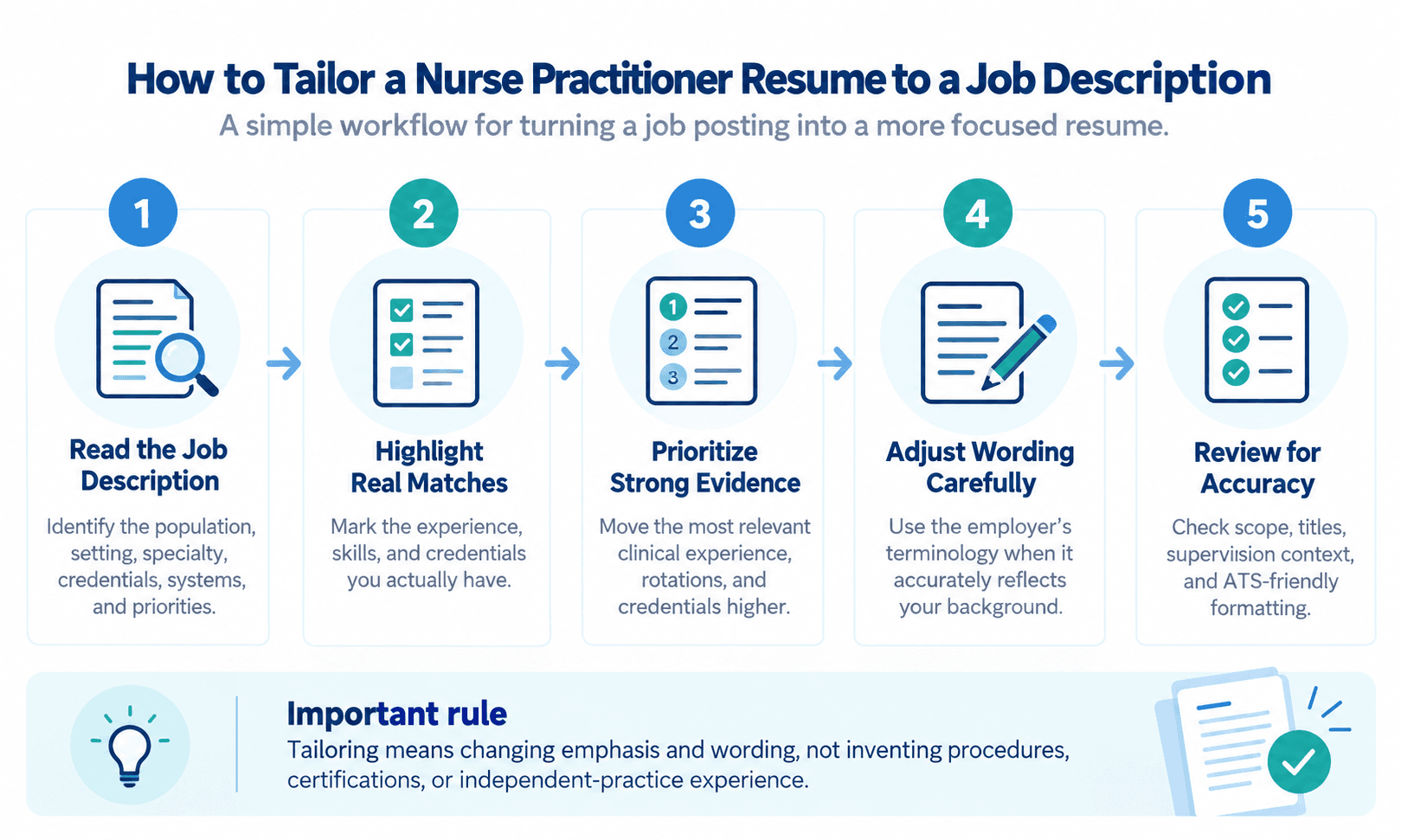
A simple workflow for turning a nurse practitioner job posting into a more focused resume without inventing experience.
Illustrative decision example
Outpatient role emphasizing adult chronic care and care coordination
The candidate already has the experience below. The tailoring step changes priority, not facts.
Job emphasizes
- Adult outpatient care
- Chronic disease follow-up
- Patient education
- Care coordination
Resume already contains
- Adult primary-care clinical rotation
- RN experience with chronic-condition education
- EHR documentation
- Interdisciplinary discharge planning
Tailoring action
Move adult-care and chronic-condition evidence higher, connect relevant RN experience to the role without changing the RN title, and keep graduate clinical work clearly identified as supervised training.
Do not do
Do not add independent panel management, procedures, prescribing, or specialty experience that the candidate cannot support.
Nurse practitioner resume vs CV
Many clinical employers ask for a resume, while academic, research, teaching, or some health-system roles may ask for a curriculum vitae. Do not assume the terms are interchangeable in every application.
A resume is usually a focused job document that prioritizes the experience and qualifications most relevant to the position. A CV can be longer and may include publications, presentations, research, teaching, committee work, professional memberships, and other academic or professional history.
If the employer asks for a CV, follow that instruction. If it asks for a resume, do not add pages of academic detail that do not help the hiring decision.
Common nurse practitioner resume mistakes
- Blending RN experience and nurse practitioner experience until the reader cannot tell which responsibilities belonged to which role.
- Presenting graduate clinical rotations as independent post-graduation NP employment.
- Listing procedures, prescribing responsibilities, or specialty skills that are outside your real training or scope.
- Using a long list of clinical keywords without showing where the important ones were used.
- Writing board certified without naming the actual credential when the exact designation is available.
- Using expired or outdated credentials without checking current status.
- Copying an NP job description into the experience section instead of describing your own work.
- Inventing patient-volume, quality, or outcome metrics to make bullets sound stronger.
- Giving every RN role equal detail even when only part of the history is relevant to the NP position.
- Sending the same resume to primary care, urgent care, specialty, inpatient, and new-graduate roles without changing emphasis.
Common questions about nurse practitioner resumes
What should a nurse practitioner put on a resume?
Prioritize current licensure and certification, relevant NP or graduate clinical experience, prior nursing experience that supports the role, job-specific clinical skills, education, and the systems or responsibilities the employer actually needs. Keep the scope and setting of each experience clear.
What skills should I list on a nurse practitioner resume?
Choose skills that match the target role and that you can support with real training or experience. Depending on the job, that may include assessment, care planning, chronic-care follow-up, preventive care, patient education, documentation, diagnostic review, care coordination, and relevant EHR systems. Specialty skills should be included only when they truly apply to you.
How do I write a nurse practitioner resume with no NP experience?
If you are a new graduate without post-graduation NP employment, make your graduate clinical experience, certification status, licensure, education, and relevant RN background easy to understand. Label clinical rotations accurately and do not present supervised student responsibilities as independent practice.
Should a new graduate NP include RN experience?
Usually, yes when it adds relevant clinical evidence. Prior RN work can show patient-care experience, specialty knowledge, communication, coordination, and understanding of healthcare workflows. Keep the RN title and level of responsibility accurate while selecting the parts most relevant to the NP job.
How long should a nurse practitioner resume be?
Use the shortest resume that still shows the qualifications the employer needs. A new graduate may fit comfortably on one or two pages depending on RN history and clinical rotations. An experienced NP may need two pages when the second page contains relevant clinical experience, credentials, leadership, or specialty evidence.
Should I use a nurse practitioner resume template?
A clean template can help with structure, but the template is not what makes the resume strong. The important part is clear credentials, readable experience, job-specific evidence, and accurate clinical scope. Avoid templates that hide essential information in graphics or narrow sidebars.
Should I use a resume or CV for a nurse practitioner job?
Follow the employer's instruction. Most standard clinical applications use a resume, while academic, research, teaching, or some institutional roles may ask for a CV with more complete professional history.
Nurse practitioner resume checklist
- Does the resume clearly fit the population, setting, specialty, and experience level of the target role?
- Are current licensure and certification written accurately and easy to find?
- Can the reader distinguish NP employment, graduate clinical experience, and prior RN work?
- Are the most important clinical skills supported by evidence rather than listed alone?
- Are procedures, prescribing responsibilities, and specialty claims accurate for your real scope?
- Do experience bullets explain what you did instead of repeating a generic job description?
- Are EHR and other system names limited to tools you have actually used?
- Are metrics included only when they are accurate and useful?
- Is the document easy to scan for both recruiters and ATS parsing?
- Can you explain every clinical, credential, and scope-related claim naturally in an interview?
Published by JobResumeAI
Further reading
Sources and references
These references were reviewed while preparing this guide. JobResumeAI may interpret or organize the guidance differently; the links below let you check the underlying advice yourself.
- U.S. Bureau of Labor StatisticsNurse Anesthetists, Nurse Midwives, and Nurse Practitioners, Occupational Outlook Handbook
- O*NET OnLineNurse Practitioners, 29-1171.00
- American Association of Nurse PractitionersState Practice Environment
- American Nurses Credentialing CenterFamily Nurse Practitioner Certification (FNP-BC)