
Action Verbs for Resume: 150+ Strong Words by Skill and Level
Get 156 action verbs for your resume, sorted by skill area and ownership level. Learn how to pick a true verb, with examples, a PDF and a CSV to download.
Quick answer
An action verb is the first word of a resume bullet. It shows what you did.
Start each bullet with a verb that fits your real work. Pick it by skill area, such as leading, analyzing or building. Then check the level. Led means you guided people. Assisted means you helped someone else.
A strong verb does not fix a weak bullet. Add the task, who it was for and a real result. Try to use the same verb no more than twice.
- Harvard Extension School Career Services lists passive language instead of action verbs as one of the top five resume mistakes.
- In a 2018 Ladders eye-tracking study, recruiters spent an average of 7.4 seconds on the first look at a resume.
- This guide has 156 verbs in 12 skill areas. Each one has an ownership level from 1 to 5.
- Use present tense for your current job and past tense for older jobs.
On this page
What action verbs are and why they matter
An action verb names what you did. It goes first in the bullet.
An action verb is a word like built, trained or reduced. It tells the reader what you did. On a resume it usually opens a bullet point, so the bullet starts with your action and not with a vague phrase.
This matters because people skim. A 2018 eye-tracking study by Ladders found that recruiters spent an average of 7.4 seconds on the first look at a resume. In a skim that short, the first word of each bullet is easy to see.
Career centers teach the same habit. Harvard Extension School Career Services lists passive language instead of action verbs as one of its top five resume mistakes. MIT career advising tells students to begin each bullet with a verb that points to the skill they want to show.
- Phrase
- Responsible for the front desk
- What the reader learns
- You had a job. It does not say what you did.
- Phrase
- Managed the front desk schedule
- What the reader learns
- You ran a task. The reader can see the work.
- Phrase
- Helped with the front desk
- What the reader learns
- You supported others. This can be true and fine for a junior role.
| Phrase | What the reader learns |
|---|---|
| Responsible for the front desk | You had a job. It does not say what you did. |
| Managed the front desk schedule | You ran a task. The reader can see the work. |
| Helped with the front desk | You supported others. This can be true and fine for a junior role. |
How to pick the right verb for each bullet
Start with what you did. Then find the verb that fits it.
Do not start with a list of fancy words. Start with the task. The right verb is usually the plainest one that is still exact.
- 1
Write what you did in plain words
For example: I answered calls and booked patients. Do not worry about style yet.
- 2
Ask how much you owned
Did you help someone, do the task yourself, own the result, lead people or set direction? The five levels below explain each one.
- 3
Pick a verb from that level
Use the verb finder or the download. Choose the verb that is closest to the real action.
- 4
Add the task, who it was for and a real result
Booked patient visits for a four dentist office is clearer than Booked appointments. Add a number only if it is real.
- 5
Check the verb for truth
Could you explain this verb in an interview? If not, pick a plainer one.
Weak phrases to replace
Some phrases hide the action. Swap them for a verb that is true.
Phrases like responsible for and duties included tell the reader what your job title covered. They do not show what you did. Replace them with the real action.
- Weak phrase
- Responsible for
- Why it is weak
- It names a duty, not an action.
- Clearer starts
- Managed, Scheduled, Maintained
- Weak phrase
- Worked on
- Why it is weak
- It does not say what your part was.
- Clearer starts
- Built, Designed, Prepared
- Weak phrase
- Helped with
- Why it is weak
- It can be true, but it hides the task.
- Clearer starts
- Updated, Prepared, Supported
- Weak phrase
- Duties included
- Why it is weak
- It reads like a job description.
- Clearer starts
- Processed, Reviewed, Resolved
- Weak phrase
- Tasked with
- Why it is weak
- It says you were given work, not what you did.
- Clearer starts
- Completed, Delivered, Tracked
- Weak phrase
- In charge of
- Why it is weak
- It shows a role, not an action.
- Clearer starts
- Led, Ran, Supervised
- Weak phrase
- Dealt with
- Why it is weak
- It is vague and can sound negative.
- Clearer starts
- Resolved, Answered, Escalated
| Weak phrase | Why it is weak | Clearer starts |
|---|---|---|
| Responsible for | It names a duty, not an action. | Managed, Scheduled, Maintained |
| Worked on | It does not say what your part was. | Built, Designed, Prepared |
| Helped with | It can be true, but it hides the task. | Updated, Prepared, Supported |
| Duties included | It reads like a job description. | Processed, Reviewed, Resolved |
| Tasked with | It says you were given work, not what you did. | Completed, Delivered, Tracked |
| In charge of | It shows a role, not an action. | Led, Ran, Supervised |
| Dealt with | It is vague and can sound negative. | Resolved, Answered, Escalated |
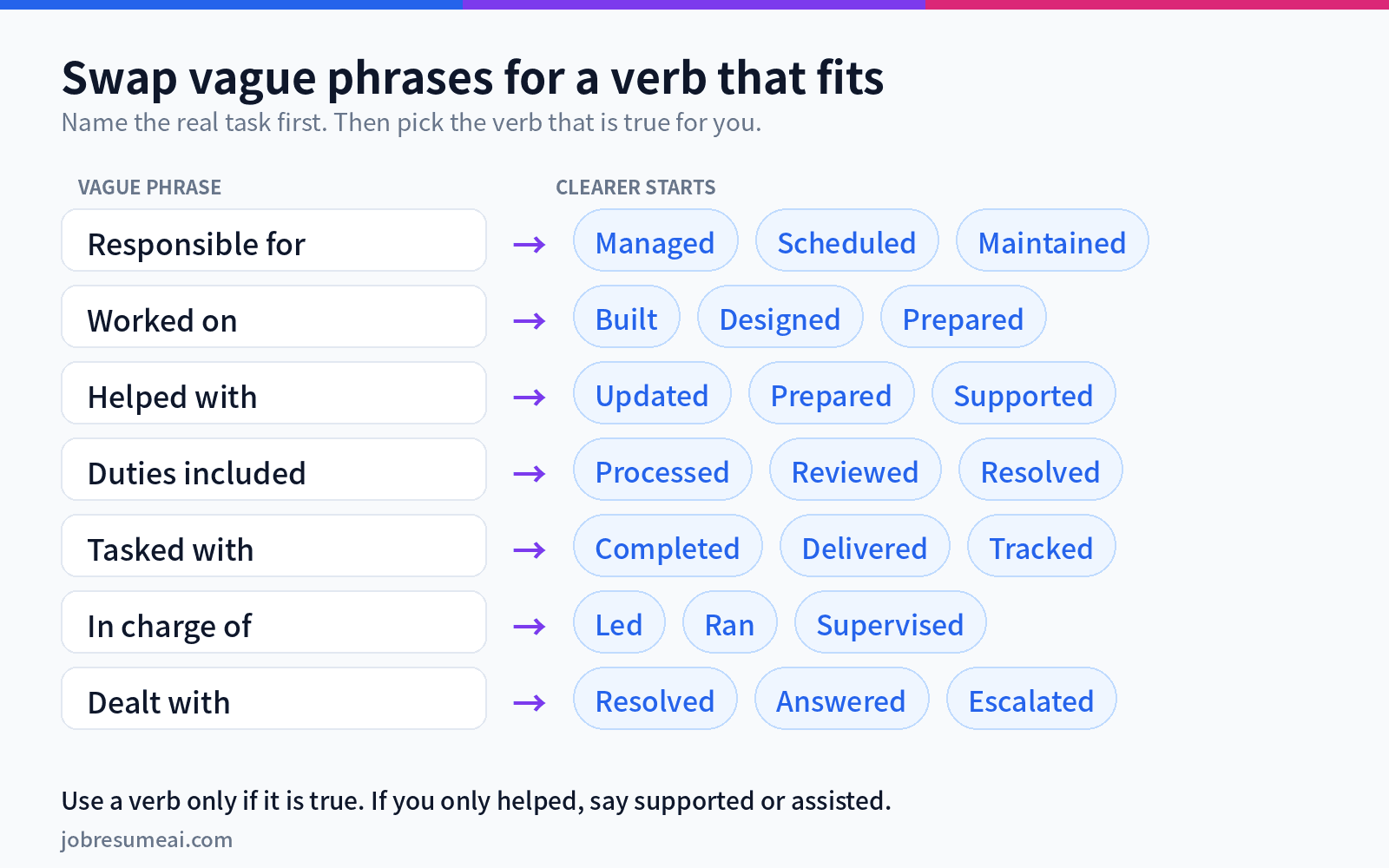
Seven common vague phrases and verbs that can replace them. Pick only a verb that is true for your work.
Vague
“Responsible for scheduling and answering phones.”
Clear
“Scheduled patient visits and answered about 40 calls a day for a four dentist office.”
Match the verb to your level of ownership
A verb tells the reader how much you owned. Pick the level you really had.
Some verbs sound bigger than others. Led says you guided people. Assisted says you helped. If the verb is bigger than your role, an interviewer will notice when they ask you to explain it.
Use the five levels below. Every verb in the download has a level from 1 to 5. The levels are our own guide, not an industry standard.
- Level
- 1
- Name
- Helped
- What it means
- You helped someone else do the work.
- Example verbs
- Assisted, Supported, Contributed
- Level
- 2
- Name
- Did
- What it means
- You did the task yourself.
- Example verbs
- Prepared, Processed, Completed
- Level
- 3
- Name
- Owned
- What it means
- You owned a task, process or result.
- Example verbs
- Managed, Coordinated, Resolved
- Level
- 4
- Name
- Led
- What it means
- You guided people or a project.
- Example verbs
- Led, Supervised, Mentored
- Level
- 5
- Name
- Set direction
- What it means
- You decided what the team or company would do.
- Example verbs
- Established, Founded, Launched
| Level | Name | What it means | Example verbs |
|---|---|---|---|
| 1 | Helped | You helped someone else do the work. | Assisted, Supported, Contributed |
| 2 | Did | You did the task yourself. | Prepared, Processed, Completed |
| 3 | Owned | You owned a task, process or result. | Managed, Coordinated, Resolved |
| 4 | Led | You guided people or a project. | Led, Supervised, Mentored |
| 5 | Set direction | You decided what the team or company would do. | Established, Founded, Launched |
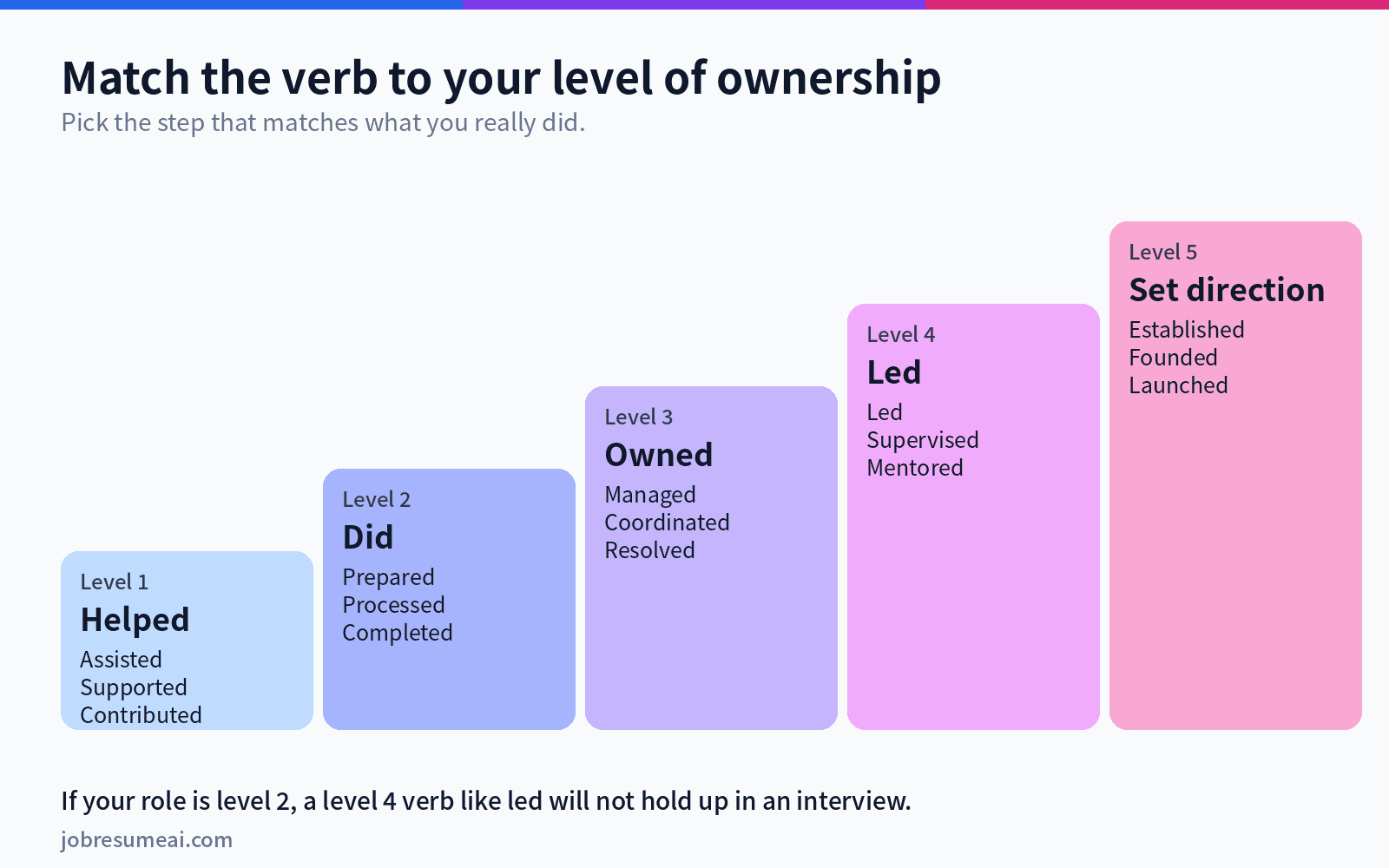
Five levels of ownership with example verbs. Choose the step that matches what you really did.
Action verbs by skill area
156 verbs in 12 skill areas. Past tense is shown.
Pick the skill area that matches the work in the bullet. The table shows past tense for older jobs. Use the base form for your current job. For example, use manage for a job you hold now and managed for a job you left.
- Skill area
- Leadership
- Verbs (past tense)
- Led, Directed, Supervised, Managed, Oversaw, Mentored, Delegated, Guided, Motivated, Recruited, Chaired, Championed, Represented
- Skill area
- Communication
- Verbs (past tense)
- Presented, Wrote, Drafted, Edited, Explained, Negotiated, Facilitated, Interviewed, Reported, Advised, Translated, Published, Responded
- Skill area
- Teamwork and support
- Verbs (past tense)
- Assisted, Supported, Contributed, Collaborated, Partnered, Coordinated, Volunteered, Participated, Cooperated, Aided, Connected, Provided, Joined
- Skill area
- Research and analysis
- Verbs (past tense)
- Analyzed, Researched, Evaluated, Reviewed, Investigated, Assessed, Compared, Identified, Measured, Audited, Surveyed, Interpreted, Tested
- Skill area
- Technical and data
- Verbs (past tense)
- Programmed, Coded, Configured, Automated, Debugged, Deployed, Integrated, Migrated, Monitored, Troubleshot, Installed, Modeled, Queried
- Skill area
- Creating and building
- Verbs (past tense)
- Built, Created, Designed, Developed, Launched, Established, Produced, Introduced, Founded, Initiated, Assembled, Constructed, Crafted
- Skill area
- Planning and organizing
- Verbs (past tense)
- Planned, Organized, Scheduled, Arranged, Prioritized, Allocated, Aligned, Mapped, Tracked, Documented, Maintained, Administered, Executed
- Skill area
- Improving and fixing
- Verbs (past tense)
- Improved, Streamlined, Reduced, Increased, Simplified, Standardized, Resolved, Repaired, Restructured, Revised, Updated, Upgraded, Strengthened
- Skill area
- Sales and customer service
- Verbs (past tense)
- Sold, Served, Retained, Closed, Generated, Prospected, Converted, Greeted, Answered, Welcomed, Recommended, Escalated, Promoted
- Skill area
- Teaching and training
- Verbs (past tense)
- Taught, Trained, Coached, Tutored, Instructed, Educated, Demonstrated, Onboarded, Oriented, Clarified, Certified, Informed, Equipped
- Skill area
- Money and numbers
- Verbs (past tense)
- Budgeted, Forecasted, Reconciled, Calculated, Invoiced, Balanced, Saved, Processed, Projected, Priced, Funded, Recorded, Billed
- Skill area
- Care and safety
- Verbs (past tense)
- Screened, Triaged, Comforted, Transported, Sterilized, Inspected, Secured, Protected, Rescued, Patrolled, Dispatched, Enforced, Safeguarded
| Skill area | Verbs (past tense) |
|---|---|
| Leadership | Led, Directed, Supervised, Managed, Oversaw, Mentored, Delegated, Guided, Motivated, Recruited, Chaired, Championed, Represented |
| Communication | Presented, Wrote, Drafted, Edited, Explained, Negotiated, Facilitated, Interviewed, Reported, Advised, Translated, Published, Responded |
| Teamwork and support | Assisted, Supported, Contributed, Collaborated, Partnered, Coordinated, Volunteered, Participated, Cooperated, Aided, Connected, Provided, Joined |
| Research and analysis | Analyzed, Researched, Evaluated, Reviewed, Investigated, Assessed, Compared, Identified, Measured, Audited, Surveyed, Interpreted, Tested |
| Technical and data | Programmed, Coded, Configured, Automated, Debugged, Deployed, Integrated, Migrated, Monitored, Troubleshot, Installed, Modeled, Queried |
| Creating and building | Built, Created, Designed, Developed, Launched, Established, Produced, Introduced, Founded, Initiated, Assembled, Constructed, Crafted |
| Planning and organizing | Planned, Organized, Scheduled, Arranged, Prioritized, Allocated, Aligned, Mapped, Tracked, Documented, Maintained, Administered, Executed |
| Improving and fixing | Improved, Streamlined, Reduced, Increased, Simplified, Standardized, Resolved, Repaired, Restructured, Revised, Updated, Upgraded, Strengthened |
| Sales and customer service | Sold, Served, Retained, Closed, Generated, Prospected, Converted, Greeted, Answered, Welcomed, Recommended, Escalated, Promoted |
| Teaching and training | Taught, Trained, Coached, Tutored, Instructed, Educated, Demonstrated, Onboarded, Oriented, Clarified, Certified, Informed, Equipped |
| Money and numbers | Budgeted, Forecasted, Reconciled, Calculated, Invoiced, Balanced, Saved, Processed, Projected, Priced, Funded, Recorded, Billed |
| Care and safety | Screened, Triaged, Comforted, Transported, Sterilized, Inspected, Secured, Protected, Rescued, Patrolled, Dispatched, Enforced, Safeguarded |
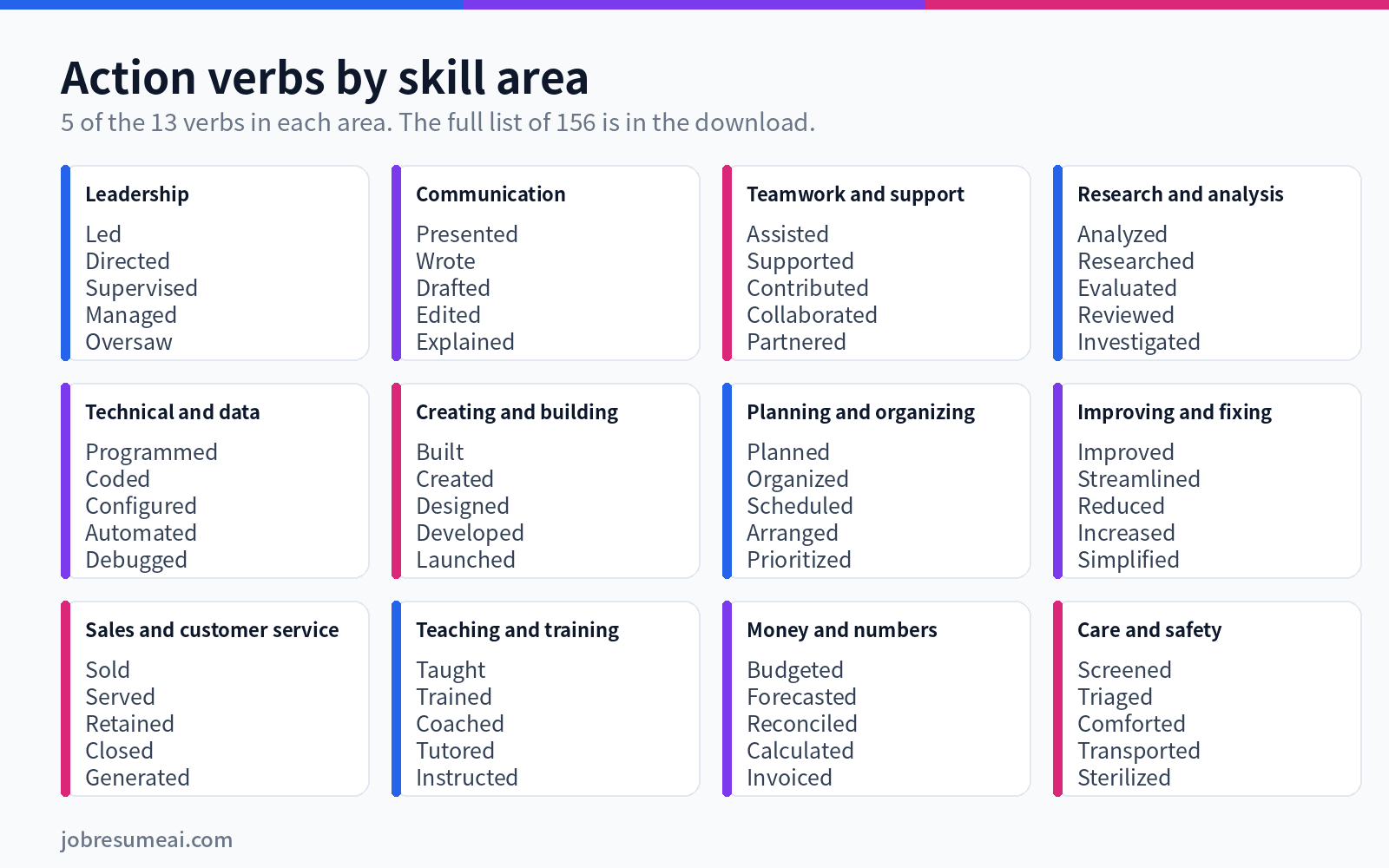
Five verbs from each of the 12 skill areas. The full list is in the table and in the download.
Which verbs fit which job
Different jobs call for different verbs. Start with these.
You do not need every verb. Most people use a small set that fits their field. These are starting points, not rules.
Office and administrative
Scheduled, Coordinated, Organized, Prepared, Maintained, Processed, Answered, Tracked. These show order and accuracy. Example: Processed 60 invoices a week and flagged errors before payment.
Healthcare support
Screened, Prepared, Documented, Sterilized, Comforted, Educated, Scheduled, Monitored. Use clinical verbs only for work you were trained and allowed to do. Example: Documented patient vitals in the record at each visit.
Tech and data
Built, Automated, Debugged, Deployed, Analyzed, Queried, Modeled, Migrated. Name the tool or language next to the verb. Example: Automated a weekly report in Python.
Sales and customer service
Sold, Retained, Resolved, Answered, Recommended, Escalated, Converted, Generated. Add the size of the work, such as customers served per day.
Management
Led, Supervised, Trained, Mentored, Prioritized, Budgeted, Delegated, Improved. Say how many people you led and what they worked on.
Public safety and trades
Inspected, Responded, Secured, Patrolled, Maintained, Installed, Repaired, Protected. Keep each bullet specific to the task, such as the type of equipment or call.
Action verbs when you have little paid experience
Class work, volunteering and projects count. Use verbs that match them.
If you are a student or changing careers, you can still use action verbs. Describe class projects, volunteer work, clubs and part time jobs. Lean on level 1 and level 2 verbs, and be exact about your part.
- Tutored four classmates in algebra each week.
- Collected survey answers from 60 students and entered them in a spreadsheet.
- Volunteered at a food bank and sorted donations for weekly pickup.
- Presented a class project to a group of 25 people.
Which tense to use
Present tense for a job you hold now. Past tense for jobs you left.
Use present tense for your current job, such as manage or schedule. Use past tense for every older job, such as managed or scheduled. Keep the tense the same inside each job.
- Current job
- Manage
- Past job
- Managed
- Current job
- Schedule
- Past job
- Scheduled
- Current job
- Train
- Past job
- Trained
- Current job
- Build
- Past job
- Built
- Current job
- Lead
- Past job
- Led
- Current job
- Write
- Past job
- Wrote
| Current job | Past job |
|---|---|
| Manage | Managed |
| Schedule | Scheduled |
| Train | Trained |
| Build | Built |
| Lead | Led |
| Write | Wrote |
Before and after: same job, stronger verbs
The facts stay the same. The verbs and details change.
The fictional example below uses one role. Notice that the after version adds detail, not only new verbs.
Numbers help when they are real. In JobResumeAI's 2026 study, no quantifiable impact was detected in 36.0% of detailed checks. If you do not have an exact number, describe the scope instead, such as how many people you served or how often you did the task.
Fictional before and after
Target role: Front desk coordinator
Every fact in the after version is something the person did. Nothing was added to sound bigger.
Before
- Responsible for the front desk.
- Helped with scheduling.
- Worked on patient records.
- Dealt with phone calls and complaints.
After
- Greeted about 50 patients a day and checked them in at the front desk.
- Scheduled and confirmed appointments for four providers.
- Updated patient records after each visit.
- Answered phone calls and resolved billing questions or passed them to the billing team.
Action verb finder
Choose a skill area and copy the verbs that are true for you.
Pick the skill area that matches the bullet you are editing. Copy only a verb you can explain in an interview.
Turn a verb into a full bullet
A verb is the start. Add the task and a real result.
Choose a verb from the finder. Then add the task, the context and a real result. Read the draft out loud and fix anything that does not sound like you.
Download the action verb tools
A printable cheat sheet and a verb bank you can track in a spreadsheet.
The PDF fits on two pages and is easy to keep next to your resume. The CSV lists all verbs with past tense, skill area and ownership level, and has a column to count how often you use each one.
Do action verbs help with ATS?
Verbs help people read. Job post terms matter more for matching.
Action verbs are not special ATS keywords. Resume match tools compare your resume with the words in a job post, so the skills, tools and job terms in the post matter more than a fancy verb.
Harvard Extension School Career Services tells students to write for both human readers and applicant tracking systems. A plain verb in a clear bullet works for both.
When the job post uses a phrase and it is true for you, use that wording. If the post says coordinate scheduling, Coordinated scheduling for four providers is a better match than Arranged calendars.
Common mistakes with action verbs
Most problems come from using a big verb without the detail behind it.
One career blog from the CUNY Graduate Center suggests using the same verb no more than twice on a resume. Treat that as a rule of thumb, not a law. Plain verbs such as led, ran, built and wrote are fine when they are true.
- Using a big verb for small work, such as spearheaded for a task you helped with.
- Starting every bullet with the same verb.
- Using a long word like utilized when used says the same thing.
- Mixing tenses inside one job.
- Adding a verb but no task, person or result.
- Copying a verb list without checking that each word is true.
- Writing a past job in present tense.
- Starting the bullet with a phrase before the verb.
Frequently asked questions
What are good action verbs for a resume?
Good action verbs are specific and true. Examples are managed, scheduled, built, analyzed, trained, reduced and resolved. Pick the one that matches your real task and level. The table above has 156, sorted by skill area.
What are strong verbs for a resume?
A strong verb is exact. Analyzed is stronger than looked at when you studied data. Led is stronger than helped only if you really led. Strong means clear and true, not fancy.
What are power words for a resume?
Power words is another name for action verbs and other strong terms. The same rule applies. Choose words that show what you did and that you can explain in an interview.
What words should I avoid on a resume?
Avoid vague phrases such as responsible for, worked on, duties included and dealt with. Also avoid verbs that make your role sound bigger than it was.
Should every bullet start with an action verb?
Most should. MIT career advising suggests opening each bullet with a verb that points to the skill you want to show. A bullet can start another way if it reads better, but keep one style across the resume.
How many action verbs should I use?
Use one per bullet. Try not to repeat a verb more than twice. If you have 15 bullets, that means at least 8 different verbs.
Which tense should action verbs be in?
Use present tense for your current job and past tense for older jobs. Keep the tense the same inside each job.
Can I use the same action verb twice?
Yes. Twice is fine, and plain verbs like led or built can repeat when they are the most accurate word. If you notice a third use, look for a more exact verb.
Do action verbs matter for ATS?
They help people read your bullets, but they are not special keywords. Match the skills, tools and job terms in the posting, and use plain verbs to show what you did.
What this guide cannot do
A verb list helps with wording. It cannot decide what is true for you.
Use this guide as a starting point. Your own work is always the source of truth.
- The ownership levels are our own guide. Employers do not use them.
- The 7.4 second figure comes from a 2018 study and is not a rule.
- A verb is one part of a bullet. Context and results matter too.
- This guide does not claim that any verb raises an ATS score.
- The examples are fictional.
Action verb checklist before you apply
- Every bullet starts with a verb.
- Each verb is true and I can explain it.
- The verb level matches my real role.
- My current job is in present tense and past jobs are in past tense.
- No verb appears more than twice if I can avoid it.
- I removed responsible for, worked on and duties included.
- Each bullet has a task, a person or thing, and a real result or size.
- I used the cheat sheet or CSV to track the verbs I used.
- I checked my resume against the job description before applying.
Further reading
Sources and references
These references were reviewed while preparing this guide. JobResumeAI may interpret or organize the guidance differently; the links below let you check the underlying advice yourself.
- Harvard Extension School Career ServicesCreate Impactful Resumes and Cover Letters (opens in a new tab)
- MIT Career Advising and Professional DevelopmentResume action verbs (opens in a new tab)
- HR DiveEye-tracking study shows recruiters look at resumes for 7 seconds (opens in a new tab)
- CUNY Graduate Center Career PlanningAction Verbs for Your Resume (opens in a new tab)
- JobResumeAICommon ATS Resume Problems in 2026: What 2,226 Checks Found (opens in a new tab)