
How Far Back Should a Resume Go? 10, 15, or 20 Years?
Learn how far back a resume should go, when 10 to 15 years is enough, when older jobs still belong, and how to shorten old work history without losing relevant experience.
Quick answer
For a long work history, focus first on the most relevant 10 to 15 years.
There is no rule that every resume must stop at exactly 10 or 15 years. CareerOneStop advises people with a longer work history to include or emphasize the jobs that add the most value from roughly the past 12 to 15 years. Indeed also uses 10 to 15 years as a common starting range.
Keep an older job when it proves something the target role still needs. Shorten it when it adds useful context but no longer needs several bullets. Remove it when it is unrelated, repetitive, or pushes stronger recent evidence farther down the page.
If you are early in your career, you may include nearly all useful work, internships, projects, or training. If you have worked for decades, your resume usually needs selection rather than a complete job-by-job record.
- Use 10 to 15 years as a starting point, not a hard cutoff.
- Give recent and relevant roles the most detail.
- Keep older work when it proves a required skill, credential, industry background, or career progression.
- Shorten older roles before deleting useful experience.
- Follow the job posting when it asks for a specific history or document format.
On this page
The 10 to 15 year rule is a starting point, not a law
CareerOneStop says people with a longer work history should include or emphasize the jobs that add the most value from the past 12 to 15 years. Indeed gives a similar 10 to 15 year range for many standard resumes.
That range is useful because recent work often gives the clearest picture of your current skills and level. But relevance can matter more than age. A job from 17 years ago may still deserve a line if it proves a required license, industry background, or type of leadership that your recent roles do not show.
The goal is not to hide your career. It is to make the resume useful for one hiring decision. A resume is a selected record of relevant qualifications, not a complete employment database.
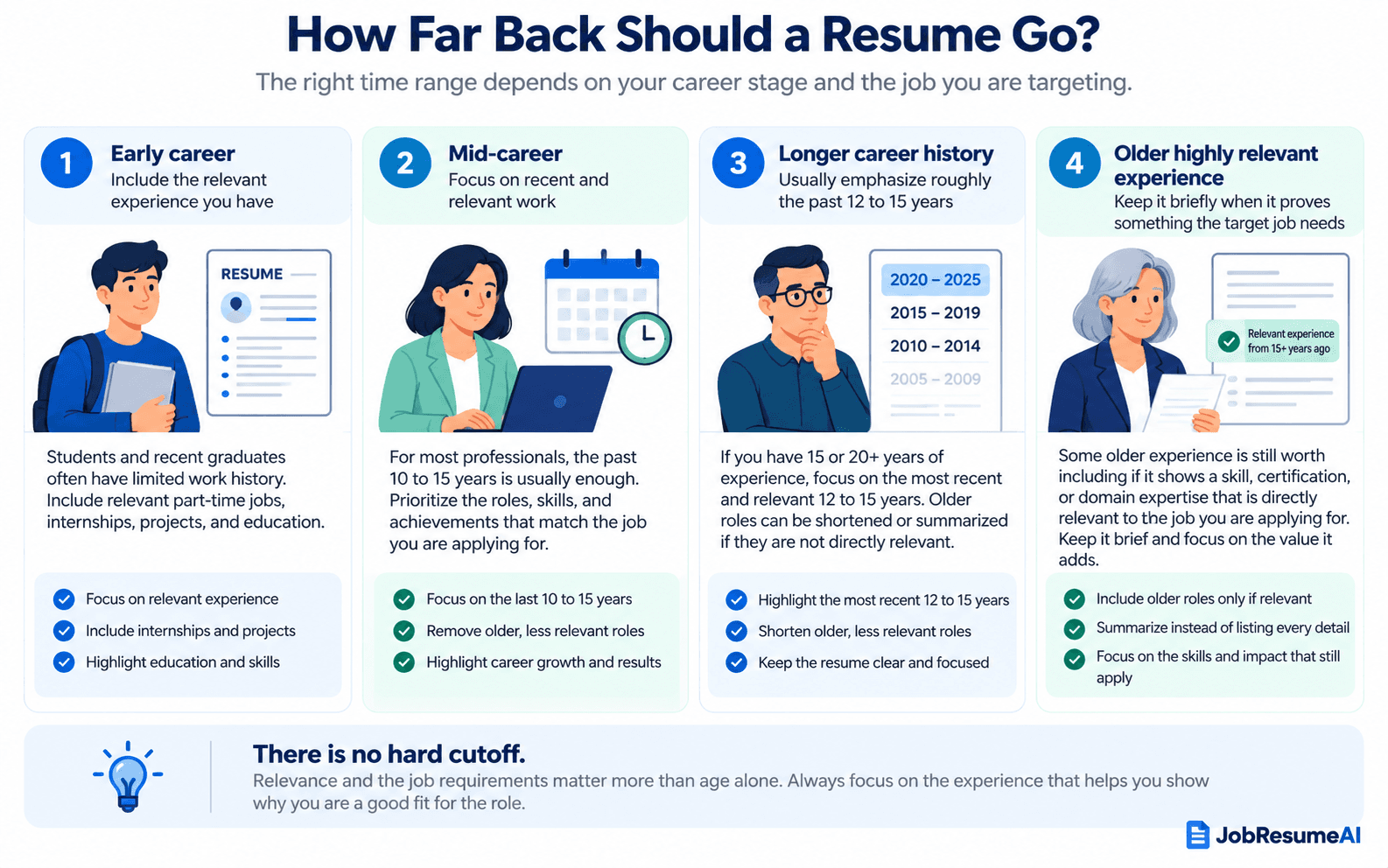
Use recent and relevant experience first, then keep older work only when it still helps the target application.
The same 15-year window can contain very different career histories
A time range does not tell you how many jobs to list. The U.S. Bureau of Labor Statistics reported that median tenure with a current employer was 4.1 years in January 2026. For workers ages 55 to 64, the median was 9.6 years.
That means one person may have several employers inside a 15-year period, while another may have one or two. Do not force a certain number of jobs onto the page. Choose the roles that explain your current fit most clearly.
- BLS employee tenure, January 2026
- All wage and salary workers age 16+
- Median years with current employer
- 4.1 years
- BLS employee tenure, January 2026
- Workers age 25 to 34
- Median years with current employer
- 3.0 years
- BLS employee tenure, January 2026
- Workers age 45 to 54
- Median years with current employer
- 7.0 years
- BLS employee tenure, January 2026
- Workers age 55 to 64
- Median years with current employer
- 9.6 years
| BLS employee tenure, January 2026 | Median years with current employer |
|---|---|
| All wage and salary workers age 16+ | 4.1 years |
| Workers age 25 to 34 | 3.0 years |
| Workers age 45 to 54 | 7.0 years |
| Workers age 55 to 64 | 9.6 years |
How far back should work history go for your career stage?
Use career stage as context, then let relevance decide the final answer. The table below is a practical starting point for a standard private-sector resume.
- Situation
- Student or recent graduate
- Practical starting point
- Use the relevant experience you have
- What to prioritize
- Internships, projects, part-time work, volunteering, education, and early jobs that prove useful skills
- Situation
- Early-career professional
- Practical starting point
- Often most or all relevant post-school experience
- What to prioritize
- Recent roles, progression, job-specific skills, and measurable or concrete contributions
- Situation
- Mid-career professional
- Practical starting point
- Often about 10 to 15 years
- What to prioritize
- Recent relevant roles first, with older experience shortened when it adds less value
- Situation
- Senior professional or executive
- Practical starting point
- Usually recent 10 to 15 years in detail, with selective earlier history
- What to prioritize
- Leadership scope, business impact, major transformations, domain depth, and career progression
- Situation
- Career changer
- Practical starting point
- Use the years that support the new direction
- What to prioritize
- Transferable work plus older experience from the target field when it is still relevant
| Situation | Practical starting point | What to prioritize |
|---|---|---|
| Student or recent graduate | Use the relevant experience you have | Internships, projects, part-time work, volunteering, education, and early jobs that prove useful skills |
| Early-career professional | Often most or all relevant post-school experience | Recent roles, progression, job-specific skills, and measurable or concrete contributions |
| Mid-career professional | Often about 10 to 15 years | Recent relevant roles first, with older experience shortened when it adds less value |
| Senior professional or executive | Usually recent 10 to 15 years in detail, with selective earlier history | Leadership scope, business impact, major transformations, domain depth, and career progression |
| Career changer | Use the years that support the new direction | Transferable work plus older experience from the target field when it is still relevant |
When 5, 10, 15, or more years of experience can make sense
Around 5 years
Five years can be enough when your recent work already proves what the new role needs. This can happen after a career change or when older roles are unrelated to the field you now target.
Do not remove earlier work just to hit five years. Keep it when it explains a key transition or provides evidence that your recent roles do not show.
Around 10 years
Ten years often gives enough room to show several recent roles, growth, and current skills. It can be a clean choice when older work mostly repeats the same duties or uses outdated tools.
Around 12 to 15 years
This range works well for many experienced professionals. It is also close to CareerOneStop's current guidance for people with a longer work history.
You can still mention earlier experience when it adds something important. The older entry may need only a title, employer, dates, and one short line instead of several bullets.
More than 15 years
Going beyond 15 years can make sense when the older job proves a required specialty, license, major leadership role, industry background, or experience that is hard to replace with newer evidence.
The older the role, the stronger the reason it should have to take space from recent work.
Keep, shorten, or remove older work experience
You do not have only two choices. An old job does not need to stay in full detail or disappear completely. Many resumes improve when older roles are shortened.
- Decision
- Keep
- Use it when
- The role proves a required skill, credential, industry background, leadership level, or career step
- Typical treatment
- Keep enough detail to show why it matters
- Decision
- Shorten
- Use it when
- The role adds useful context but recent work is more important
- Typical treatment
- Use the title, employer, dates, and one concise bullet or line
- Decision
- Remove
- Use it when
- The role is unrelated, repetitive, outdated, or takes space from stronger evidence
- Typical treatment
- Leave it off the standard resume unless the application specifically asks for full history
| Decision | Use it when | Typical treatment |
|---|---|---|
| Keep | The role proves a required skill, credential, industry background, leadership level, or career step | Keep enough detail to show why it matters |
| Shorten | The role adds useful context but recent work is more important | Use the title, employer, dates, and one concise bullet or line |
| Remove | The role is unrelated, repetitive, outdated, or takes space from stronger evidence | Leave it off the standard resume unless the application specifically asks for full history |
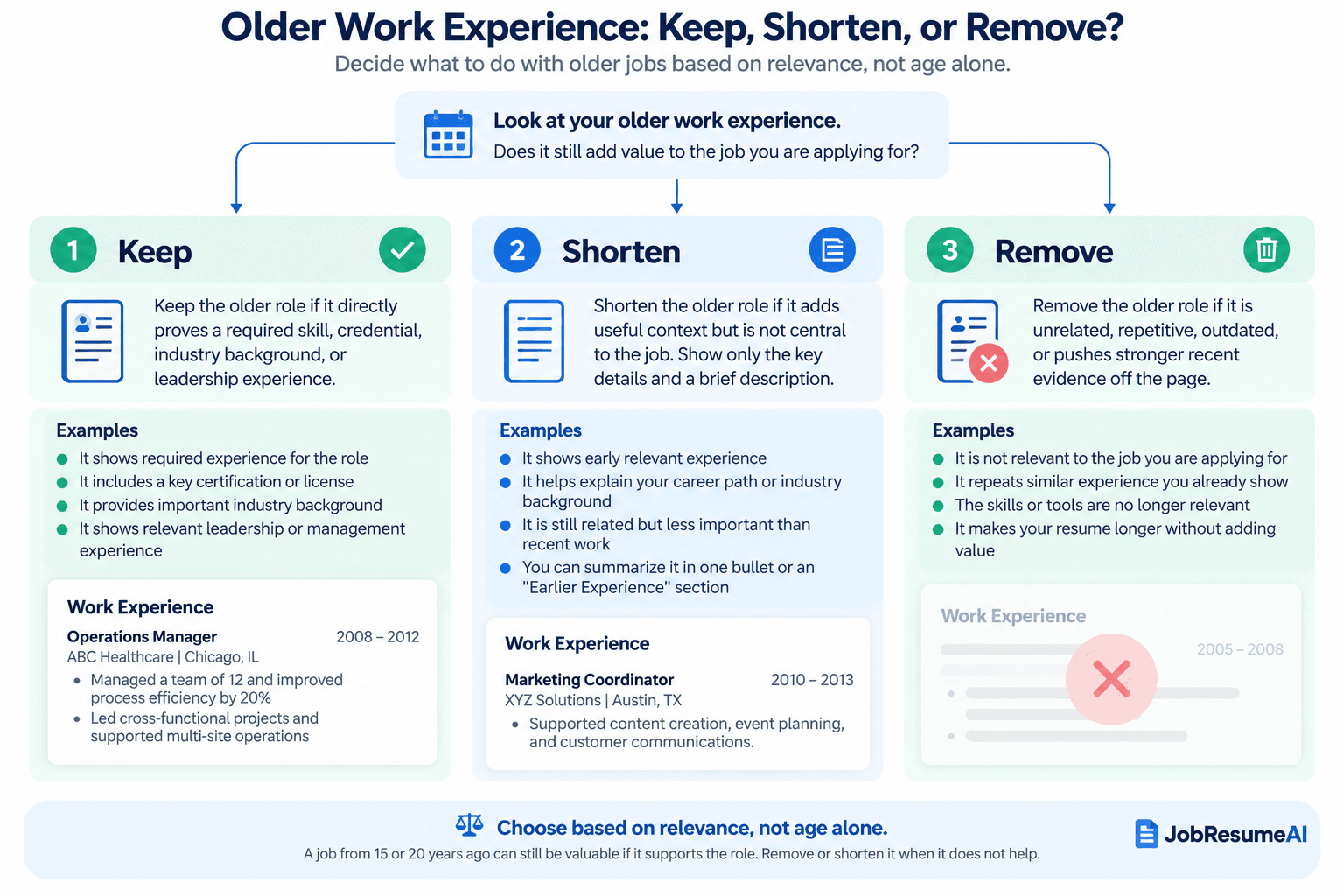
Choose based on how much the older role helps the current application, not on age alone.
When a job from 15 or 20 years ago still belongs on the resume
Older experience can still be useful. The test is whether it proves something important for the job you want now.
- It shows direct experience in the industry you are returning to.
- It proves a license, certification, specialty, or type of regulated work that still matters.
- It shows a leadership level or scale that your recent roles do not show.
- It explains a major career step, promotion, acquisition, or long period with one employer.
- It proves a required skill that you still use and can discuss today.
- The job posting asks for a long period of relevant experience and the older role helps meet that requirement.
When older jobs can come off the resume
Older work can usually be removed when it no longer changes the employer's understanding of your fit. This is especially true when newer roles already prove the same skill at a higher level.
- The role is unrelated to the target job and adds no useful transferable skill.
- The duties repeat work shown more clearly in recent roles.
- The tools or methods are no longer relevant and you no longer use them.
- The entry pushes stronger recent work onto another page without adding value.
- The role was very short and does not help explain a meaningful part of your career.
How to shorten older experience without erasing it
Older jobs often need less detail, not zero detail. Keep the facts that help the reader understand your path and remove the routine tasks that recent roles already prove.
- 1
Keep the title and employer
These details give the reader useful career context and make progression easier to understand.
- 2
Keep dates when the format calls for them
Use a consistent date format across the experience section. Do not create a confusing timeline just to save space.
- 3
Cut routine duties first
Remove older bullets about basic tasks that your recent jobs already prove at a higher level.
- 4
Keep one relevant achievement or responsibility
If the old job still supports the target role, one concise bullet may be enough to show why it remains on the resume.
- 5
Consider an Earlier Experience section
A short section can preserve relevant career history without giving old roles the same weight as current work.
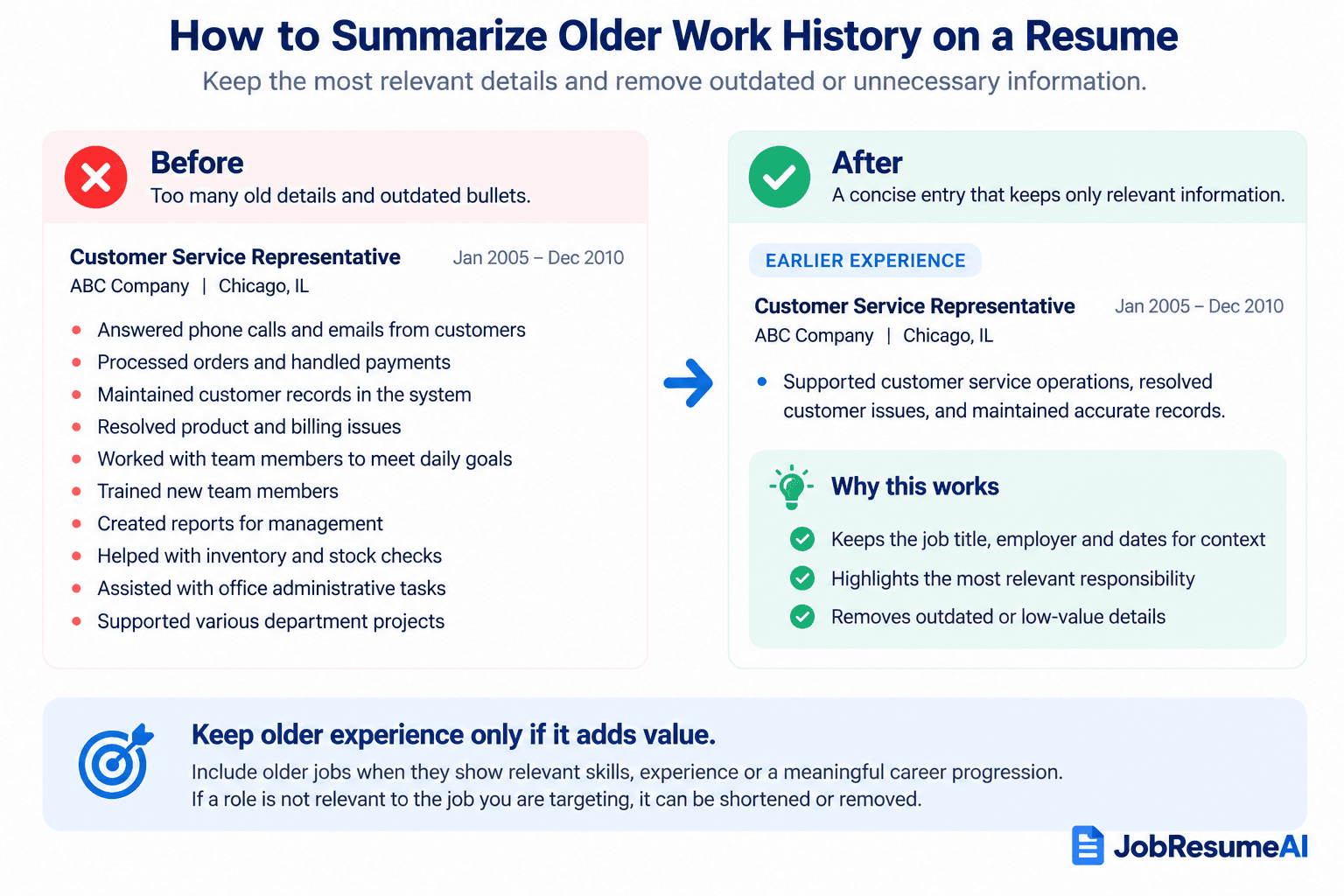
Keep the role when it adds value, but reduce old detail that no longer helps the hiring decision.
Career changers may need to reach farther back
A career change can make older work more useful than recent work. If you worked in accounting 12 years ago, moved into operations, and now want to return to accounting, the older accounting role may deserve space because it proves direct field experience.
Keep the connection clear. Do not give an old role several bullets just because it matches the field. Choose the parts that still matter and pair them with current transferable skills.
A gap can change how far back you go
A long break from paid work can make earlier experience more important. For example, someone returning after several years of caregiving may need to show work from before the break because it contains the strongest direct evidence for the role.
Do not stretch dates or invent work to make the timeline look continuous. Use the real history. Then make the relevant experience easy to find and explain the gap briefly only when it helps the application.
Senior professionals should show scope, not every old duty
A senior resume can include more history, but the document should still be selective. The goal is to show how your scope grew, what you owned, and what changed because of your work.
Give recent leadership roles the most detail. Older jobs can be compressed once they stop adding new evidence. A past management role may still matter if it explains your progression, but routine bullets from early individual-contributor jobs usually need less space.
- Prioritize team, budget, product, portfolio, customer, or operational scope when accurate.
- Show major changes, launches, turnarounds, integrations, or improvements that are relevant to the target role.
- Reduce repeated duties across several older leadership roles.
- Keep older industry experience when the target role values deep domain knowledge.
Early-career candidates do not need to invent a cutoff
If you have only a few years of work history, include the relevant experience you have. A part-time role, internship, project, volunteer position, or campus job can stay when it proves skills needed for the target role.
The question is not whether the job is old enough to remove. The question is whether it helps the reader understand what you can do now.
How many jobs should you list on a resume?
There is no fixed number. One person may need two jobs to cover 12 years. Another may need five. A candidate with contract work may have even more.
Do not add or remove jobs just to hit a number. Include enough work history to show the experience the employer needs, then cut entries that no longer add information.
- Question
- Do I need my last 3 jobs?
- Better decision rule
- Keep the roles that best prove fit, even if the count is 2 or 5
- Question
- Should I list every short contract?
- Better decision rule
- Combine or shorten related contract work when that is accurate and easier to read
- Question
- Should every role have the same number of bullets?
- Better decision rule
- No. Give the most relevant recent roles more detail
- Question
- Can I leave out an unrelated old job?
- Better decision rule
- Yes on a standard resume when it adds little value, unless the application asks for full history
| Question | Better decision rule |
|---|---|
| Do I need my last 3 jobs? | Keep the roles that best prove fit, even if the count is 2 or 5 |
| Should I list every short contract? | Combine or shorten related contract work when that is accurate and easier to read |
| Should every role have the same number of bullets? | No. Give the most relevant recent roles more detail |
| Can I leave out an unrelated old job? | Yes on a standard resume when it adds little value, unless the application asks for full history |
Keep employment dates clear and consistent
Your resume should make the order of your experience easy to follow. Use one date style throughout the work history and keep each date attached to the correct role.
Do not change dates to make an older job look newer. Do not merge separate jobs in a way that changes what actually happened. Concise formatting is fine, but the timeline should remain accurate.
Does an ATS require your full work history?
There is no universal ATS rule that requires every job you have ever held. Applicant tracking systems and employer workflows differ. The job posting and application instructions matter more than a general ATS myth.
For the resume itself, make titles, employers, dates, and relevant skills easy to read. Then use the application form to provide any extra history the employer specifically requests.
Federal resumes now have a current two-page rule on USAJOBS
Old advice often says federal resumes should be very long. That is no longer the current rule for USAJOBS applications. The U.S. Office of Personnel Management says resumes used to apply for federal jobs through USAJOBS must be two pages or less under the rule that took effect September 27, 2025.
USAJOBS also tells applicants to include relevant work experience that proves they meet the job announcement. For each relevant role, it asks for the employer, title, start and end dates, hours per week, and brief descriptions that show the required level of work.
If you apply for a federal job, follow the current announcement and USAJOBS instructions. Do not rely on old long-form federal resume guidance.
A resume and an academic CV handle history differently
A standard resume is selective and tailored to the job. An academic CV is usually a fuller record of academic credentials and accomplishments.
Penn Career Services describes a CV as a full history of academic credentials and notes that its length can be longer and variable. If the employer or institution asks for a CV, do not automatically apply the 10 to 15 year resume rule.
Examples of how far back to go on a resume
These examples are fictional. They show the decision process, not fixed rules for every person.
Illustrative examples
Three different work-history decisions
The same year cutoff can produce the wrong answer when relevance is different.
Mid-career operations manager
Has 16 years of work history. The most recent 12 years contain operations, team leadership, vendor management, and process improvement. An older retail role adds little, so it is removed.
Career changer returning to accounting
Worked in accounting 14 years ago, then moved into operations. An older accounting role stays in a short Earlier Experience section because it proves direct field experience for the target job.
Senior software engineer
Has 20 years of technical work. Recent roles show current architecture, cloud, reliability, and leadership. Early roles using outdated tools are reduced to titles and employers unless they show important domain or leadership history.
Work-history depth and resume length are connected
A resume can become too long because every old job receives the same detail as the current one. Before shrinking fonts or margins, reduce low-value history first.
Give the first page to the evidence the target job needs most. If a second page is useful, fill it with relevant work, education, certifications, projects, or other qualifications rather than old duties that repeat what the reader already knows.
Common mistakes when deciding how far back a resume should go
- Treating 10 years or 15 years as an automatic cutoff for every candidate.
- Keeping every old job because it feels wrong to leave anything out.
- Removing an older role that proves a qualification the target job actually needs.
- Giving a 20-year-old job more detail than a recent relevant role.
- Using outdated tools or skills as the main evidence for a current role when newer evidence exists.
- Changing dates, titles, or responsibilities to make old experience look newer or more senior.
- Leaving large blocks of routine duties in older roles instead of summarizing them.
- Assuming an ATS requires a complete lifetime work history.
- Using old federal resume advice instead of current USAJOBS instructions.
Common questions about how far back a resume should go
How many years back should a resume go?
For people with a long work history, about 10 to 15 years is a common starting point. CareerOneStop currently recommends emphasizing the jobs that add the most value from roughly the past 12 to 15 years. Go farther back when older experience is still important to the role.
Should I include a job from 20 years ago?
Include it when it proves something the target job still needs, such as relevant industry experience, a major leadership role, a license, or a specialty. Keep it short if recent work is more important.
Should you include all jobs on a resume?
Usually not on a standard resume. Choose the jobs that help explain your qualifications for the target role. A later application form may ask for a more complete history, and you should answer that form fully.
How many jobs should I put on my resume?
There is no fixed number. Use enough roles to show your relevant experience and career path. The number will depend on how long you stayed with each employer and how closely each job relates to the new role.
Can I leave off a job that is older than 10 years?
Yes, when it adds little value to a standard resume and the employer does not ask for a complete history. Keep it when it still proves an important qualification or explains the path to your current level.
How far back should a senior executive resume go?
Recent 10 to 15 years usually deserve the most detail. Earlier senior roles can stay when they show major leadership scope, domain depth, or career progression. Older individual-contributor roles often need much less detail.
Does a federal resume follow the same rule?
Not exactly. As of the current USAJOBS rule, a federal resume must be two pages or less. Focus on relevant work that proves the qualifications in the announcement and follow the required details for each role.
Does an academic CV stop at 10 or 15 years?
Not necessarily. Academic CVs are fuller records of academic credentials and accomplishments, so the standard resume cutoff does not apply in the same way. Follow the expectations of the academic field and institution.
Work-history checklist before you send the resume
- Does the recent work history prove the main requirements of the target job?
- Is every older role still adding useful evidence or context?
- Can any old role be shortened instead of removed completely?
- Are recent relevant jobs getting more detail than older low-priority jobs?
- Are the titles, employers, and dates accurate?
- Have you removed outdated or unrelated details that distract from the target role?
- If you are changing careers, did you keep older experience that supports the new direction?
- If you are applying through USAJOBS, does the resume follow the current two-page rule and the announcement's requirements?
- Does the resume remain easy to scan at its final length?
- Can you explain every role and timeline honestly in an interview or application form?
Published by JobResumeAI
Further reading
Sources and references
These references were reviewed while preparing this guide. JobResumeAI may interpret or organize the guidance differently; the links below let you check the underlying advice yourself.
- CareerOneStopWork experience | Resume Guide (opens in a new tab)
- U.S. Bureau of Labor StatisticsEmployee Tenure in 2026 (opens in a new tab)
- Indeed Career GuideQ&A: How Far Back Should I Go on My Resume? (opens in a new tab)
- USAJOBS Help CenterHow do I write a resume for a federal job? (opens in a new tab)
- U.S. Office of Personnel ManagementApplicant Guidance on the Two-Page Resume Limit (opens in a new tab)
- University of Pennsylvania Career ServicesWrite a Resume/CV (opens in a new tab)