
How to Write Strong Resume Bullet Points (With Examples)
Learn how to write stronger resume bullet points with clear action, context, and outcomes, plus practical examples for different roles.
Quick answer
A strong resume bullet shows what you did, the context, and the result.
Start with the work you actually performed. Name the action you took, give enough context to understand the responsibility or problem, and add the outcome when you can support it.
Metrics can make a result easier to understand, but they are not required. A specific truthful outcome is stronger than an invented percentage.
- Lead with a clear action rather than a vague responsibility phrase.
- Add context so the reader understands what you worked on, for whom, or at what scope.
- Include a result, improvement, decision, output, or business effect when it is known.
- Prioritize bullets that are relevant to the job you are targeting.
- Never invent numbers, ownership, tools, or achievements to make a bullet sound stronger.
On this page
What a strong resume bullet point actually does
A resume bullet should help a reader understand your contribution quickly. Listing a task can show what was assigned to you, but stronger bullets usually make your action, context, and contribution easier to see.
Career guidance from Yale and the University of Michigan both emphasizes moving beyond task lists toward accomplishment-focused statements that explain what you did and the effect or purpose of the work.
Responsibility only
“Responsible for weekly reports and customer data.”
Clearer contribution
“Prepared weekly customer-health reports from CRM data and highlighted accounts that needed follow-up before renewal reviews.”
Use an action + context + outcome framework
You do not need a complicated formula. You need enough information to make the contribution understandable.
- 1
Start with the action
Use a verb that accurately describes your contribution: analyzed, built, coordinated, redesigned, prepared, resolved, led, automated, investigated, or another precise action.
- 2
Add the context
Explain what you worked on, which process or audience was involved, or what problem you were addressing.
- 3
Add the outcome when known
Show what changed: time saved, errors reduced, a launch completed, a decision supported, a customer issue resolved, a process standardized, or another credible result.
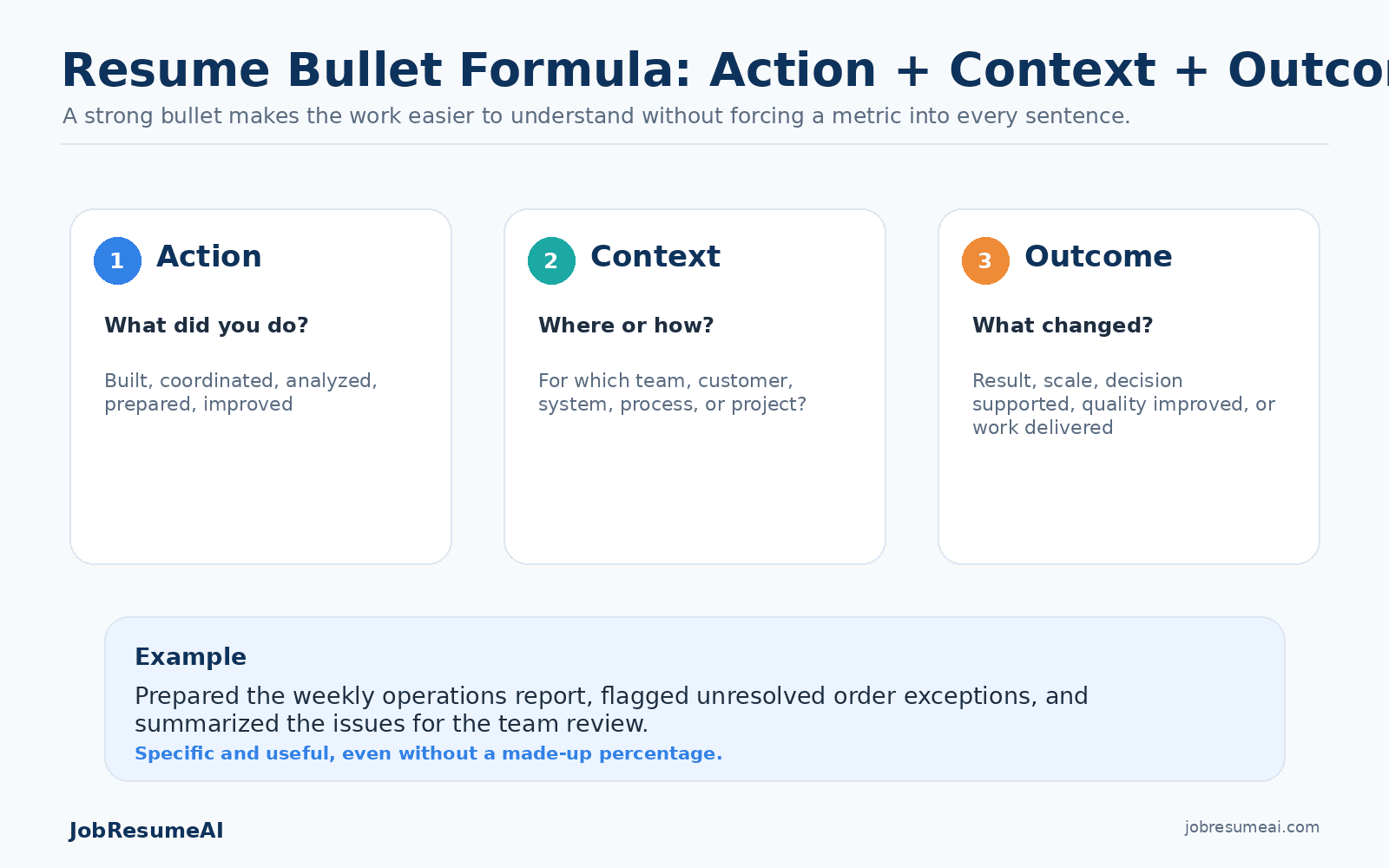
A strong bullet explains what you did, the useful context, and what changed or was delivered when the outcome is known.
Simple framework
Action + context + outcome
A good bullet often contains these three elements, but the exact order can change.
Action
Automated
Context
a weekly reporting workflow using Python and SQL
Outcome
so the operations team could review updated metrics without rebuilding the report manually
Combined
Automated a weekly reporting workflow using Python and SQL so the operations team could review updated metrics without rebuilding the report manually.
Use metrics when they are real — not because every bullet needs a number
Numbers can provide scale and make an achievement easier to evaluate. Useful metrics might include revenue, costs, time, volume, error rate, response time, users, accounts, tickets, conversion, or another measure directly connected to your work.
But many useful contributions do not have a clean percentage attached to them. If you do not know the number, describe the concrete outcome instead of estimating one.
- If you know this
- Time saved
- You can show
- How much faster a process became or how much manual work was removed
- If you know this
- Volume
- You can show
- Number of customers, records, requests, campaigns, projects, or transactions handled
- If you know this
- Quality
- You can show
- Reduction in errors, rework, incidents, defects, or support burden
- If you know this
- Business result
- You can show
- Revenue, retention, conversion, cost, adoption, or another supported outcome
- If you know this
- No reliable metric
- You can show
- The decision, process improvement, deliverable, ownership, or problem solved
| If you know this | You can show |
|---|---|
| Time saved | How much faster a process became or how much manual work was removed |
| Volume | Number of customers, records, requests, campaigns, projects, or transactions handled |
| Quality | Reduction in errors, rework, incidents, defects, or support burden |
| Business result | Revenue, retention, conversion, cost, adoption, or another supported outcome |
| No reliable metric | The decision, process improvement, deliverable, ownership, or problem solved |
Choose bullets that support the job you are targeting
A strong bullet can still be low-value for a particular application if it proves something the employer does not care much about. Read the job description first, identify the responsibilities and skills that matter most, then prioritize bullets that provide real evidence for those requirements.
That may mean moving one achievement higher, adding useful context to a relevant bullet, or shortening older details that do not help the target role.
Resume bullet examples: weak wording vs clearer evidence
The examples below are fictional and exist to demonstrate structure. Do not copy tools, scope, metrics, or achievements that are not true for your own experience.
Software engineering
Weak: Worked on APIs and fixed bugs.
Stronger direction: Maintained Node.js APIs for the onboarding workflow and investigated production failures reported by support, documenting recurring causes for the engineering team.
Data analysis
Weak: Made dashboards and reports.
Stronger direction: Built a Power BI dashboard from cleaned operational data so team leads could review weekly volume, backlog, and trend changes in one place.
Marketing
Weak: Helped with email campaigns.
Stronger direction: Coordinated weekly email campaigns across copy, segmentation, and QA, then summarized engagement results for the next campaign review.
Customer success
Weak: Helped customers with issues.
Stronger direction: Managed onboarding questions for assigned B2B accounts and coordinated product or support escalations when setup issues blocked adoption.
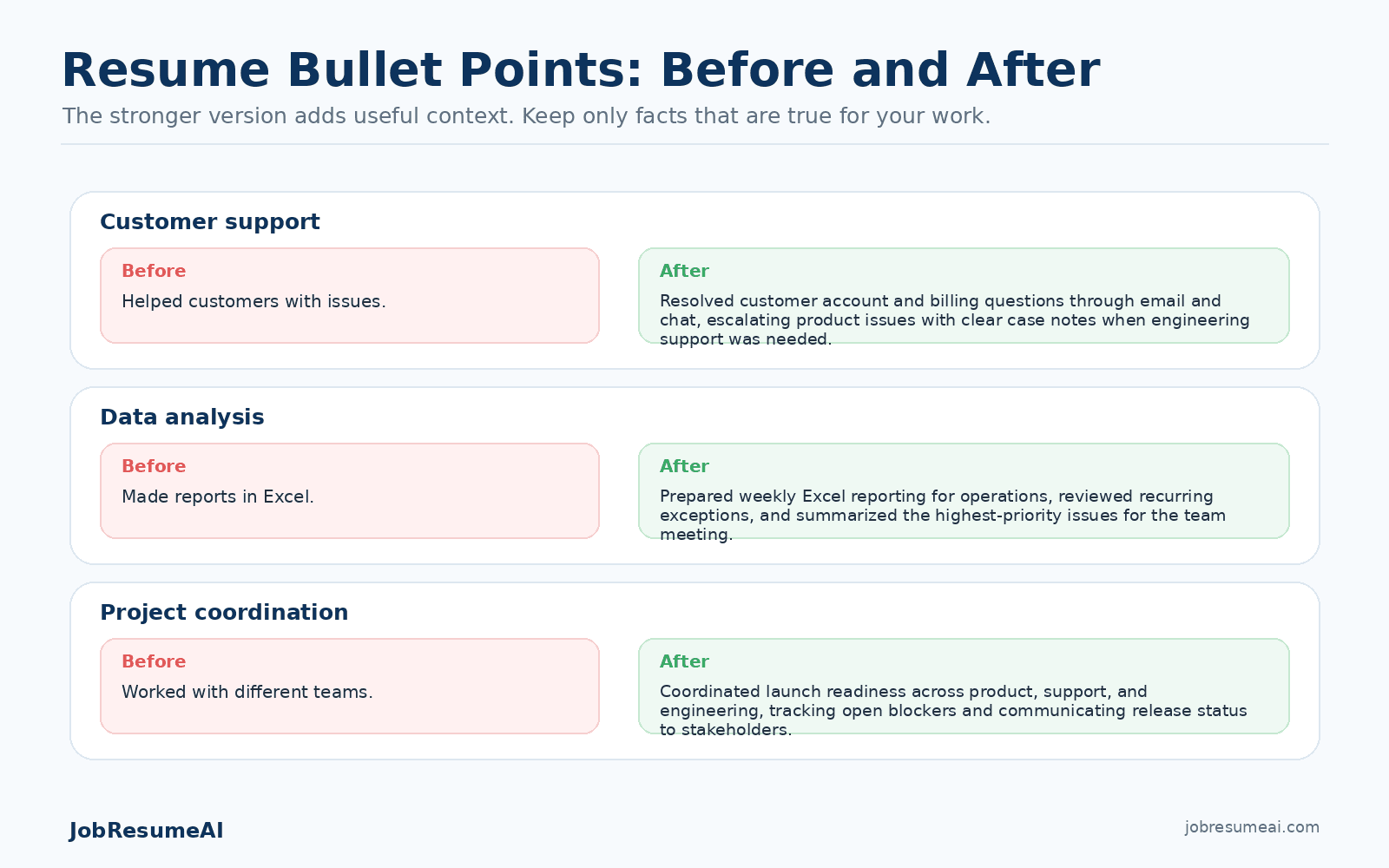
Use the stronger structure as a guide, but keep the tools, scope, responsibilities, and outcomes truthful to your own experience.
Use strong action verbs, but do not rely on verbs alone
Action verbs make ownership clearer, especially at the beginning of a bullet. Yale and Harvard both maintain career guidance encouraging active, specific verbs instead of vague responsibility language.
But replacing helped with spearheaded does not automatically improve a weak bullet. The verb must accurately match what you did, and the rest of the sentence still needs enough context to be credible.
- Use led only when you actually led.
- Use built or developed when you created something.
- Use analyzed when the work involved evaluation or interpretation.
- Use coordinated when your contribution was organizing people, work, or information.
- Use improved only when you can explain what became better.
- Avoid exaggerating ownership just to make the sentence sound more senior.
Common resume bullet-point mistakes
- Starting every bullet with Responsible for.
- Listing tools without explaining how they were used.
- Adding a percentage because the bullet feels weak without one.
- Using inflated verbs that overstate your role.
- Writing long paragraphs instead of concise bullets.
- Repeating the same responsibility in several bullets.
- Prioritizing impressive-sounding work that is not relevant to the target job.
- Copying wording from the job description without evidence from your background.
- Using vague phrases such as worked on, helped with, or various tasks when a more precise description is available.
Resume bullet checklist before you apply
- Does each bullet start with a clear, accurate action?
- Can a reader understand what you actually worked on?
- Is the scope or context clear enough to make the contribution meaningful?
- Did you include an outcome when you genuinely know it?
- Are any metrics accurate and defensible?
- Are the most job-relevant bullets easy to find?
- Did you remove unsupported tools, responsibilities, or achievements?
- Can you explain every bullet naturally in an interview?
Published by JobResumeAI
Further reading
Sources and references
These references were reviewed while preparing this guide. JobResumeAI may interpret or organize the guidance differently; the links below let you check the underlying advice yourself.