
Firefighter Resume: Examples, Skills & Keywords
Build a stronger firefighter resume with role-specific skills, emergency response experience, clear bullet examples, certifications, keywords, and ATS-friendly formatting.
Quick answer
A strong firefighter resume shows emergency-response experience, current credentials, and clear evidence of the work you can safely perform.
Start with the department or fire-service role you are applying for. Then make the most relevant experience easy to find. That may include fire suppression, search and rescue, emergency medical response, apparatus or equipment work, incident documentation, station duties, inspections, training, or public education.
Keep titles and credentials exact. Career firefighter, volunteer firefighter, EMT, paramedic, driver/operator, and wildland roles can overlap, but they are not interchangeable. If you supported a task under supervision, describe it that way. If a certification is expired, in progress, or not held, do not present it as current.
- Match the resume to the department's actual duties and minimum qualifications.
- List only certifications, licenses, and medical credentials you currently hold or can accurately explain.
- Show emergency-response duties in context instead of copying a generic firefighter job description.
- Use numbers only when you know them, such as call volume, training hours, inspections, or team size.
- Keep the layout simple so experience, credentials, and training are easy to scan.
On this page
What a firefighter resume needs to show
Make your response experience, training, credentials, and level of responsibility clear quickly.
Firefighter roles can cover much more than structural fire suppression. O*NET lists work such as rescue, first aid or emergency medical care, apparatus operation, response to accidents, equipment use, incident communication, training, and other emergency duties. The exact mix depends on the department, assignment, location, and certification level.
The U.S. Bureau of Labor Statistics reported about 355,300 paid firefighter jobs in 2025. It projects employment to reach about 368,400 by 2035, a 4% increase, with about 26,800 openings per year on average. The median annual wage was $59,280 in May 2025.
Those numbers describe the national firefighter occupation. They do not predict hiring at one department. BLS also notes that its paid-employment count excludes volunteer firefighters, so a volunteer role can still be important resume evidence when it is labelled accurately.
- If the role emphasizes
- Fire suppression
- Evidence you may prioritize
- Structure or wildland response, hose operations, ventilation, overhaul, water supply, fireground assignments you actually performed
- If the role emphasizes
- EMS response
- Evidence you may prioritize
- Patient assessment, first aid, CPR, basic or advanced life support, transport support, documentation within your credential and role
- If the role emphasizes
- Rescue
- Evidence you may prioritize
- Search and rescue, vehicle incidents, water rescue, technical rescue support, victim removal, scene safety when part of your training and duties
- If the role emphasizes
- Apparatus and equipment
- Evidence you may prioritize
- Daily checks, hose and tool readiness, pump or apparatus operation, SCBA checks, maintenance support, driver/operator duties when qualified
- If the role emphasizes
- Prevention and community work
- Evidence you may prioritize
- Inspections, public education, station tours, smoke-alarm programs, preincident planning, community events when you actually handled them
| If the role emphasizes | Evidence you may prioritize |
|---|---|
| Fire suppression | Structure or wildland response, hose operations, ventilation, overhaul, water supply, fireground assignments you actually performed |
| EMS response | Patient assessment, first aid, CPR, basic or advanced life support, transport support, documentation within your credential and role |
| Rescue | Search and rescue, vehicle incidents, water rescue, technical rescue support, victim removal, scene safety when part of your training and duties |
| Apparatus and equipment | Daily checks, hose and tool readiness, pump or apparatus operation, SCBA checks, maintenance support, driver/operator duties when qualified |
| Prevention and community work | Inspections, public education, station tours, smoke-alarm programs, preincident planning, community events when you actually handled them |
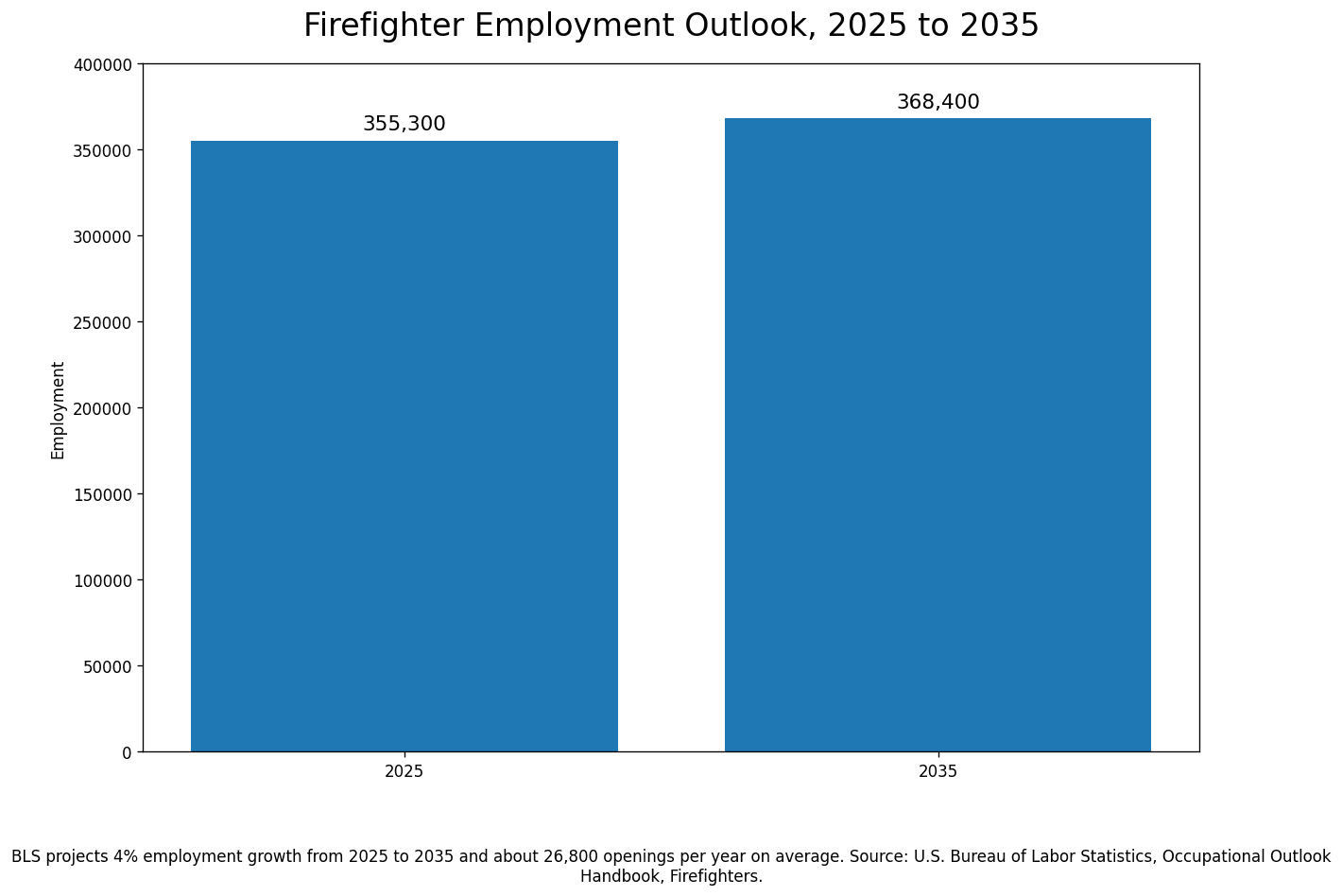
BLS projects 4% firefighter employment growth from 2025 to 2035 and about 26,800 openings per year on average.
Source: U.S. Bureau of Labor Statistics, Occupational Outlook Handbook, Firefighters
A clear firefighter resume structure
Fire-service hiring often involves several steps, so the resume should make basic qualifications easy to verify. A recruiter or department reviewer should not have to search for your certifications, fire-service experience, EMS background, or training.
Use a simple reading order. Keep the most relevant experience and current credentials near the top. Put older or less relevant work later, especially when it does not help explain your readiness for the target role.
- 1
Contact information
Use your name, phone, professional email, location, and a relevant professional link if you have one.
- 2
Professional summary or objective
Use a short summary when you have relevant experience. An objective can help an entry-level candidate explain the transition into fire service.
- 3
Certifications and licenses
List current fire, EMS, CPR, HazMat, driver/operator, or other credentials that matter for the posting. Use exact names and current status.
- 4
Skills
Keep the list focused on fire, EMS, rescue, equipment, communication, and technical skills that match the role and your actual background.
- 5
Experience
Separate career, volunteer, wildland, military fire, and EMS roles clearly. Show duties, scope, and useful outcomes without inflating titles.
- 6
Education and training
Include relevant education, academy training, fire science, department training, and completed courses when they strengthen the application.
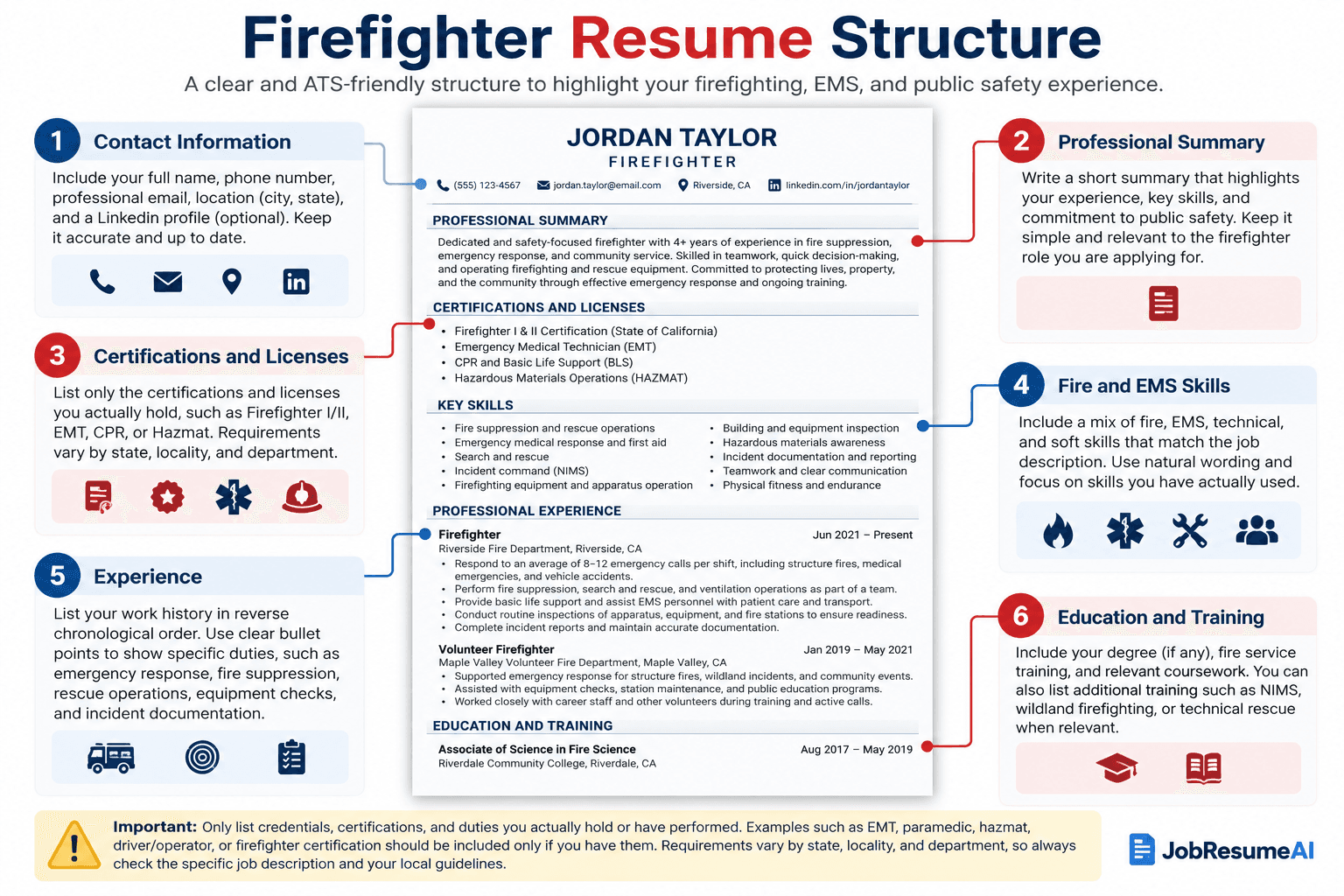
Keep credentials, emergency-response experience, and training easy to find, and use only titles and duties that match your real background.
Firefighter resume example
The example below is fictional. It shows one way to organize fire-service experience without pretending that every firefighter has the same duties or credentials.
Illustrative example
Firefighter
Use the structure as a reference only. Replace every credential, responsibility, call type, and result with information that is true for you.
Professional summary
Firefighter with municipal emergency-response experience supporting fire suppression, medical calls, rescue operations, equipment readiness, incident documentation, and public-safety activities. Current EMT certification and regular department training in fireground operations and incident response.
Selected skills
- Fire suppression and hose operations
- Search and rescue
- Emergency medical response
- SCBA and PPE use
- Apparatus and equipment checks
- Incident documentation
- Radio communication
- Team-based emergency response
Experience bullet example
Responded with the engine company to structure fires, medical calls, vehicle incidents, and other emergencies, carrying out assigned suppression, rescue, scene-support, and equipment tasks under department procedures.
Another experience bullet
Completed scheduled checks of SCBA, hose, hand tools, medical equipment, and assigned apparatus so deficiencies could be reported and corrected before emergency response.
Firefighter resume skills to prioritize
Choose skills from the target department and your real training rather than building a long generic list.
O*NET describes firefighter work across rescue, emergency medical care, firefighting equipment, response to accidents, communications, training, and incident operations. That is useful occupational context, but it is not a checklist for one resume.
The strongest skills section reflects the role you want. A firefighter-paramedic opening may give more weight to advanced medical response. A wildland position may focus on fireline work and extended incidents. A municipal role may combine structure fires, EMS, rescue, inspections, station duties, and community work.
- Skill area
- Fireground operations
- Examples when they are accurate for you
- Fire suppression, hose deployment, ventilation, overhaul, water supply, SCBA, PPE, fire behavior, scene safety
- Skill area
- Rescue
- Examples when they are accurate for you
- Search and rescue, vehicle incidents, victim removal, ladder operations, technical rescue support, water rescue when trained
- Skill area
- Emergency medical
- Examples when they are accurate for you
- First aid, CPR, patient assessment, BLS, ALS, medical documentation, transport support within your credential level
- Skill area
- Apparatus and equipment
- Examples when they are accurate for you
- Equipment inspections, hose and tool readiness, pump operations, apparatus checks, driver/operator duties when qualified
- Skill area
- Incident operations
- Examples when they are accurate for you
- Radio communication, incident command awareness, accountability, reports, scene coordination, mutual-aid operations
- Skill area
- Prevention and public service
- Examples when they are accurate for you
- Inspections, preincident planning, public education, community events, smoke-alarm programs, station tours when performed
| Skill area | Examples when they are accurate for you |
|---|---|
| Fireground operations | Fire suppression, hose deployment, ventilation, overhaul, water supply, SCBA, PPE, fire behavior, scene safety |
| Rescue | Search and rescue, vehicle incidents, victim removal, ladder operations, technical rescue support, water rescue when trained |
| Emergency medical | First aid, CPR, patient assessment, BLS, ALS, medical documentation, transport support within your credential level |
| Apparatus and equipment | Equipment inspections, hose and tool readiness, pump operations, apparatus checks, driver/operator duties when qualified |
| Incident operations | Radio communication, incident command awareness, accountability, reports, scene coordination, mutual-aid operations |
| Prevention and public service | Inspections, preincident planning, public education, community events, smoke-alarm programs, station tours when performed |
How to choose firefighter resume keywords
The best firefighter resume keywords come from the actual job posting. Start with required certifications, minimum qualifications, emergency duties, equipment, medical responsibilities, training, and department-specific terminology.
Use exact names when they are true. If the posting asks for EMT certification and you hold it, use the correct credential name. If it asks for paramedic and you are an EMT, do not use paramedic as a keyword. If the department lists a specific apparatus or rescue qualification you do not hold, leave it out.
- Keyword area
- Fire operations
- What to look for
- Fire suppression, structure fire, hose operations, ventilation, overhaul, wildland, fire behavior
- Resume action
- Show the work in experience when you have performed it
- Keyword area
- EMS
- What to look for
- EMT, paramedic, CPR, BLS, ALS, patient assessment, medical response
- Resume action
- Use only credentials and care levels you actually hold or performed
- Keyword area
- Rescue and special operations
- What to look for
- Search and rescue, vehicle extrication, HazMat, technical rescue, water rescue
- Resume action
- Include only training and duties that are accurate for you
- Keyword area
- Apparatus and equipment
- What to look for
- SCBA, pump operations, driver/operator, apparatus inspection, equipment maintenance
- Resume action
- Connect the term to real training or assigned work
- Keyword area
- Incident management
- What to look for
- ICS, NIMS, accountability, radio communication, incident reports, mutual aid
- Resume action
- Use completed training and actual incident duties without overstating command responsibility
| Keyword area | What to look for | Resume action |
|---|---|---|
| Fire operations | Fire suppression, structure fire, hose operations, ventilation, overhaul, wildland, fire behavior | Show the work in experience when you have performed it |
| EMS | EMT, paramedic, CPR, BLS, ALS, patient assessment, medical response | Use only credentials and care levels you actually hold or performed |
| Rescue and special operations | Search and rescue, vehicle extrication, HazMat, technical rescue, water rescue | Include only training and duties that are accurate for you |
| Apparatus and equipment | SCBA, pump operations, driver/operator, apparatus inspection, equipment maintenance | Connect the term to real training or assigned work |
| Incident management | ICS, NIMS, accountability, radio communication, incident reports, mutual aid | Use completed training and actual incident duties without overstating command responsibility |
Write firefighter resume bullet points around real incidents and responsibilities
A firefighter job description is usually written as a list of duties. Your resume should go one step further. Show what you did, where the work happened, what you were responsible for, and any useful scope you can state accurately.
Do not expose confidential patient details, names, addresses, or protected incident information. The goal is to explain your contribution, not recreate an incident report.
Fire suppression example
Instead of: Put out fires.
Stronger direction: Performed assigned hose, suppression, ventilation, overhaul, and scene-support tasks during structure-fire responses under department procedures.
EMS example
Instead of: Helped patients.
Stronger direction: Provided emergency medical care within EMT scope, completed patient assessment and basic interventions, and documented care according to department protocol.
Equipment example
Instead of: Checked equipment.
Stronger direction: Inspected assigned SCBA, hose, hand tools, and medical equipment at shift start and reported readiness issues for correction.
Too generic
“Responded to fires and emergencies and maintained equipment.”
Clearer evidence
“Responded to structure fires, medical calls, and vehicle incidents as part of an engine company, then completed assigned apparatus and equipment readiness checks between calls.”
How to show firefighter accomplishments without inventing numbers
Fire-service work is not always easy to reduce to a percentage. Safety, readiness, response, teamwork, training, inspections, and reliable execution can be meaningful evidence even when there is no sales-style metric.
Use numbers when you know them and when they add context. Examples include average call volume, completed inspections, training hours, equipment inventories, public-education events, recruits trained, or the number of stations or units supported. Do not estimate a number just because a resume formula asks for one.
- If you know this
- Call volume
- Useful resume evidence can show
- Approximate or verified emergency-call load when your department allows you to state it
- If you know this
- Training
- Useful resume evidence can show
- Completed training hours, drills, academy milestones, or continuing education when verified
- If you know this
- Inspections or public education
- Useful resume evidence can show
- Number of inspections, events, presentations, or community contacts when tracked
- If you know this
- Equipment responsibility
- Useful resume evidence can show
- Apparatus, tools, SCBA, medical gear, or inventory you routinely checked or maintained
- If you know this
- No reliable metric
- Useful resume evidence can show
- A specific duty, response type, readiness task, or team responsibility stated clearly
| If you know this | Useful resume evidence can show |
|---|---|
| Call volume | Approximate or verified emergency-call load when your department allows you to state it |
| Training | Completed training hours, drills, academy milestones, or continuing education when verified |
| Inspections or public education | Number of inspections, events, presentations, or community contacts when tracked |
| Equipment responsibility | Apparatus, tools, SCBA, medical gear, or inventory you routinely checked or maintained |
| No reliable metric | A specific duty, response type, readiness task, or team responsibility stated clearly |
How to list volunteer firefighter experience
Volunteer firefighter experience can be highly relevant, especially when it includes real emergency response, department training, equipment duties, public education, or station responsibilities. Keep the volunteer status clear. Do not rewrite it as paid career employment if it was not.
BLS notes that national employment figures for firefighters exclude volunteer firefighters. That makes accurate labelling even more important. A volunteer role is still fire-service experience. The resume should simply tell the employer what kind of experience it was.
- Use the actual department name and role title.
- Label the position Volunteer Firefighter when that is the correct title.
- Include dates and the duties you really performed.
- Show completed department training and current credentials separately.
- Do not imply independent authority, paid status, or certifications you did not hold.
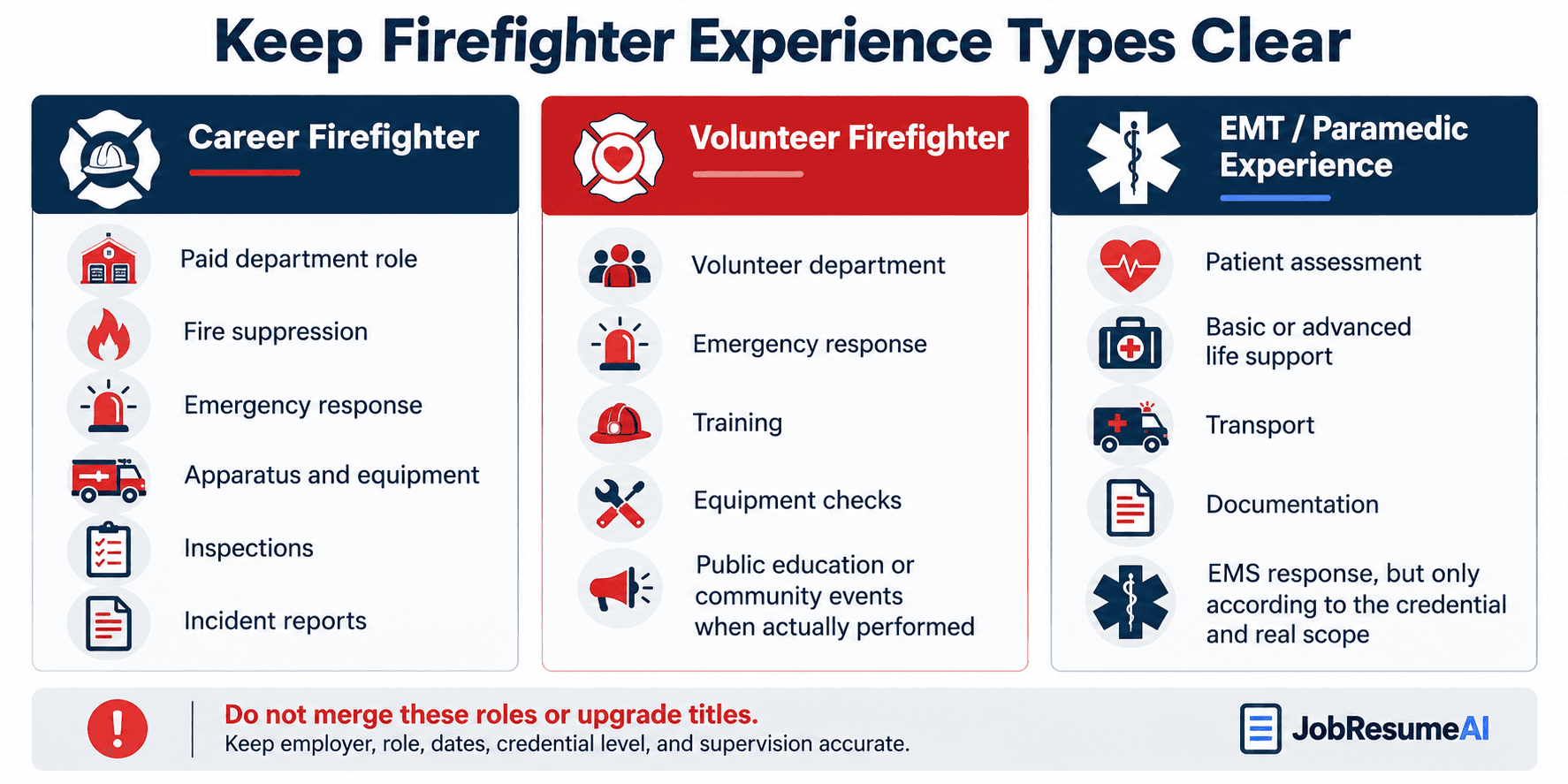
Career fire, volunteer fire, and EMS experience can support the same application, but titles, credentials, dates, and scope should remain accurate.
How to present EMT or paramedic experience on a firefighter resume
Many firefighter jobs involve medical response, but the required credential varies. BLS says firefighters typically need emergency medical services training and notes that EMT certification requirements vary by state or locality.
If you hold an EMT or paramedic credential, use its exact current title and status. Then show the medical work you actually performed. Keep the difference between basic and advanced life support clear. A firefighter with EMT experience should not present paramedic-level care unless the credential and duties are real.
- Background
- EMT
- How to present it
- List the current EMT credential and describe BLS care, assessment, first aid, CPR, documentation, and other duties within your real scope
- Background
- Paramedic
- How to present it
- List the current paramedic credential and describe ALS duties only when they were part of your actual role and authorized scope
- Background
- EMS experience outside the fire department
- How to present it
- Keep the EMS employer and job title separate, then emphasize transferable emergency-response and patient-care experience
- Background
- No medical credential yet
- How to present it
- Do not list EMT or paramedic as a skill. Show completed training that is accurate and relevant, and follow the target department's requirements
| Background | How to present it |
|---|---|
| EMT | List the current EMT credential and describe BLS care, assessment, first aid, CPR, documentation, and other duties within your real scope |
| Paramedic | List the current paramedic credential and describe ALS duties only when they were part of your actual role and authorized scope |
| EMS experience outside the fire department | Keep the EMS employer and job title separate, then emphasize transferable emergency-response and patient-care experience |
| No medical credential yet | Do not list EMT or paramedic as a skill. Show completed training that is accurate and relevant, and follow the target department's requirements |
Firefighter resume summary examples
A professional summary can help when you already have fire, EMS, military, wildland, or public-safety experience. Keep it short and specific. The summary should tell the reader what kind of emergency-response background you bring and what qualifications matter most for the target role.
Avoid broad claims such as brave, heroic, fearless, or highly dedicated. Those words do not prove readiness. Concrete experience, credentials, and responsibilities are more useful.
Illustrative examples
Summary directions for different firefighter backgrounds
Adapt the structure to your own role, certification level, department type, and emergency-response experience.
Career firefighter
Firefighter with municipal emergency-response experience in structure fires, medical calls, rescue operations, equipment readiness, incident documentation, and station duties. Current EMT certification with regular department training in fireground and EMS response.
Volunteer firefighter
Volunteer firefighter with experience supporting emergency response, fire suppression, equipment checks, department drills, and community-safety activities. Brings current fire-service training and a record of reliable participation in department operations.
Firefighter-paramedic
Firefighter-paramedic with combined fire suppression and advanced prehospital-care experience, including emergency assessment, ALS response, incident documentation, and coordinated fire/EMS operations. Use only if both the title and current paramedic credential are accurate.
Firefighter resume objective for entry-level candidates
An objective can help when you are applying for your first firefighter role and your strongest evidence comes from academy training, EMT work, military service, volunteering, athletics, public safety, skilled trades, or another background.
Keep the focus on what you already bring. Do not use most of the space to say that you want a rewarding career or want to help people. Departments already know why applicants are interested. The resume should explain what makes you ready to contribute.
Too generic
“Seeking a firefighter job where I can serve my community and grow my career.”
More specific
“Entry-level firefighter candidate with completed fire academy training and current EMT certification, bringing emergency medical response experience, strong physical readiness, and team-based safety training to a municipal fire department.”
How to write an entry-level firefighter resume with little or no fire-service experience
A first firefighter resume does not need to pretend that training is the same as paid fire-service experience. Instead, make the evidence you do have easy to understand. That may include academy training, EMT work, volunteer service, military experience, skilled trades, athletics, public safety, community service, or work that shows dependable team performance under pressure.
BLS says firefighters typically need a high school diploma and EMS training, and most receive fire-academy training. Requirements vary by state, locality, and department, so the job posting should decide which qualifications receive the most attention on your resume.
- Place current required certifications where the reviewer can find them quickly.
- Create a Training section for completed academy or department training when it is relevant.
- Use volunteer fire or EMS experience when it involved real duties, and label it accurately.
- Use transferable evidence from military, trades, public safety, athletics, or other roles when it supports teamwork, mechanical ability, communication, safety, or disciplined response.
- Do not rename an unrelated job to make it look like fire-service employment.
How to list firefighter certifications, licenses, and training
Firefighter requirements are not uniform across the United States. BLS notes that firefighters usually receive fire-academy training and that EMT requirements vary by state or locality. Your target department may also have its own minimum qualifications, testing rules, medical requirements, driver's-license rules, or preferred certifications.
For professional qualification standards, NFPA's current 2024 NFPA 1010 consolidates earlier standards for firefighter, apparatus driver/operator, airport firefighter, and land-based marine firefighter qualifications. That does not mean every department requires every NFPA credential. Use the job announcement and the authority that issued your credential as the source of truth.
FEMA also uses a progressive NIMS and Incident Command System training structure. The authority having jurisdiction decides how far personnel need to progress based on their role and incident complexity. So list completed ICS or NIMS courses accurately rather than implying a universal requirement.
- Credential or training area
- Firefighter certification
- Resume guidance
- Use the exact credential or academy completion you hold, including level and issuing authority when relevant
- Credential or training area
- EMT or paramedic
- Resume guidance
- List the exact current medical credential and state or issuing organization when useful
- Credential or training area
- CPR or BLS
- Resume guidance
- List current certifications when requested or relevant to the role
- Credential or training area
- HazMat or technical rescue
- Resume guidance
- Name only completed levels or qualifications you actually hold
- Credential or training area
- Driver/operator or apparatus qualification
- Resume guidance
- List only when trained, authorized, or credentialed as required by your department
- Credential or training area
- ICS or NIMS courses
- Resume guidance
- List completed course names or numbers when relevant to the posting; do not imply command authority from course completion alone
| Credential or training area | Resume guidance |
|---|---|
| Firefighter certification | Use the exact credential or academy completion you hold, including level and issuing authority when relevant |
| EMT or paramedic | List the exact current medical credential and state or issuing organization when useful |
| CPR or BLS | List current certifications when requested or relevant to the role |
| HazMat or technical rescue | Name only completed levels or qualifications you actually hold |
| Driver/operator or apparatus qualification | List only when trained, authorized, or credentialed as required by your department |
| ICS or NIMS courses | List completed course names or numbers when relevant to the posting; do not imply command authority from course completion alone |
Keep the firefighter resume ATS-friendly and easy to review
A firefighter resume still needs readable text and a clear structure. Use standard headings, normal selectable text, consistent dates, and simple formatting. Important certifications should not be hidden inside icons or graphics.
JobResumeAI's analysis of 2,226 resume checks found formatting warnings were less common than job-alignment gaps in that self-selected sample. That does not make formatting unimportant. It means a clean file still needs accurate job-specific evidence.
- Use headings such as Summary, Certifications, Skills, Experience, Education, and Training.
- Keep department names, job titles, and dates together.
- Write certifications and course names as normal text.
- Avoid graphical skill bars or icons as the only place important qualifications appear.
- Follow the application instructions for PDF, DOCX, or another accepted format.
- Use job-description terminology naturally when it accurately matches your experience.
Tailor the firefighter resume to the actual department opening
Firefighter openings can look similar while placing very different weight on EMS, apparatus operation, HazMat, wildland response, rescue, prevention, public education, or prior department experience. The job announcement should decide what you emphasize.
Tailoring changes priority, not history. If the opening requires EMT and you hold it, make that credential easy to find. If it prefers paramedic and you are not a paramedic, do not add the term. If the role emphasizes driver/operator experience and you have it, move the strongest related evidence higher.
Illustrative tailoring example
Municipal firefighter role emphasizing EMS and apparatus readiness
The candidate already has the experience below. The tailoring step changes emphasis, not facts.
Job emphasizes
- Current EMT certification
- Medical calls
- Apparatus and equipment checks
- Fire suppression
Resume already contains
- Current EMT certification
- BLS response experience
- Daily engine and equipment checks
- Structure-fire response
Tailoring action
Move the EMT credential and medical-response evidence higher, then keep apparatus readiness and fire-suppression duties visible in the first experience entry.
Do not do
Do not add paramedic, HazMat technician, driver/operator, or another qualification simply because the posting prefers it if you do not hold it.
How much older fire-service experience should you keep?
Older fire-service experience can still matter when it shows qualifications that remain relevant, such as apparatus work, leadership, rescue training, fire prevention, or a long record in a specific department type. It does not always need the same detail as your current role.
Give the most space to recent and relevant experience. Earlier jobs can be shortened when they repeat duties already proven in newer roles. Keep required credentials, major qualifications, and important earlier assignments when they still help the target application.
Common firefighter resume mistakes
- Copying a generic firefighter job description into the experience section.
- Listing EMT, paramedic, HazMat, driver/operator, or technical-rescue credentials you do not currently hold.
- Blending volunteer service, paid fire-service work, and EMS employment so the reader cannot tell which role involved which duties.
- Using firefighter-paramedic as a title when you were not employed or credentialed in that role.
- Writing only broad traits such as brave, hardworking, disciplined, or team player instead of showing relevant work.
- Publishing patient details, incident addresses, names, or other sensitive information in bullet points.
- Inventing call volume, response times, lives saved, property value, or other metrics that you cannot verify.
- Hiding certifications in graphics instead of writing them as normal text.
- Giving every old job equal space even when recent fire-service experience is much more relevant.
- Sending the same resume to departments with different certification and duty requirements.
Common questions about firefighter resumes
What should a firefighter put on a resume?
Prioritize current credentials, relevant fire or EMS experience, emergency-response duties, rescue or equipment work, training, education, and transferable experience that directly supports the target opening. Use the department's job announcement to decide what belongs near the top.
What are good skills for a firefighter resume?
Good skills are the ones the role requires and you can support. Depending on the job, that may include fire suppression, search and rescue, emergency medical response, SCBA, apparatus checks, radio communication, incident documentation, HazMat awareness, inspections, or public education. Do not use a skill just because it appears on a sample resume.
Should I put volunteer firefighter experience on my resume?
Yes, when it is relevant. Label it as volunteer service and show the duties, training, and emergency response you actually performed. Do not present the role as paid career employment if it was not.
How do I write a firefighter resume with no experience?
Use relevant academy training, current certifications, EMT or other emergency-service work, volunteering, military service, skilled trades, public safety, athletics, or other experience that proves useful skills. Keep training and employment clearly separated.
Should I include EMT or paramedic on a firefighter resume?
Include the exact current credential when you hold it and it is relevant. Keep EMT and paramedic distinct because they represent different training and scope. If the credential is expired or not yet earned, do not present it as current.
Does a firefighter resume need an objective?
Not always. An objective can help an entry-level candidate connect training or transferable experience to the fire-service role. Experienced firefighters can usually use a short professional summary instead, or skip both when the rest of the resume is already clear.
Can a firefighter resume be two pages?
Yes, when the second page contains useful evidence such as relevant fire-service roles, EMS experience, training, certifications, leadership, or specialized assignments. Do not force one page by removing important qualifications or using very small text.
What is the current NFPA firefighter qualification standard?
NFPA 1010 is the current 2024 Standard on Professional Qualifications for Firefighters and consolidates several earlier standards. A department may use its own state, local, academy, or certification requirements, so check the specific job announcement rather than assuming one national credential applies everywhere.
Firefighter resume checklist before you apply
- Does the resume clearly match the type of firefighter role and department you are targeting?
- Are current required certifications and licenses easy to find?
- Are career, volunteer, EMS, wildland, and other experience types labelled accurately?
- Do important fire, rescue, EMS, and equipment skills appear in context instead of only in a skills list?
- Do experience bullets explain your actual duties instead of copying a generic job description?
- Are medical and technical responsibilities limited to your real credential and scope?
- Are numbers and accomplishments accurate and defensible?
- Did you avoid patient details and other sensitive incident information?
- Is the document structured clearly for both reviewers and applicant tracking systems?
- Can you explain every important credential, duty, and claim naturally in an interview or background process?
Published by JobResumeAI
Further reading
Sources and references
These references were reviewed while preparing this guide. JobResumeAI may interpret or organize the guidance differently; the links below let you check the underlying advice yourself.
- U.S. Bureau of Labor StatisticsFirefighters, Occupational Outlook Handbook (opens in a new tab)
- O*NET OnLineFirefighters, 33-2011.00 (opens in a new tab)
- National Fire Protection AssociationNFPA 1010, Standard on Professional Qualifications for Firefighters (opens in a new tab)
- FEMA National Disaster and Emergency Management UniversityICS Training Based on Role and Incident Complexity (opens in a new tab)