
Accomplishments for Resume: 120+ Examples & How to Write Them
See 120+ accomplishments for a resume, learn how to turn duties into achievements, quantify results honestly, and download practical examples and worksheets.
Quick answer
A resume accomplishment shows what you did and why the work mattered.
A responsibility tells the reader what your job included. An accomplishment adds evidence: what you changed, delivered, improved, solved, supported, or made easier. The result can be a number, but it does not have to be.
Start with work you actually did. Add useful context, such as the people, process, tool, scope, or problem involved. Then show the result when you know it. If you do not have a reliable metric, describe the concrete outcome instead of inventing one.
- Use accomplishments inside experience and project bullets rather than relying on a separate achievements section.
- Numbers are useful when they are real, but a specific outcome without a number can still be strong.
- Do not claim a team result as your personal result without explaining your contribution.
- Choose accomplishments that matter for the job you are targeting, not every success from your career.
On this page
What counts as an accomplishment on a resume?
An accomplishment is useful evidence of contribution, not just a big award or a record-breaking result.
Many people hear the word accomplishment and think they need a promotion, a major award, or a huge revenue number. That is too narrow. A useful resume accomplishment can be much smaller: fixing a recurring problem, making a process easier to follow, finishing important work on time, training someone, preventing an error, improving a handoff, or creating something the team kept using.
Yale career guidance describes accomplishment statements as resume bullets that show achievements, results, and successes rather than only listing responsibilities. UC Davis teaches a similar idea with an action, context, and result framework. The point is not to make ordinary work sound dramatic. It is to make your contribution easier to understand.
The best accomplishments for a resume are also relevant. A result can be impressive and still take up valuable space if it has little to do with the job you want next.
- Type of accomplishment
- Improvement
- What it can look like
- Made something faster, clearer, cheaper, safer, or more reliable
- Example
- Reduced weekly reporting time by automating repetitive cleanup steps.
- Type of accomplishment
- Delivery
- What it can look like
- Completed or launched useful work
- Example
- Created a shared onboarding checklist used by managers and IT.
- Type of accomplishment
- Problem solving
- What it can look like
- Found and fixed a recurring issue
- Example
- Identified the source of repeated invoice errors and corrected the coding process.
- Type of accomplishment
- Scale or ownership
- What it can look like
- Handled meaningful volume or responsibility
- Example
- Coordinated calendars for 5 leaders and resolved scheduling conflicts before weekly meetings.
- Type of accomplishment
- Support or enablement
- What it can look like
- Helped other people work more effectively
- Example
- Trained 4 new team members on ticket workflow and escalation rules.
- Type of accomplishment
- Recognition
- What it can look like
- Received a formal award or positive result
- Example
- Selected for a quarterly service award based on documented customer feedback.
| Type of accomplishment | What it can look like | Example |
|---|---|---|
| Improvement | Made something faster, clearer, cheaper, safer, or more reliable | Reduced weekly reporting time by automating repetitive cleanup steps. |
| Delivery | Completed or launched useful work | Created a shared onboarding checklist used by managers and IT. |
| Problem solving | Found and fixed a recurring issue | Identified the source of repeated invoice errors and corrected the coding process. |
| Scale or ownership | Handled meaningful volume or responsibility | Coordinated calendars for 5 leaders and resolved scheduling conflicts before weekly meetings. |
| Support or enablement | Helped other people work more effectively | Trained 4 new team members on ticket workflow and escalation rules. |
| Recognition | Received a formal award or positive result | Selected for a quarterly service award based on documented customer feedback. |
Resume accomplishments vs. responsibilities
A responsibility says what the role covered. An accomplishment shows your contribution within that responsibility.
Responsibilities still belong on a resume because the reader needs to understand what kind of work you did. The problem is a resume that stops there. Phrases such as responsible for reporting or helped customers do not show what you handled, what changed, or why the work mattered.
A stronger version does not need to sound bigger. It needs to be more specific. Keep the facts the same, name the action clearly, and add useful context or an outcome when you know it.
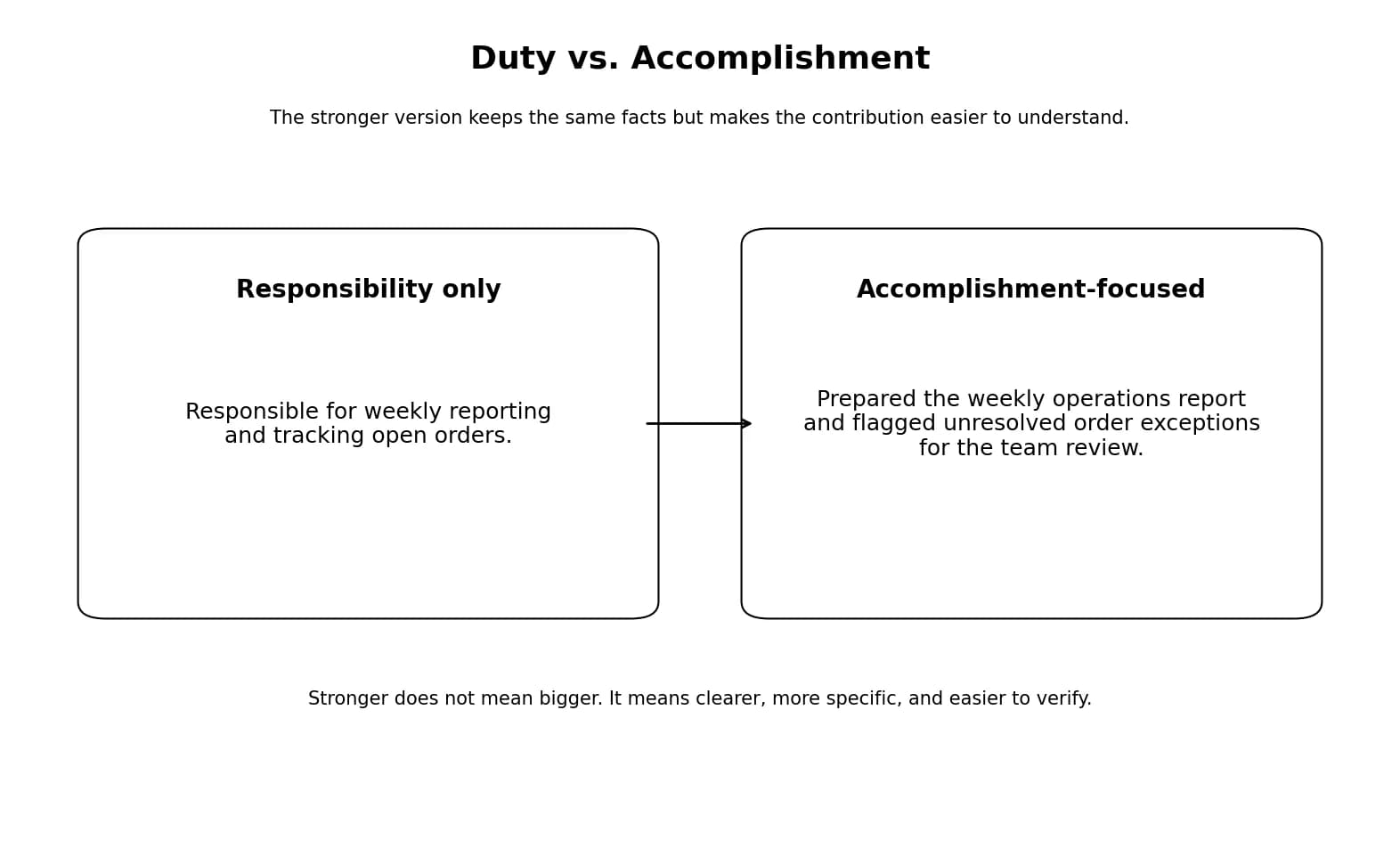
Stronger wording should make the contribution clearer without changing the facts.
Responsibility only
“Responsible for weekly reporting and tracking open orders.”
Accomplishment-focused
“Prepared the weekly operations report and flagged unresolved order exceptions for the team review.”
How to find accomplishments when your job felt ordinary
Start with moments where your work changed something, solved something, supported someone, or made the next step easier.
Most people do not keep a list of achievements while they work. That is why a blank page can make it feel like there is nothing to write. Instead of asking, What were my biggest accomplishments?, ask smaller questions about the work you already remember.
Look through old calendars, project notes, performance reviews, reports, dashboards, tickets, customer feedback, launch documents, and training materials when you are allowed to use them. You are looking for evidence, not perfect wording yet.
- What did you make faster, easier, safer, clearer, more accurate, or more reliable?
- What problems did people come to you to solve?
- What did you create, launch, organize, repair, document, or improve?
- Where did you save time, reduce rework, prevent an error, or remove a blocker?
- What work did you own that other people depended on?
- What changed because you trained, supported, or coordinated other people?
- What did you deliver on time, under pressure, or with limited resources?
- What are you proud of that would not be obvious from your job title?
A simple formula for writing resume accomplishments
Use action + context + result as a guide, not a rigid sentence template.
UC Davis recommends an accomplishment-statement formula built around an action verb, context, and result. Yale teaches a closely related action, project, and result approach. These frameworks are useful because they force you to explain the work before you polish the sentence.
You do not need all three parts in exactly the same order. Sometimes the result belongs first. Sometimes context is only a few words. The goal is a bullet that a reader can understand quickly and that you can defend in an interview.
- 1
Write the action in plain words
Start with what you personally did. Do not upgrade helped into led unless you actually led the work.
- 2
Add the context that makes the action meaningful
Name the process, customer, team, tool, frequency, scale, problem, or setting when it helps the reader understand the work.
- 3
Add the result or value
Use a verified number when you have one. If you do not, describe what was delivered, improved, fixed, clarified, prevented, or made easier.
- 4
Cut anything the reader does not need
A resume bullet is not a project report. Keep the details that prove relevance and remove the rest.
- 5
Check the claim for truth
Make sure every number, scope statement, tool, and result matches what actually happened.
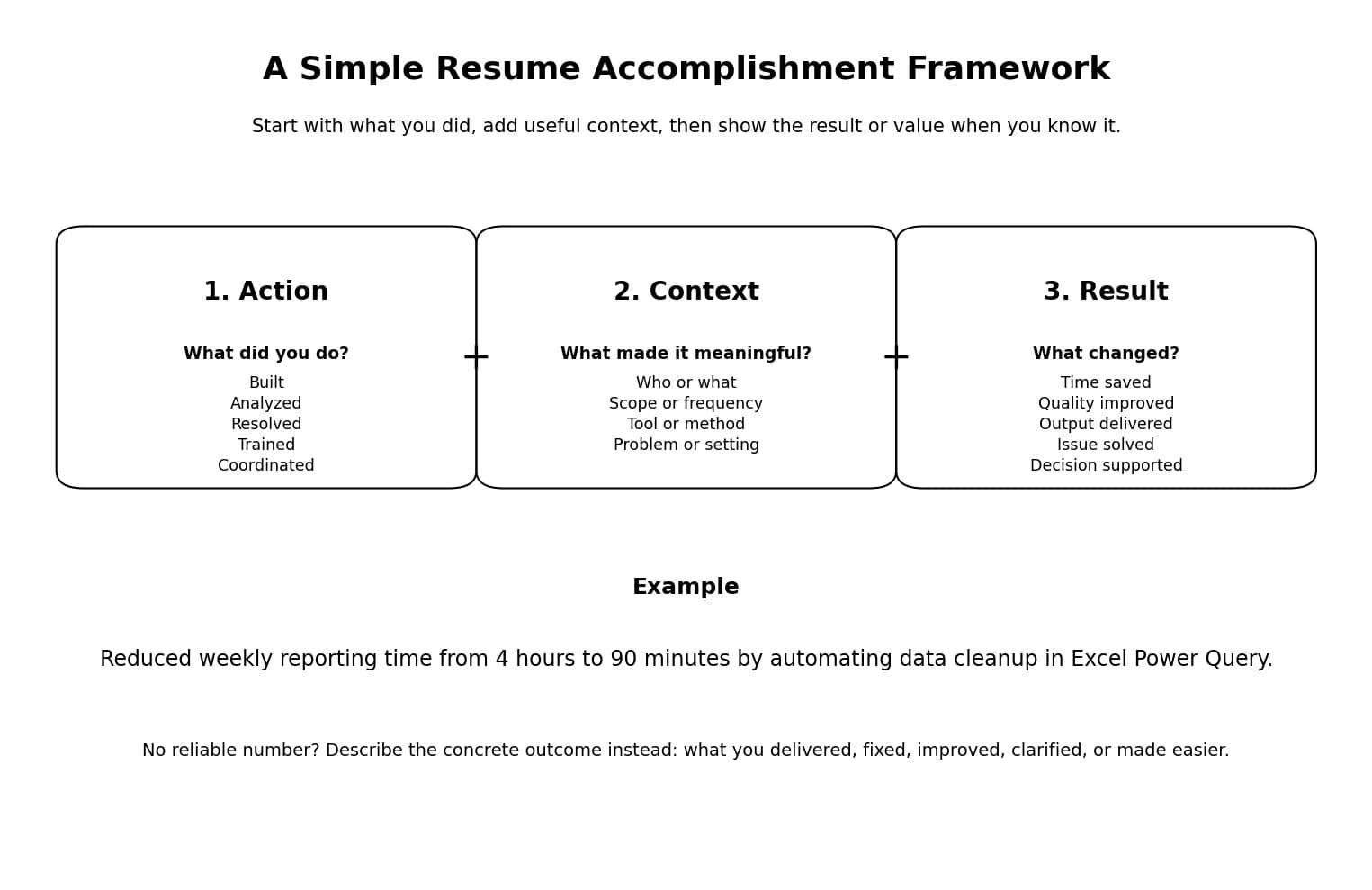
Use action, context, and result to organize the facts before you worry about perfect wording.
Do resume accomplishments need numbers?
No. Numbers can make scale easier to understand, but only when they are real and meaningful.
In JobResumeAI's 2026 analysis of 2,225 detailed resume checks, some form of quantifiable impact was detected in 64.0% of checks. The remaining 36.0% did not show quantifiable impact under the diagnostic.
That does not mean 36% of resumes were bad, and it does not mean every bullet should contain a percentage. The useful takeaway is narrower: many resumes could not show scale or measurable impact through the diagnostic, so candidates should check whether they have real numbers available before giving up on them.
Metrics are most useful when they answer a question the reader naturally has: how much, how many, how often, how fast, how large, how much money, how much time, or how much change?
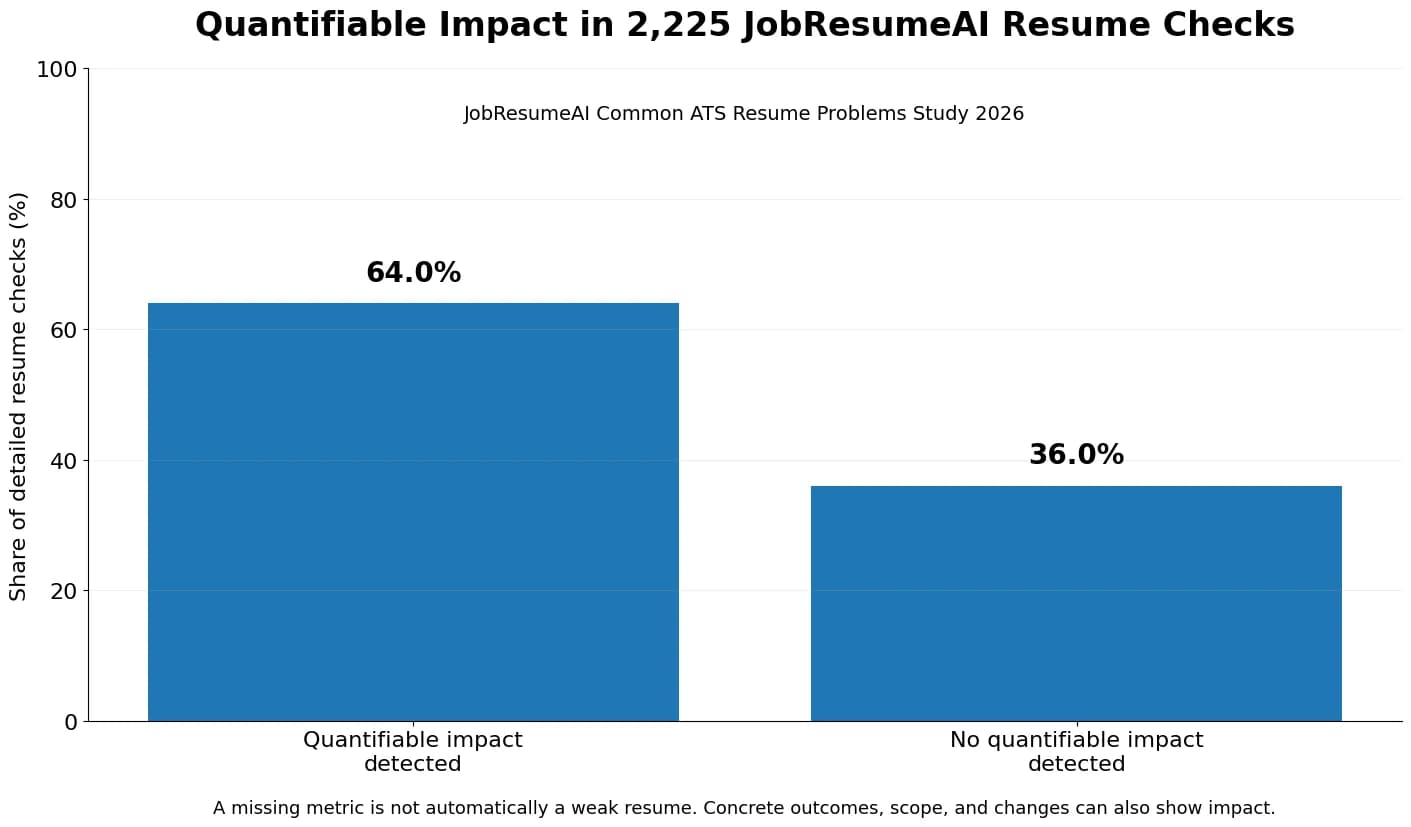
JobResumeAI detected some quantifiable impact in 64.0% of detailed checks and none in 36.0%. This is diagnostic data, not employer outcome data.
Source: JobResumeAI, Common ATS Resume Problems Study 2026
How to quantify resume achievements without making numbers up
Do not start by inventing a percentage because a resume article told you to quantify everything. Start with records you can actually verify. Good sources can include dashboards, schedules, sales reports, ticket counts, project plans, calendars, invoices, budgets, customer records, training rosters, and your own documented workload.
When you cannot verify an exact historical number, use honest scope instead of false precision. About 40 calls a day can be appropriate if that is a reasonable figure you genuinely remember and can explain. A made-up 37% improvement is not.
- What you can quantify
- Volume
- Questions to ask
- How many customers, tickets, invoices, records, users, reports, or transactions?
- Example
- Processed about 60 invoices each week and flagged missing purchase-order details before approval.
- What you can quantify
- Time
- Questions to ask
- How long did the task take before and after? How often did it happen?
- Example
- Reduced weekly report preparation from 4 hours to 75 minutes by automating cleanup steps.
- What you can quantify
- Money
- Questions to ask
- What revenue, budget, savings, spend, cost, or contract value was involved?
- Example
- Managed a $180,000 annual event budget and tracked vendor commitments against approved spend.
- What you can quantify
- Quality
- Questions to ask
- Did errors, defects, rework, complaints, or failed checks change?
- Example
- Cut duplicate CRM records by standardizing the intake and merge process.
- What you can quantify
- Growth
- Questions to ask
- Did users, followers, subscribers, pipeline, attendance, or adoption change?
- Example
- Grew the newsletter from 8,400 to 11,200 subscribers through lead magnets and partner promotions.
- What you can quantify
- Scope
- Questions to ask
- How many people, locations, teams, systems, accounts, or projects were involved?
- Example
- Coordinated onboarding schedules for 18 new hires across HR, IT, and department managers.
| What you can quantify | Questions to ask | Example |
|---|---|---|
| Volume | How many customers, tickets, invoices, records, users, reports, or transactions? | Processed about 60 invoices each week and flagged missing purchase-order details before approval. |
| Time | How long did the task take before and after? How often did it happen? | Reduced weekly report preparation from 4 hours to 75 minutes by automating cleanup steps. |
| Money | What revenue, budget, savings, spend, cost, or contract value was involved? | Managed a $180,000 annual event budget and tracked vendor commitments against approved spend. |
| Quality | Did errors, defects, rework, complaints, or failed checks change? | Cut duplicate CRM records by standardizing the intake and merge process. |
| Growth | Did users, followers, subscribers, pipeline, attendance, or adoption change? | Grew the newsletter from 8,400 to 11,200 subscribers through lead magnets and partner promotions. |
| Scope | How many people, locations, teams, systems, accounts, or projects were involved? | Coordinated onboarding schedules for 18 new hires across HR, IT, and department managers. |
Strong accomplishments without numbers
A concrete outcome can still be useful when no reliable metric exists.
Some work produces clear value that is difficult to measure. A nurse may clarify discharge instructions. An administrator may surface a renewal date before a contract auto-renews. An engineer may fix a production issue that stops recurring failures. None of those accomplishments becomes weak just because the exact dollar value is unknown.
When there is no trustworthy number, name the output, change, decision, problem solved, or process improved. Specific nouns often do more work than a fake metric.
- Instead of
- Helped with vendor contracts
- Show the concrete outcome
- Created a vendor renewal calendar and surfaced notice dates before renewal deadlines.
- Instead of
- Improved communication
- Show the concrete outcome
- Documented launch decisions, owners, and follow-up actions so teams had one current status view.
- Instead of
- Solved customer problems
- Show the concrete outcome
- Identified a recurring billing confusion and sent examples to the product team, leading to clearer invoice wording.
- Instead of
- Worked on documentation
- Show the concrete outcome
- Wrote a setup and troubleshooting guide that new team members used during onboarding.
- Instead of
- Supported patient care
- Show the concrete outcome
- Coordinated follow-up appointments and referral records so patients left with clear next steps.
| Instead of | Show the concrete outcome |
|---|---|
| Helped with vendor contracts | Created a vendor renewal calendar and surfaced notice dates before renewal deadlines. |
| Improved communication | Documented launch decisions, owners, and follow-up actions so teams had one current status view. |
| Solved customer problems | Identified a recurring billing confusion and sent examples to the product team, leading to clearer invoice wording. |
| Worked on documentation | Wrote a setup and troubleshooting guide that new team members used during onboarding. |
| Supported patient care | Coordinated follow-up appointments and referral records so patients left with clear next steps. |
120 resume accomplishment examples by job and situation
Use these as patterns for structure and specificity. Every example is fictional, so replace the facts with your own.
The examples below cover common job families and early-career situations. They are not sentences to copy into your resume. A good accomplishment is only useful when the underlying work, scope, tools, and result are true for you.
Notice that some examples use numbers and some do not. Both can work. The stronger examples make the contribution concrete.
Administrative Assistant accomplishment examples
- Coordinated calendars for 5 leaders and reduced double-booked meetings by creating one shared scheduling process.
- Prepared weekly meeting packets and distributed final agendas at least 24 hours before recurring leadership meetings.
- Reorganized digital records by department and year, cutting the time staff spent locating archived files.
- Processed an average of 65 invoices each week and flagged mismatched purchase orders before approval.
- Created a travel checklist that reduced last-minute itinerary changes for recurring client visits.
- Standardized office supply ordering and consolidated vendor requests into one monthly purchase cycle.
- Built an Excel tracker for open requests so managers could see owners, deadlines, and unresolved items in one place.
- Coordinated onboarding schedules for 18 new hires across HR, IT, and department managers.
- Updated contact and vendor records after a system cleanup, removing duplicate entries and outdated information.
- Prepared monthly expense summaries and identified missing receipts before reports were sent to finance.
Software Engineer accomplishment examples
- Reduced API response time by 28% by caching repeated database queries and removing duplicate calls.
- Built an automated test suite for a billing service, increasing coverage from 61% to 84%.
- Migrated a legacy deployment workflow to CI/CD and cut routine release preparation from about 45 minutes to 12 minutes.
- Resolved a recurring memory leak in a background worker that had caused overnight processing failures.
- Designed a reusable authentication middleware used across 6 internal services.
- Added structured logging to a payments service, making production errors easier to trace during incident reviews.
- Partnered with product and support to reproduce a customer-reported defect and shipped a fix in the next patch release.
- Refactored a reporting module into smaller components, reducing duplicate code and simplifying future changes.
- Documented local setup and common debugging steps, helping new engineers get the service running without repeated team support.
- Reviewed pull requests for a 7-person engineering team and focused feedback on correctness, maintainability, and test coverage.
Data Analyst accomplishment examples
- Automated a weekly sales report in SQL and Excel, reducing manual preparation from 4 hours to 75 minutes.
- Built a Power BI dashboard that combined pipeline, conversion, and revenue metrics for weekly leadership reviews.
- Cleaned and standardized 120,000 customer records before a CRM migration, reducing duplicate and invalid entries.
- Identified a reporting logic error that had overstated one regional KPI and corrected the historical dashboard calculation.
- Created a recurring quality check that flagged missing product codes before data reached the monthly report.
- Analyzed support-volume patterns and found two time windows responsible for the largest queue spikes.
- Combined survey and account data to show which customer segment had the highest renewal risk.
- Wrote documentation for 14 recurring metrics so analysts used the same definitions across dashboards.
- Built a forecasting workbook that replaced separate team spreadsheets and gave operations one shared planning view.
- Presented monthly findings to sales and operations leaders and answered follow-up questions on metric definitions and data limits.
Sales accomplishment examples
- Closed $420,000 in new annual contract value across 11 mid-market accounts in one year.
- Increased qualified discovery meetings by 22% after reorganizing outreach by industry and account priority.
- Reactivated 9 dormant accounts by reviewing prior objections and rebuilding contact with new stakeholders.
- Built a follow-up cadence that reduced the number of opportunities with no next step in the CRM.
- Partnered with solutions engineering on 14 technical demos for prospects with complex integration requirements.
- Renewed a portfolio of 38 accounts while documenting expansion risks and next actions before quarterly reviews.
- Created a simple objection library from call notes that gave new representatives examples for common buyer concerns.
- Improved CRM data quality by updating close dates, next steps, and contact roles during weekly pipeline reviews.
- Generated $96,000 in expansion revenue by identifying additional team use cases during account reviews.
- Mentored 2 new representatives on discovery calls, follow-up notes, and opportunity hygiene during their first quarter.
Customer Service accomplishment examples
- Resolved an average of 45 customer requests per day across phone, email, and chat while maintaining complete case notes.
- Reduced repeat questions by creating 12 help-center drafts based on the issues customers asked about most often.
- Identified a recurring billing confusion and shared examples with the product team, which led to clearer invoice wording.
- Handled escalated delivery complaints and coordinated replacements with warehouse staff until each case had a clear next step.
- Created a tag guide for the support queue so agents categorized similar issues more consistently.
- Trained 4 new team members on ticket workflow, account verification, and escalation rules.
- Compiled a weekly list of unresolved cases so supervisors could assign owners before the backlog grew.
- Recovered 6 at-risk customer relationships by coordinating follow-up between support and account management.
- Updated saved replies to remove outdated policy language and make common responses easier to understand.
- Flagged a pattern of failed password-reset emails that helped the engineering team reproduce and fix the issue.
Marketing and Social Media accomplishment examples
- Increased organic social engagement by 31% over 6 months by shifting the content mix toward short-form video and customer examples.
- Built a 90-day content calendar that aligned product launches, educational posts, and campaign deadlines across 3 channels.
- Reduced paid social cost per lead by 18% after testing new audience segments and pausing low-performing creative.
- Grew an email newsletter from 8,400 to 11,200 subscribers through lead magnets and partner promotions.
- Created a campaign reporting template that combined spend, leads, conversion rate, and revenue in one weekly view.
- Coordinated 7 creator partnerships from outreach through content approval and final performance reporting.
- Repurposed webinar material into 18 social posts, 4 email sends, and 2 blog updates for the same campaign.
- Improved landing-page conversion from 3.8% to 4.6% after testing a shorter form and clearer call to action.
- Built a social response guide that helped the team handle common questions and escalations with a consistent brand voice.
- Analyzed top-performing posts each month and used the findings to adjust topics, hooks, and posting times.
Project Management and Operations accomplishment examples
- Coordinated a 5-team product launch and kept 42 cross-functional tasks on schedule through a shared risk and dependency tracker.
- Reduced weekly status-meeting time from 60 to 35 minutes by moving routine updates into a written pre-read.
- Created a vendor renewal calendar that prevented missed notice dates across 27 active contracts.
- Standardized project intake so new requests included an owner, target date, scope, and success criteria before planning began.
- Recovered a delayed implementation by re-sequencing dependencies and securing decisions on the 3 blocked workstreams.
- Built a monthly capacity view that helped managers identify overloaded teams before committing to new work.
- Documented the handoff between sales and implementation, reducing repeated clarification requests after contract signature.
- Consolidated 4 separate project trackers into one portfolio view for leadership reporting.
- Facilitated post-launch reviews and turned recurring issues into owners and follow-up actions instead of meeting notes only.
- Negotiated a revised vendor timeline that kept the critical launch date intact without adding rush fees.
Accounting and Finance accomplishment examples
- Reconciled 24 balance-sheet accounts each month and resolved aging differences before close sign-off.
- Reduced month-end spreadsheet rework by creating a standardized journal-entry support template.
- Identified duplicate vendor payments during an accounts-payable review and coordinated corrections before the next payment run.
- Prepared monthly variance explanations for operating expenses and flagged unusual changes for department managers.
- Built an Excel schedule for prepaid expenses that replaced manual roll-forwards across multiple tabs.
- Cleared a backlog of 180 unreconciled transactions by grouping recurring issues and resolving them by source.
- Improved audit readiness by organizing supporting documents to match the trial balance and requested sample list.
- Created a cash forecast that combined expected receipts, payroll, vendor payments, and recurring obligations.
- Standardized invoice coding guidance for frequent vendors, reducing corrections during account review.
- Partnered with operations to correct cost-center assignments that had been distorting departmental reporting.
Healthcare Support accomplishment examples
- Prepared exam rooms and restocked supplies before each clinic session so providers could begin visits without setup delays.
- Collected and documented patient vital signs for scheduled visits following clinic procedure.
- Coordinated follow-up appointments and referral records so patients left with clear next steps.
- Reviewed the next-day schedule and identified missing forms before patient arrival.
- Updated patient contact and insurance information during intake, reducing incomplete records at checkout.
- Sterilized and packaged instruments according to clinic protocol and documented required cycle records.
- Created a restock checklist for frequently used supplies and flagged low inventory before it affected clinic flow.
- Handled patient calls about scheduling and routed clinical questions to the appropriate licensed staff member.
- Organized incoming records by patient and visit date so clinicians could find outside documentation quickly.
- Trained 2 new support staff on room turnover, scheduling workflow, and documentation expectations.
Nursing and Clinical accomplishment examples
- Coordinated discharge teaching for patients with new medications and documented questions requiring provider follow-up.
- Reviewed care-plan tasks at shift start and escalated time-sensitive changes in patient status to the appropriate clinician.
- Improved handoff consistency by using a structured shift-report checklist for high-risk patients.
- Participated in a unit review of fall events and helped update the bedside risk reminder process.
- Precepted 3 newly hired nurses during orientation on unit workflow, documentation, and escalation procedures.
- Identified a recurring documentation gap during chart review and shared examples with the charge nurse for team coaching.
- Coordinated with pharmacy, case management, and providers to resolve discharge barriers before planned release.
- Prepared patient education materials in plain language for a recurring clinic topic and reviewed them with the care team.
- Monitored assigned patients for changes and documented assessments according to unit and licensure requirements.
- Supported a quality-improvement audit by reviewing charts against the defined documentation criteria.
Education accomplishment examples
- Raised assignment completion in one class from 78% to 91% after introducing a weekly progress check and missing-work routine.
- Designed 6 project-based lessons that connected course standards with real-world case examples.
- Created a parent communication template that made missing assignments, deadlines, and next steps easier to understand.
- Analyzed assessment results by skill and used the findings to plan small-group review sessions.
- Mentored 2 first-year teachers on lesson planning, classroom routines, and family communication.
- Coordinated a school event for 180 students with staff assignments, room schedules, and contingency planning.
- Reworked a unit after student feedback showed that the original instructions were unclear.
- Built a shared resource folder that organized current handouts, rubrics, and answer keys for the grade-level team.
- Supported students who were behind by creating individualized catch-up plans and checking progress each week.
- Introduced a rubric review before major assignments so students could see how work would be evaluated.
Student and Entry Level accomplishment examples
- Analyzed 2,400 public records in a class project and summarized 4 trends in a final presentation.
- Coordinated meeting notes and action items for a 6-person student organization planning committee.
- Raised $3,200 for a campus fundraiser by organizing outreach to local sponsors and student groups.
- Built a simple Python script that cleaned survey responses before a statistics project analysis.
- Presented a semester research project to 35 classmates and faculty guests.
- Trained 3 new part-time employees on opening tasks, register procedures, and customer-service expectations.
- Volunteered 4 hours each week at a food pantry and organized donations by category before distribution.
- Created a shared study guide from 12 lecture topics and coordinated peer review before the final exam.
- Managed appointment scheduling and reminder calls during a 120-hour administrative internship.
- Completed a capstone project for a local nonprofit and delivered a final report with recommended next steps.
Resume accomplishments with no experience or little paid experience
Entry-level candidates often have accomplishments. They just come from different places. Class projects, internships, student organizations, volunteering, part-time work, capstones, research, sports, and community responsibilities can all provide evidence when they are relevant to the job.
Keep the setting clear. A class project can prove SQL, writing, research, teamwork, or presentation skills, but it should not be presented as paid professional experience if it was not.
- Analyzed 2,400 public records in a class project and summarized 4 trends in a final presentation.
- Raised $3,200 for a campus fundraiser by organizing outreach to local sponsors and student groups.
- Built a Python script that cleaned survey responses before a statistics project analysis.
- Coordinated meeting notes and action items for a 6-person student organization planning committee.
- Trained 3 new part-time employees on opening tasks, register procedures, and customer-service expectations.
- Completed a capstone project for a local nonprofit and delivered a final report with recommended next steps.
Where should accomplishments go on a resume?
Most accomplishments belong inside the experience or projects section, close to the job or project that produced them. That context helps the reader understand when the result happened and what role you played.
A separate achievements section can make sense when you have a small group of major awards, publications, company recognition, or cross-role achievements that do not fit neatly under one job. It is not required. In JobResumeAI's 2,225 detailed checks, an achievements section was detected in 28.2%, which shows that many resumes did not use one at all.
- Resume area
- Experience
- What belongs there
- Job-specific accomplishments tied to the role where they happened.
- Resume area
- Projects
- What belongs there
- Project outcomes, technical work, research, launches, or portfolio evidence.
- Resume area
- Professional summary
- What belongs there
- At most one or two high-level results when they help position you for the target role.
- Resume area
- Awards / honors
- What belongs there
- Formal recognition, competitive awards, scholarships, or honors.
- Resume area
- Achievements section
- What belongs there
- A selective group of major cross-role achievements when the section adds clarity.
| Resume area | What belongs there |
|---|---|
| Experience | Job-specific accomplishments tied to the role where they happened. |
| Projects | Project outcomes, technical work, research, launches, or portfolio evidence. |
| Professional summary | At most one or two high-level results when they help position you for the target role. |
| Awards / honors | Formal recognition, competitive awards, scholarships, or honors. |
| Achievements section | A selective group of major cross-role achievements when the section adds clarity. |
Choose accomplishments for the job you are targeting
A strong base resume can contain more accomplishments than one application needs. Tailoring means choosing the evidence that best matches the target role and moving it where a recruiter can find it quickly.
Read the job description for responsibilities, tools, qualifications, and outcomes the employer cares about. Then ask which of your real accomplishments prove those things. Do not rewrite an unrelated achievement just to force a keyword into it.
- 1
Mark the job's central responsibilities
Focus on the work the person will actually own, not every adjective or culture phrase in the posting.
- 2
Find one or two accomplishments that prove each major requirement
Use real work, projects, training, or credentials. Leave a gap when you do not have the evidence.
- 3
Move the strongest matches higher
Relevant accomplishments should be easier to find than older or less relevant successes.
- 4
Use the employer's terminology when it is accurate
Name the tool, method, or responsibility clearly when it genuinely describes what you did.
Download the resume accomplishment tools and before-and-after example
The worksheet helps you find evidence before you start editing. The CSV gives you all 120 fictional examples in one place. The before-and-after resume shows how the same underlying experience can move from duty-heavy wording to clearer accomplishment-focused bullets.
Common mistakes when writing resume accomplishments
- Inventing percentages because the bullet feels too plain without a metric.
- Claiming a team outcome as your personal outcome without explaining your contribution.
- Using a dramatic verb such as transformed or spearheaded when the real role was smaller.
- Adding so much context that the bullet becomes a project report.
- Listing only responsibilities and assuming the job title explains the contribution.
- Using the same impressive accomplishment for every application even when it is not relevant.
- Confusing an award with an accomplishment. Awards are recognition; accomplishments describe what you did and what happened.
- Repeating the same metric in the summary, skills, and several bullets without adding new information.
- Copying accomplishment examples from the web and changing only the company name.
- Optimizing for keywords while making the result harder for a person to understand.
Common questions about resume accomplishments and achievements
What are good accomplishments to put on a resume?
Good accomplishments are relevant, specific, and true. They can show improvement, delivery, problem solving, ownership, scale, recognition, or support that made other work possible. Choose the examples that best prove your fit for the target role.
Are accomplishments and achievements the same on a resume?
The terms overlap heavily in everyday resume writing. Achievement often sounds more like a notable result or recognition, while accomplishment can include a wider range of useful contributions. You do not need separate sections for both terms.
How many accomplishments should I put on my resume?
There is no fixed number. Most recent and relevant roles usually deserve more evidence than older or less relevant roles. A resume with 3 to 5 strong bullets for a key job can be more useful than a long list of weak claims.
Do resume achievements need numbers?
No. Numbers are useful when they are accurate and meaningful. If no reliable metric exists, describe the concrete result, output, problem solved, decision supported, or process improved.
How do I list accomplishments on a resume?
Usually, put them as bullets under the job or project where they happened. Start with your action, add relevant context, and include the result or value when you can support it.
What if I cannot remember exact numbers?
Do not guess. Look for records you are allowed to use, use an honest approximate scope you genuinely remember, or write the concrete outcome without a number. False precision is worse than a truthful non-numeric result.
Should I have a separate achievements section?
Only when it adds clarity. Major awards, cross-role achievements, or notable recognition can justify a separate section, but most job-specific accomplishments are stronger when they sit under the relevant experience or project.
Can students and recent graduates have accomplishments?
Yes. Projects, internships, volunteering, part-time work, research, clubs, capstones, and community work can all produce accomplishments. Keep the setting clear and do not present academic or volunteer work as paid professional experience.
Should I use achievements in a cover letter too?
A cover letter can use one or two relevant accomplishments as evidence, but it should add context rather than repeat the resume line for line. Make sure the result and role are consistent across both documents.
Accomplishment checklist before you apply
- Does each important bullet make my contribution clear?
- Can I explain where every number came from?
- Did I separate my contribution from the team's overall result?
- Did I use concrete outcomes when a reliable metric was not available?
- Are the strongest accomplishments relevant to this specific job?
- Did I avoid adding tools, titles, credentials, or results I cannot support?
- Are older or less relevant accomplishments taking space away from stronger recent evidence?
- Does the resume still read naturally instead of sounding like copied job-description language?
- Can I defend every important claim in an interview?
Further reading
Sources and references
These references were reviewed while preparing this guide. JobResumeAI may interpret or organize the guidance differently; the links below let you check the underlying advice yourself.
- UC Davis Career CenterAccomplishment Statements (opens in a new tab)
- Yale Office of Career StrategyWriting Impactful Resume Bullets (opens in a new tab)
- Harvard FAS Mignone Center for Career SuccessHarvard College Guide to Creating a Strong Resume (opens in a new tab)
- University of Pennsylvania Career ServicesWrite a Resume/CV (opens in a new tab)
- JobResumeAICommon ATS Resume Problems in 2026: What 2,226 Checks Found (opens in a new tab)