
Fresher vs Experienced Resumes: What 261 First Resume Checks Show
How 261 users' first resume checks differed by detected experience section, with a second sample of 1,437 sessions: headline, summary, impact and projects.
Founder, JobResumeAI
Quick answer
Resumes with no experience section less often had a headline, a summary or detected quantified impact, and more often had a projects section.
We looked at the first resume check from each of 261 JobResumeAI users with a recorded user id. 75 resumes had no experience section detected. We call them fresher resumes for short, but the label only stands for that detection rule. The other 186 had an experience section, and we call them experienced. The first group more often had no quantified impact detected (57% compared with 33%). It less often had a headline (13% compared with 63%) or a summary (52% compared with 82%). It more often had a projects section (69% compared with 55%).
Formatting and spelling were similar. 97% of the first group passed JobResumeAI's ATS-safe formatting check, compared with 99%, and 88% of both groups had no spelling or grammar errors found. A headline and a summary are optional, so these are differences in choices, not proof of mistakes.
A second sample of 1,437 sessions with no user id showed the same direction. 57% compared with 34% had no quantified impact detected, 23% compared with 52% had a headline, and 58% compared with 76% had a summary. Projects were again more common in the no-experience-section group (57% compared with 49%).
This is not hiring data. The samples are self-selected, and most checks in both came from one 10-day period in March 2026, including 91% of the no-experience-section group in the main sample. Do not extend the results to all entry-level applicants.
- 261 users, using each user's first resume check.
- 75 had no experience section detected, and 186 had one.
- Fresher and experienced are shorthand for those two detection groups.
- No quantified impact detected: 57% compared with 33%.
- Headline: 13% compared with 63%. Summary: 52% compared with 82%.
- Projects section: 69% compared with 55%.
- A second sample of 1,437 sessions with no user id shows the same direction.
- Keyword match is covered separately, using a small job description subset.
- These are diagnostic checks, not employer hiring results.
What 261 first resume checks showed
The two groups differed on headlines, summaries, numbers and projects. They looked similar on formatting and spelling.
This study compares two groups of resumes with one rule. If JobResumeAI detected no experience section, the resume is in the first group (75 users). If it detected one, the resume is in the second group (186 users). For short, we call these fresher and experienced. The rule describes the resume, not the person. A student whose paid work sits under another heading, or a career changer with no work history, can land in either group.
The biggest difference was the headline. About one in eight resumes in the first group had one, compared with nearly two in three in the second. Quantified impact followed the same direction. JobResumeAI detected none in 57% of the first group, compared with 33%. The summary gap was about 30 percentage points (52% compared with 82%), which is smaller than the headline gap of about 50 points.
One measure went the other way. 69% of the first group had a projects section, compared with 55%.
- Measure
- No quantified impact detected
- No experience section (75 users)
- 57% (43 users)
- Experience section (186 users)
- 33% (62 users)
- Measure
- Has a headline
- No experience section (75 users)
- 13% (10 users)
- Experience section (186 users)
- 63% (118 users)
- Measure
- Has a summary
- No experience section (75 users)
- 52% (39 users)
- Experience section (186 users)
- 82% (152 users)
- Measure
- Has a projects section
- No experience section (75 users)
- 69% (52 users)
- Experience section (186 users)
- 55% (103 users)
| Measure | No experience section (75 users) | Experience section (186 users) |
|---|---|---|
| No quantified impact detected | 57% (43 users) | 33% (62 users) |
| Has a headline | 13% (10 users) | 63% (118 users) |
| Has a summary | 52% (39 users) | 82% (152 users) |
| Has a projects section | 69% (52 users) | 55% (103 users) |
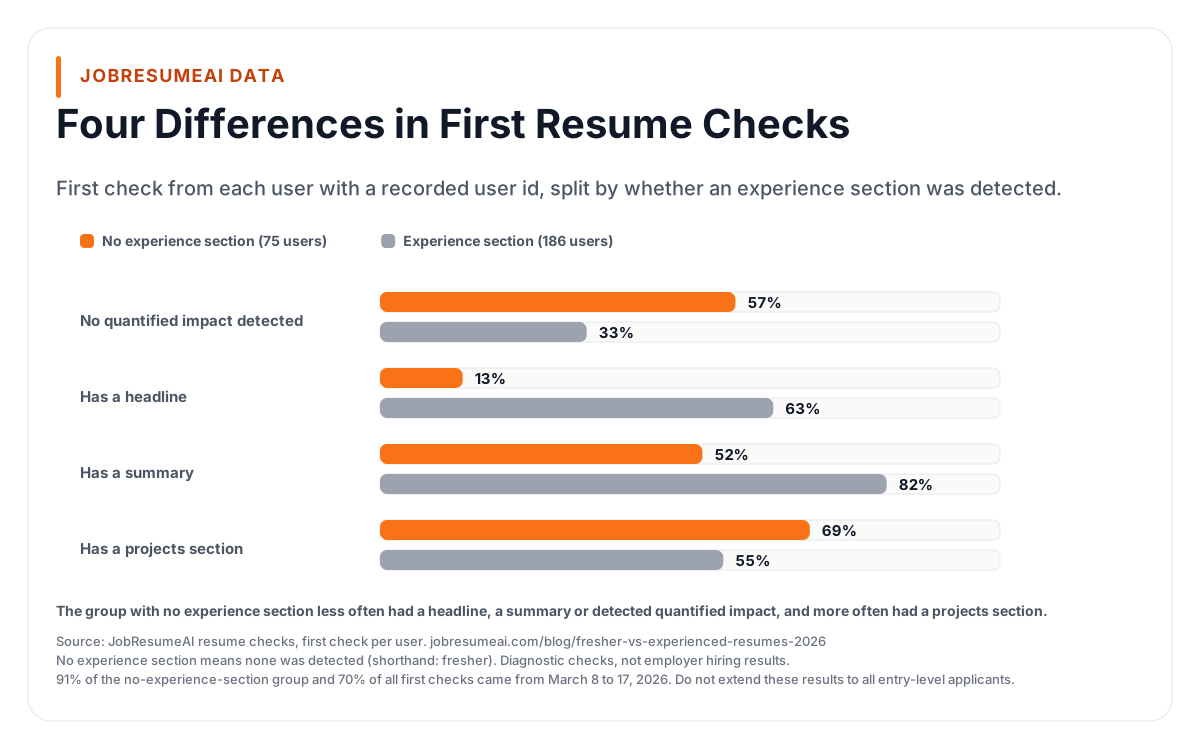
The group with no experience section less often had a headline, a summary or detected quantified impact, and more often had a projects section. 91% of that group came from one 10-day period in March 2026.
Source: JobResumeAI, Fresher vs Experienced Resume Study 2026
You may republish this chart with attribution to JobResumeAI and a link to this study.
Differences, not deficits
A headline and a summary are optional, and some career offices advise against objective statements. These numbers show what the resumes contained. They do not show that a resume without a headline or summary is worse, or that any difference causes a rejection.
Methodology: how we compared the two groups
The export contained 2,252 JobResumeAI resume checks created between October 19, 2025 and November 4, 2026. 489 of those checks, from 261 users, had a user id recorded. The other 1,763 checks, from 1,442 sessions, had none. The main analysis uses the 261 users, and each user counts once, using their earliest check. Our earlier studies counted checks, and some users ran many of them, so this keeps heavy users from dominating the results.
The checks with no user id cannot be tied to a person, so we analyze them separately as a replication sample. We use the first check from each session: 1,437 sessions, with 399 in the no-experience-section group and 1,038 in the experience-section group. Five sessions were left out because they also appear on a check with a user id or lack an experience flag. A session is not a person, so one person may appear more than once.
Group assignment follows that first check only. If JobResumeAI detected an experience section on it, the user is in the experience-section group (186). If not, the user is in the no-experience-section group (75). We use fresher and experienced as shorthand. The labels are not verified. No experience section does not prove someone is a fresher, and an experience section does not prove paid employment.
Each percentage is the share of users in a group whose first check showed a flag, such as a detected headline section or no quantified impact. The flags come from JobResumeAI's own detection and analysis rules. Every flag reported here had a recorded value on all 261 first checks. The counts behind every percentage are in the data file below. The check-level export stays private for privacy reasons, so that file is the public record. We did not use employer ATS logs, recruiter decisions or hiring outcomes.
Two parts of the study use smaller samples. The summary wording analysis uses first checks where a summary was detected and its text was stored: 38 of 39 in the first group and 110 of 152 in the second. The 43 detected summaries with no stored text all came from checks between October 19, 2025 and February 16, 2026, and all had a stored job description. They are left out of the wording counts, so the wording results lean toward later checks, and the share left out differs by group. The keyword match analysis uses only users whose first check had a stored job description and a usable match percentage: 19 and 92 users.
Wording flags are word matches, not quality scores. Trait words are motivated, passionate, hard-working, detail-oriented, team player, dynamic and enthusiastic. Selected objective-style phrases are seeking, looking to, looking for, aspiring, eager to or hoping, or a summary that starts with "To". These are keyword matches, not human classification. Selected first-person phrases are I am, I have, I'm, I can or my. That list misses other first-person writing, such as I led or we, so it is not the overall rate of first-person writing. A digit is any number character, including years. Word matches ignore case and match whole words.
Our earlier studies on common ATS problems and keyword match used exports of 2,226 checks through September 21, 2026, so the samples overlap. The numbers here differ because the unit is one first check per user, not every check.
- 2,252 checks were in the export (October 19, 2025 to November 4, 2026): 489 with a user id (261 users) and 1,763 without (1,442 sessions).
- The main analysis counts each user once, using their earliest check.
- The replication sample uses the first check from each of 1,437 sessions.
- Groups: no experience section detected (75) and experience section detected (186).
- Summary wording uses 38 and 110 summaries with stored text.
- Keyword match uses 19 and 92 users whose first check had a stored job description.
- Raw checks, names, emails, resume text and job description text are not published.
What this study can measure
It can describe how first resume checks differ between two groups under JobResumeAI's detection rules. It cannot show why an employer accepted or rejected anyone, or whether a change to a resume would change a hiring result.
Difference 1: Quantified impact was detected less often in the first group
57% of the no-experience-section group had no quantified impact detected, compared with 33% of the experience-section group. This is JobResumeAI's own diagnostic flag, not a count of every number on the resume. Part of the difference is expected. Experienced candidates often have sales figures, volumes or budgets to report. Entry-level work often does not.
Numbers do not have to be large. The career center at Boston College suggests using numbers that show the scope of your work, such as the number of people supervised, the size of an event, or a budget you oversaw. Student work has scope too. A group project has a number of members. A club has a number of meetings. A dataset has a number of rows.
Numbers are not required, and you should never guess. The University of Minnesota's career services says numbers are not the only way to show results, so a clear bullet with no number can be fine.
In the example below, the fictional source facts are: the club had 60 members, the writer used Excel, and they logged about 40 expenses a month. The stronger bullet adds no new facts. It only states them.
No scope
“Helped with the club's budget and kept records.”
Scope you can explain
“Recorded about 40 expenses a month in Excel for a student club of 60 members.”
Do not copy the example
The stronger version is fictional and illustrative. Use only numbers you can explain if an interviewer asks where they came from.
Difference 2: Fewer resumes in the first group had a headline
63% of the experience-section group had a headline, compared with 13% of the no-experience-section group. This was the largest difference in the study.
A headline is optional. It is a short line near the top of the resume, under your name. It can help when it makes your target role clear in a few words. Experienced candidates can often use their current job title. Others need another way to say it, or can skip the line and let a summary or a projects section carry the message.
If you want to try one, a simple pattern is target role plus a tool or skill, with an optional proof point. Here are three fictional examples.
- Target role
- Junior Data Analyst
- Proof point (optional)
- Campus bus tracker project
- Tool or skill
- Python and SQL
- Target role
- Accounting Assistant
- Proof point (optional)
- Student club budget log
- Tool or skill
- Excel and bookkeeping
- Target role
- Office Administrator
- Proof point (optional)
- Volunteer front desk shifts at a campus library
- Tool or skill
- Outlook and scheduling
| Target role | Proof point (optional) | Tool or skill |
|---|---|---|
| Junior Data Analyst | Campus bus tracker project | Python and SQL |
| Accounting Assistant | Student club budget log | Excel and bookkeeping |
| Office Administrator | Volunteer front desk shifts at a campus library | Outlook and scheduling |
Claim only what is true
A headline names the role you are targeting. It should not claim a job title you have not held, or a tool you have not used.
Difference 3: Summaries were less common and worded differently
52% of the no-experience-section group had a summary, compared with 82% of the experience-section group. Among resumes with a summary whose text was stored, the wording also differed. We read 38 summaries in the first group and 110 in the second and counted four patterns.
Summaries in the first group more often used stock trait words such as motivated, passionate or hard-working (61% compared with 35%). They more often used selected objective-style phrases, such as seeking or looking to (66% compared with 35%). They more often used selected first-person phrases such as I am, I have or my (29% compared with 10%). And they less often contained a digit (13% compared with 46%).
These counts are word matches, not a quality score. A trait word is not wrong by itself, but it tells the reader little unless proof comes with it. A short summary can also be strong without a number. Experienced candidates are more likely to have professional results to report, so read the digit difference as descriptive only. A digit can be a year or another fact, so this measure is not the same as quantified professional impact.
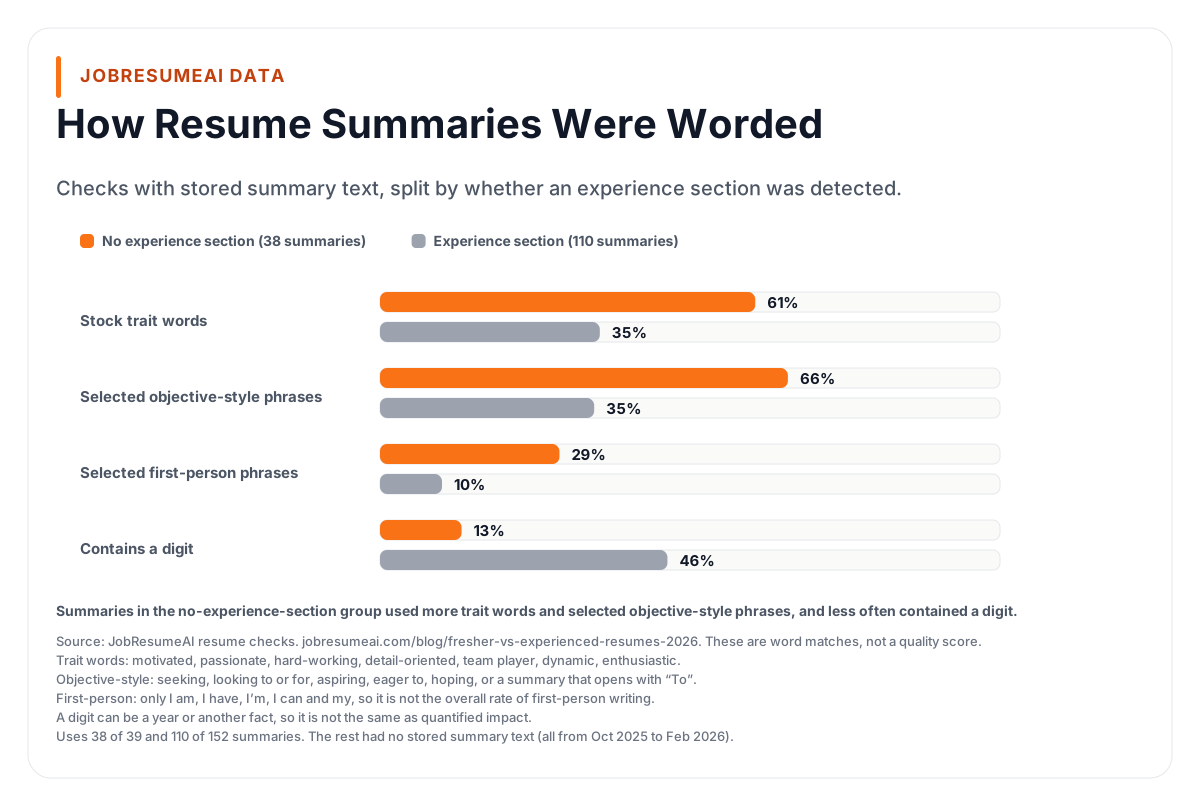
Summaries in the no-experience-section group used more trait words and selected objective-style phrases, and less often contained a digit. The sample is 38 and 110 summaries.
Source: JobResumeAI, Fresher vs Experienced Resume Study 2026
You may republish this chart with attribution to JobResumeAI and a link to this study.
Trait words, no proof
“Motivated and hardworking fresher with good communication skills.”
Real work, named plainly
“Business administration graduate who managed the budget log for a student club of 60 members. Comfortable with Excel and basic bookkeeping.”
Small sample
The first group has 38 summaries with stored text. In the fictional example, the source facts are a club budget log, 60 members, Excel and basic bookkeeping. Treat the wording results as a pattern in this group, not as a rule.
Is a summary or an objective needed?
Not for every resume, and career offices do not agree. The University of Minnesota's career services advises against objective statements and calls a summary optional. Boston College says a summary or objective is unnecessary for most students, but a short objective can help when you are entering a field where you have very limited experience.
Those views point to the same practical choice. If you use one, make it specific. A short line that names a real project, course or job, the tools you used and the role you want gives the reader more than a general goal does.
Keyword match: a cautious look at a small subset
We did not put keyword match in the main comparison. 150 of the 261 first checks had no stored job description. JobResumeAI still reports a match percentage on those checks, but we do not interpret it as a match to a specific job.
For a cleaner look, we used only users whose first check had a stored job description and a usable match percentage: 19 users with no experience section and 92 with one. Group assignment follows that same first check.
The median match was 25% for the first group and 45% for the second. The middle half ran from 6.5% to 37.5% in the first group and from 40% to 75% in the second. The median check had 9 missing items, compared with 6. With only 19 users in the first group, treat this as a hint, not a finding. These users also chose to paste a job description, so they may differ from other users.
This subset was also unevenly spread across time. 14 of the 19 no-experience-section checks fall between March 8 and 17, compared with 30 of the 92 in the experience-section group. Inside March only, the median match was 27.5% compared with 40%, so the direction held, but those samples are 14 and 30 users. Results from different periods may not be directly comparable, especially if the diagnostic system changed.
- First check had a stored job description
- Median keyword match
- No experience section (19 users)
- 25%
- Experience section (92 users)
- 45%
- First check had a stored job description
- Middle half of checks
- No experience section (19 users)
- 6.5% to 37.5%
- Experience section (92 users)
- 40% to 75%
- First check had a stored job description
- Median missing items
- No experience section (19 users)
- 9
- Experience section (92 users)
- 6
| First check had a stored job description | No experience section (19 users) | Experience section (92 users) |
|---|---|---|
| Median keyword match | 25% | 45% |
| Middle half of checks | 6.5% to 37.5% | 40% to 75% |
| Median missing items | 9 | 6 |
Do not add terms you cannot support
A missing item can be a wording gap or a real gap. Use a posting's wording only for requirements you can support with a project, a course, volunteering or a job.
Where the two groups looked similar or the pattern reversed
Projects were more common in the no-experience-section group, at 69% compared with 55%. That fits career office advice. The University of Minnesota's career services lists academic projects, coursework, volunteering and personal projects as experience, and Boston College says experience is not only paid work.
Formatting and spelling were similar. 97% of the first group passed JobResumeAI's ATS-safe formatting check, compared with 99% of the second. 88% of both groups had no spelling or grammar errors found. Formatting was not the biggest problem in our broader study of 2,226 checks either.
- Measure
- Has a projects section
- No experience section (75 users)
- 69%
- Experience section (186 users)
- 55%
- Measure
- Has an education section
- No experience section (75 users)
- 88%
- Experience section (186 users)
- 99.5%
- Measure
- Has a skills section
- No experience section (75 users)
- 84%
- Experience section (186 users)
- 95%
- Measure
- Has a certifications section
- No experience section (75 users)
- 41%
- Experience section (186 users)
- 44%
- Measure
- Has portfolio or profile links
- No experience section (75 users)
- 59%
- Experience section (186 users)
- 63%
- Measure
- Has an achievements section
- No experience section (75 users)
- 21%
- Experience section (186 users)
- 30%
- Measure
- Passed the ATS-safe formatting check
- No experience section (75 users)
- 97%
- Experience section (186 users)
- 99%
- Measure
- No spelling or grammar errors found
- No experience section (75 users)
- 88%
- Experience section (186 users)
- 88%
| Measure | No experience section (75 users) | Experience section (186 users) |
|---|---|---|
| Has a projects section | 69% | 55% |
| Has an education section | 88% | 99.5% |
| Has a skills section | 84% | 95% |
| Has a certifications section | 41% | 44% |
| Has portfolio or profile links | 59% | 63% |
| Has an achievements section | 21% | 30% |
| Passed the ATS-safe formatting check | 97% | 99% |
| No spelling or grammar errors found | 88% | 88% |
What ATS-safe means here
It means JobResumeAI's formatting check passed. It does not guarantee that any employer's system will read the resume the same way.
Does the March 2026 spike change the result?
Most of this data came from one short period. 70% of all first checks (182 of 261) were created between March 8 and March 17, 2026. For the no-experience-section group the share was higher: 91% (68 of 75), compared with 61% of the experience-section group (114 of 186).
That matters because one group of similar users could shape the results. To test it, we compared the two groups inside that period only. The differences stayed in the same direction.
Outside that period only 7 users were in the no-experience-section group. That is too few to measure, so we do not report a separate result for them. We do not know why the period was so busy, and we do not claim a cause. Do not extend these results to all entry-level applicants.
- March 8 to 17, 2026 only
- No quantified impact detected
- No experience section (68 users)
- 56% (38 users)
- Experience section (114 users)
- 37% (42 users)
- March 8 to 17, 2026 only
- Has a headline
- No experience section (68 users)
- 12% (8 users)
- Experience section (114 users)
- 51% (58 users)
- March 8 to 17, 2026 only
- Has a summary
- No experience section (68 users)
- 51% (35 users)
- Experience section (114 users)
- 82% (93 users)
| March 8 to 17, 2026 only | No experience section (68 users) | Experience section (114 users) |
|---|---|---|
| No quantified impact detected | 56% (38 users) | 37% (42 users) |
| Has a headline | 12% (8 users) | 51% (58 users) |
| Has a summary | 51% (35 users) | 82% (93 users) |
Does the pattern hold in a second sample?
In direction, yes. We ran the same four measures on the replication sample: the first check from each of 1,437 sessions with no user id. 399 had no experience section detected and 1,038 had one.
The no-experience-section group again had no quantified impact detected more often (57% compared with 34%), a headline less often (23% compared with 52%) and a summary less often (58% compared with 76%). It again had a projects section more often (57% compared with 49%).
This second sample does not test other months. 95% of its no-experience-section checks also fall between March 8 and 17. Outside that period only 18 sessions were in the no-experience-section group, compared with 212 with an experience section. The direction was the same on all four measures, but 18 sessions is too few to rely on.
- Replication sample (sessions with no user id)
- No quantified impact detected
- No experience section (399 sessions)
- 57% (228 sessions)
- Experience section (1,038 sessions)
- 34% (351 sessions)
- Replication sample (sessions with no user id)
- Has a headline
- No experience section (399 sessions)
- 23% (91 sessions)
- Experience section (1,038 sessions)
- 52% (544 sessions)
- Replication sample (sessions with no user id)
- Has a summary
- No experience section (399 sessions)
- 58% (233 sessions)
- Experience section (1,038 sessions)
- 76% (784 sessions)
- Replication sample (sessions with no user id)
- Has a projects section
- No experience section (399 sessions)
- 57% (227 sessions)
- Experience section (1,038 sessions)
- 49% (506 sessions)
| Replication sample (sessions with no user id) | No experience section (399 sessions) | Experience section (1,038 sessions) |
|---|---|---|
| No quantified impact detected | 57% (228 sessions) | 34% (351 sessions) |
| Has a headline | 23% (91 sessions) | 52% (544 sessions) |
| Has a summary | 58% (233 sessions) | 76% (784 sessions) |
| Has a projects section | 57% (227 sessions) | 49% (506 sessions) |
Sessions are not people
A session is one visit's first check. One person can start several sessions, and we cannot tell. Treat the replication sample as supporting evidence for the direction of the differences, not as a count of people.
If you want to strengthen an early-career resume: a five-step order
These steps are optional. Use the ones that fit the job and your background. They start with evidence, then build the headline, summary and bullets from it.
Step 1: List your real work
Write down projects, coursework, volunteer roles, clubs and any short jobs. University career offices count these as experience when paid work is limited.
Step 2: Consider a headline
If it helps, use the target role, a tool or skill, and an optional proof point. Keep it to one line, or skip it.
Step 3: Write a summary from proof, if you use one
Name who you are now, one thing you did, the tools you used and the role you want. Leave out trait words you cannot back up.
Step 4: Add the numbers you know
Count people, items, how often, how long and how large. Leave a number out if you do not know it. A bullet without a number can be fine.
Step 5: Check the job posting
Pick the requirements you can support and use the posting's wording for them. Then compare your resume with the job description.
Download the fresher resume worksheet
The worksheet turns the five steps above into fill-in boxes. It has three pages: an optional headline builder, an optional short-summary builder, a table for finding countable details, a table for choosing which projects and experience to show, and an eight-point final check. Rows shaded gray are fictional examples. Do not copy them.
Download
Fresher resume worksheet
Printable PDF and an editable Word version.
Fill it in with facts that are true for you. The examples in it are fictional.
Limitations of this study
- The main sample is 261 users with a recorded user id who chose to use JobResumeAI. It is not a random sample of freshers or of job seekers. The 1,763 checks with no user id are analyzed separately.
- The groups are detection labels. No experience section detected does not prove someone is a fresher, and an experience section does not prove paid employment.
- 75 users are in the no-experience-section group, so small differences should not be over-read.
- 91% of that group in the main sample, and 95% in the replication sample, came from March 8 to 17, 2026. Only 7 users and 18 sessions fall outside it, so we cannot say whether the differences hold in other months, and we do not know the cause of the spike.
- The replication sample uses sessions, not people, and one person may appear more than once.
- Summary wording uses 38 and 110 summaries with stored text. 43 detected summaries had no stored text, all from October 2025 to February 2026, and the share left out differs by group.
- Keyword match uses only 19 and 92 users whose first check had a stored job description. 150 of the 261 first checks had none, and we do not interpret their match percentages as job-specific. The subset is also uneven across time: 14 of 19 and 30 of 92 first checks fall between March 8 and 17.
- Keyword match and all other flags follow JobResumeAI's own analysis rules. No analysis version is recorded for 257 of the 261 first checks, so we cannot confirm the rules stayed the same across the period. The March-only comparison, inside a 10-day window, is a partial check.
- Wording counts use fixed word lists and do not measure quality. The first-person count covers only five phrases, and a digit can be a year or another fact.
- A headline, a summary and numbers are optional. A difference in how often they appear is not evidence that their absence is a mistake.
- We do not have employer ATS settings, recruiter decisions, interview outcomes or hiring outcomes for these checks.
- The study does not show that changing a resume would lead to an interview.
Privacy
The report uses aggregate diagnostic fields only. It does not publish names, email addresses, phone numbers, resume text, filenames or job description text from individual checks.
How to cite or reuse this research
Writers, career educators, universities and journalists may cite the aggregate findings in this report. Link to the original study when possible so readers can review the methodology and limitations.
When you cite a statistic, describe the sample accurately. Say 261 first resume checks from JobResumeAI users with a recorded user id, grouped by whether an experience section was detected, not 261 job seekers in general.
- Use case
- Article or newsletter
- Suggested attribution
- According to JobResumeAI's 2026 analysis of 261 first resume checks...
- Use case
- Formal citation
- Suggested attribution
- Ahmed, Abid. "Fresher vs Experienced Resumes: What 261 First Resume Checks Show." JobResumeAI, 2026.
- Use case
- Chart or presentation
- Suggested attribution
- Source: JobResumeAI, Fresher vs Experienced Resume Study 2026
| Use case | Suggested attribution |
|---|---|
| Article or newsletter | According to JobResumeAI's 2026 analysis of 261 first resume checks... |
| Formal citation | Ahmed, Abid. "Fresher vs Experienced Resumes: What 261 First Resume Checks Show." JobResumeAI, 2026. |
| Chart or presentation | Source: JobResumeAI, Fresher vs Experienced Resume Study 2026 |
Reuse policy
You may reference or republish the aggregate statistics and charts with attribution to JobResumeAI and a link to this study. Keep the methodology and limitations intact, and do not present the results as employer rejection data or a universal ATS threshold.
Download the chart pack and data
The pack contains both charts, a citation file and a CSV with the aggregate figures used in this study, including counts, group sizes and definitions. Reuse the charts only with the limitations intact.
Copy-ready
Copy the study citation or embed code
Use the original study link so readers can check the methodology.
Suggested citation
Ahmed, Abid. "Fresher vs Experienced Resumes: What 261 First Resume Checks Show." JobResumeAI, 2026.
Four differences chart embed
<img src="https://www.jobresumeai.com/blog-resources/research-chart-pack-fresher-resume-2026/fresher-vs-experienced-resume-differences-2026.png" alt="JobResumeAI 2026 comparison of first resume checks with and without a detected experience section." />
Summary wording chart embed
<img src="https://www.jobresumeai.com/blog-resources/research-chart-pack-fresher-resume-2026/fresher-resume-summary-wording-2026.png" alt="JobResumeAI 2026 comparison of resume summary wording in first resume checks." />
Download
Download the 2026 fresher vs experienced resume charts and data
Publication-ready PNG charts, citation text and the aggregate data as CSV.
261 first resume checks from JobResumeAI users. The metrics are JobResumeAI diagnostics, not employer ATS thresholds.
Common questions about fresher resumes
What are the most common fresher resume mistakes?
This study did not measure mistakes. It measured differences. The group with no experience section detected less often had a headline, a summary or detected quantified impact, and more often had a projects section. A headline, a summary and numbers are all optional, so a difference in how often they appear does not prove an error.
Should a fresher resume have a summary or an objective?
Career offices disagree, and neither is required. If you use one, make it specific. Name a real project, course or job, the tools you used and the role you want, and skip trait words you cannot support.
Do freshers need a headline?
No. A headline is optional, and only 13% of the no-experience-section group had one. A short line under your name can make your target role clear at a glance. Only name a role you are targeting, not a title you have not held.
How can a fresher add numbers with no job experience?
Count the scope of your projects, clubs and volunteer work. Useful counts include team size, number of items, how often something happened and how large a dataset or event was. If you do not know a number, leave it out. A bullet without a number can be fine.
Is a fresher resume different for ATS?
The formatting rules are the same. In this study 97% of the no-experience-section group passed JobResumeAI's ATS-safe formatting check. The harder part is wording. Use a posting's terms only for requirements you can support.
What counts as a fresher in this study?
A resume where JobResumeAI detected no experience section on the user's first check. It is a rule based on the resume, not a label chosen by the user, and it can miss students whose work sits under another heading.
Published by JobResumeAI
Already have a resume?
Check your resume against a job description
Use JobResumeAI to review your headline, summary, quantified impact and keyword match. If you are starting your first resume, build it from scratch instead.
Treat the result as diagnostic guidance. Use only facts that are true for you.
Further reading
Sources and references
These references were reviewed while preparing this guide. JobResumeAI may interpret or organize the guidance differently; the links below let you check the underlying advice yourself.