
Resume Keyword Match in 2026: What 639 Resume-to-Job Checks Found
See what 639 JobResumeAI resume-to-job checks found about keyword match, missing resume keywords, match scores, and job-description alignment.
Quick answer
A resume match score can reveal gaps, but it is not a hiring cutoff.
We analyzed 639 JobResumeAI checks that included a stored job description. Of those, 638 had a usable keyword-match percentage. The median JobResumeAI keyword match was 40%, and the middle half of checks ranged from 35% to 70%.
More than half of the usable checks, 56.3%, had a keyword match below 50%. Only 14.3% were at 80% or higher. That does not mean 50% is bad or 80% is good. JobResumeAI's match percentage is a diagnostic comparison, not an employer ATS threshold.
Missing items were common too. 95.8% of the 639 checks had at least one item in JobResumeAI's Missing list. The median was 6 missing items, and 71.0% had 5 or more. A missing term should only be added when it truthfully reflects the candidate's real experience, training, projects, or credentials.
- 639 checks contained a stored job description.
- 516 unique exact job-description texts appeared in the sample.
- The median keyword match was 40% across 638 usable checks.
- 56.3% of usable checks were below 50% match.
- 95.8% had at least one missing item.
- 71.0% had 5 or more missing items.
- There is no universal match percentage that guarantees an interview.
On this page
What 639 resume-to-job checks found
The typical check was far from a complete keyword match, but the score alone does not tell us whether the resume was good or bad.
This study looks only at JobResumeAI checks where a job description was stored with the analysis. That gives us a narrower dataset than our broader ATS study, but it also lets us focus on one question: how closely did the resume language line up with the target job description under JobResumeAI's comparison?
Across 638 checks with a usable match percentage, the median was 40%. The 25th percentile was 35%, and the 75th percentile was 70%. In simple terms, half of the usable checks landed between 35% and 70%.
The spread was wide. Some resumes had very little overlap with the target posting. Others had much stronger overlap. That is exactly why a single score needs context. A lower result can reflect weak wording, a real qualification gap, a career change, or a job that is simply a poor fit. A higher result can still hide vague bullets or unsupported claims.
- Finding
- Checks with a stored job description
- Result
- 639
- Finding
- Unique exact job-description texts
- Result
- 516
- Finding
- Checks with a usable keyword-match percentage
- Result
- 638
- Finding
- 25th percentile keyword match
- Result
- 35%
- Finding
- Median keyword match
- Result
- 40%
- Finding
- 75th percentile keyword match
- Result
- 70%
- Finding
- Checks below 50% match
- Result
- 56.3%
- Finding
- Checks at 80% match or higher
- Result
- 14.3%
| Finding | Result |
|---|---|
| Checks with a stored job description | 639 |
| Unique exact job-description texts | 516 |
| Checks with a usable keyword-match percentage | 638 |
| 25th percentile keyword match | 35% |
| Median keyword match | 40% |
| 75th percentile keyword match | 70% |
| Checks below 50% match | 56.3% |
| Checks at 80% match or higher | 14.3% |
Methodology: how we built this resume keyword match study
The full export contained 2,226 JobResumeAI resume checks created between October 19, 2025 and September 21, 2026. For this study, we selected the 639 checks that contained a non-empty stored job description. Those checks ran from October 19, 2025 through September 13, 2026.
Within those 639 checks, 516 exact job-description texts were unique. This matters because the sample includes repeated job descriptions. It also may include repeat checks from the same user or resume. We therefore describe the unit as checks, not unique candidates, unique resumes, or unique jobs.
One of the 639 checks did not contain a usable keyword-match percentage, so match-score statistics use 638 checks. Missing-item statistics use all 639 checks.
We calculated counts, percentages, medians, and percentile ranges from JobResumeAI's own keyword-comparison fields. We did not use employer-side ATS logs, recruiter decisions, application outcomes, interview outcomes, or hiring outcomes.
- 639 checks included a stored job description.
- 638 had a usable keyword-match percentage.
- 516 exact job-description texts were unique.
- Repeated checks or repeated job descriptions may be present.
- The data is self-selected from people who used JobResumeAI.
- No personal resume text, names, emails, phone numbers, or other identifying information is published in this report.
More than half of usable checks were below 50% keyword match
A median can hide the shape of a dataset, so the distribution matters. Among the 638 usable checks, 7.5% were below 20% match. Another 24.9% were between 20% and 39%.
The largest concentration was around the middle. 23.8% landed between 40% and 49%, while 9.7% were between 50% and 59%. Another 19.7% were between 60% and 79%. Only 14.3% reached 80% or higher.
Put another way, 56.3% of the checks were below 50% match. That sounds dramatic until the score is given the right context. A candidate should not increase a match percentage by adding a technology, credential, responsibility, or qualification they do not have.
- JobResumeAI keyword-match range
- Below 20%
- Checks
- 48
- Share
- 7.5%
- JobResumeAI keyword-match range
- 20% to 39%
- Checks
- 159
- Share
- 24.9%
- JobResumeAI keyword-match range
- 40% to 49%
- Checks
- 152
- Share
- 23.8%
- JobResumeAI keyword-match range
- 50% to 59%
- Checks
- 62
- Share
- 9.7%
- JobResumeAI keyword-match range
- 60% to 79%
- Checks
- 126
- Share
- 19.7%
- JobResumeAI keyword-match range
- 80% or higher
- Checks
- 91
- Share
- 14.3%
| JobResumeAI keyword-match range | Checks | Share |
|---|---|---|
| Below 20% | 48 | 7.5% |
| 20% to 39% | 159 | 24.9% |
| 40% to 49% | 152 | 23.8% |
| 50% to 59% | 62 | 9.7% |
| 60% to 79% | 126 | 19.7% |
| 80% or higher | 91 | 14.3% |
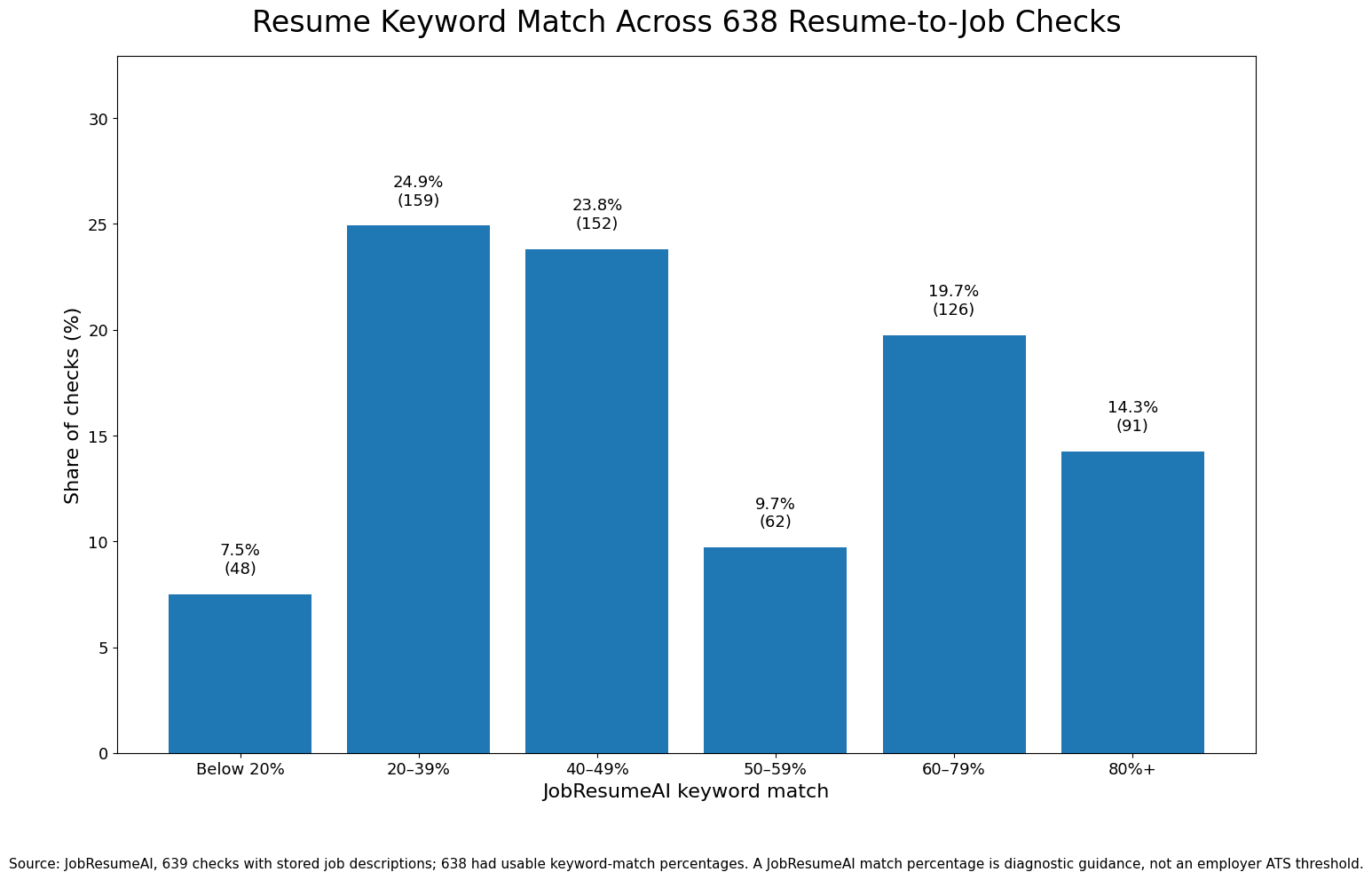
More than half of usable checks were below 50% match, while 14.3% were at 80% or higher.
Source: JobResumeAI, Resume Keyword Match Study 2026
You may republish this chart with attribution to JobResumeAI and a link to this study.
What is a good resume match score?
There is no universal answer. JobResumeAI's score belongs to JobResumeAI. Another resume tool may calculate a score differently, and an employer's recruiting system may use a completely different process.
Current recruiting platforms show why one number should not be treated as a universal gate. Greenhouse supports keyword searches, Boolean candidate searches, custom filters, application rules, and newer matching features. Workday describes ATS workflows that can include parsing, filtering, search, screening, and matching. Employers can configure these systems differently.
That means a 70% match in one tool does not translate into a 70% chance of passing an employer ATS. It also does not mean a candidate at 40% is automatically rejected. The useful question is what sits behind the number.
- Instead of asking
- Is 80% a good ATS score?
- Ask this
- Which important job requirements are clearly supported by my resume?
- Instead of asking
- Will 70% pass ATS?
- Ask this
- Are any important requirements missing because my wording is vague?
- Instead of asking
- How do I reach 100%?
- Ask this
- Which missing terms are truthful to add, and which represent real gaps?
- Instead of asking
- What score guarantees an interview?
- Ask this
- Does the resume make my strongest relevant evidence easy to find?
| Instead of asking | Ask this |
|---|---|
| Is 80% a good ATS score? | Which important job requirements are clearly supported by my resume? |
| Will 70% pass ATS? | Are any important requirements missing because my wording is vague? |
| How do I reach 100%? | Which missing terms are truthful to add, and which represent real gaps? |
| What score guarantees an interview? | Does the resume make my strongest relevant evidence easy to find? |
95.8% of checks had at least one missing item
Keyword match was only one part of the pattern. JobResumeAI's Missing list contained at least one item in 95.8% of the 639 checks. Only 27 checks, or 4.2%, had no missing items.
The median check had 6 missing items. The middle half had between 4 and 8. A large share of the sample had several gaps at once: 71.0% had 5 or more missing items, and 30.8% had 8 or more.
These numbers do not mean candidates should add 6 new keywords to every resume. The Missing list can mix two very different situations. Sometimes the candidate has the experience but uses different or vague wording. Other times the posting asks for something the candidate genuinely does not have.
- Missing items
- 0
- Checks
- 27
- Share
- 4.2%
- Missing items
- 1 to 4
- Checks
- 158
- Share
- 24.7%
- Missing items
- 5 to 7
- Checks
- 257
- Share
- 40.2%
- Missing items
- 8 or more
- Checks
- 197
- Share
- 30.8%
| Missing items | Checks | Share |
|---|---|---|
| 0 | 27 | 4.2% |
| 1 to 4 | 158 | 24.7% |
| 5 to 7 | 257 | 40.2% |
| 8 or more | 197 | 30.8% |
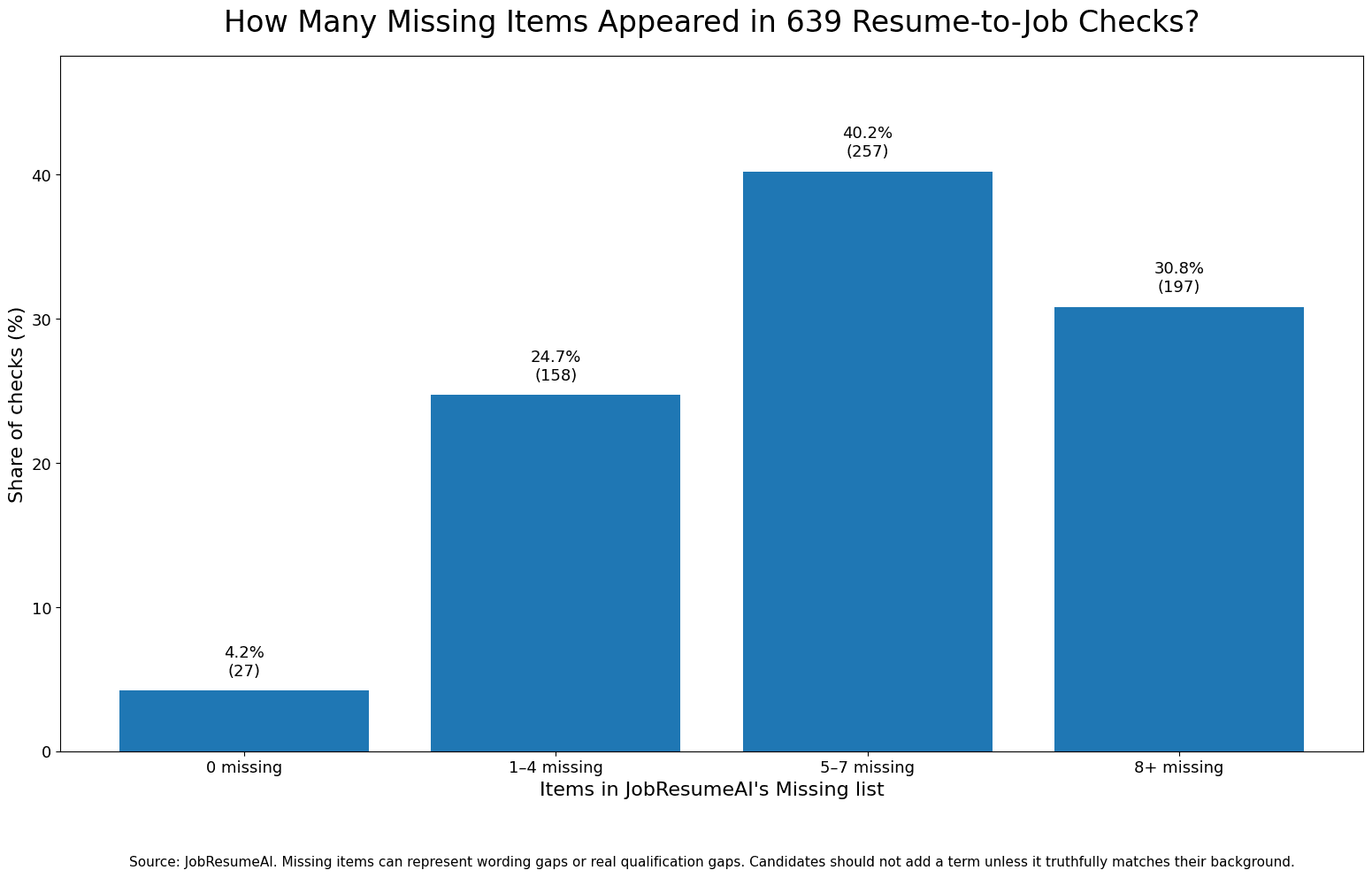
71.0% of checks contained at least 5 items in JobResumeAI's Missing list.
Source: JobResumeAI, Resume Keyword Match Study 2026
You may republish this chart with attribution to JobResumeAI and a link to this study.
A missing resume keyword can mean two different things
The most important step after a keyword comparison is deciding what kind of gap you are looking at.
A wording gap happens when your background supports the requirement, but the resume does not describe it clearly. For example, a job may ask for project management while the resume says only that you helped coordinate tasks across teams. If you genuinely planned timelines, owners, risks, or delivery, clearer terminology may make the evidence easier to understand.
A real qualification gap is different. If the role requires Kubernetes and you have never used Kubernetes, adding the term would not improve the truth of your resume. It would only make the document look more aligned than your background really is.
- Type of gap
- Wording gap
- What it means
- You have relevant experience, but the resume hides it behind vague or different language
- What to do
- Clarify the wording and use accurate job terminology where it fits
- Type of gap
- Evidence gap
- What it means
- You claim a skill, but the resume does not show where you used it
- What to do
- Add truthful context in experience, projects, education, or credentials
- Type of gap
- Real qualification gap
- What it means
- The job asks for something you do not have
- What to do
- Leave it missing and focus on the strengths you can support
| Type of gap | What it means | What to do |
|---|---|---|
| Wording gap | You have relevant experience, but the resume hides it behind vague or different language | Clarify the wording and use accurate job terminology where it fits |
| Evidence gap | You claim a skill, but the resume does not show where you used it | Add truthful context in experience, projects, education, or credentials |
| Real qualification gap | The job asks for something you do not have | Leave it missing and focus on the strengths you can support |
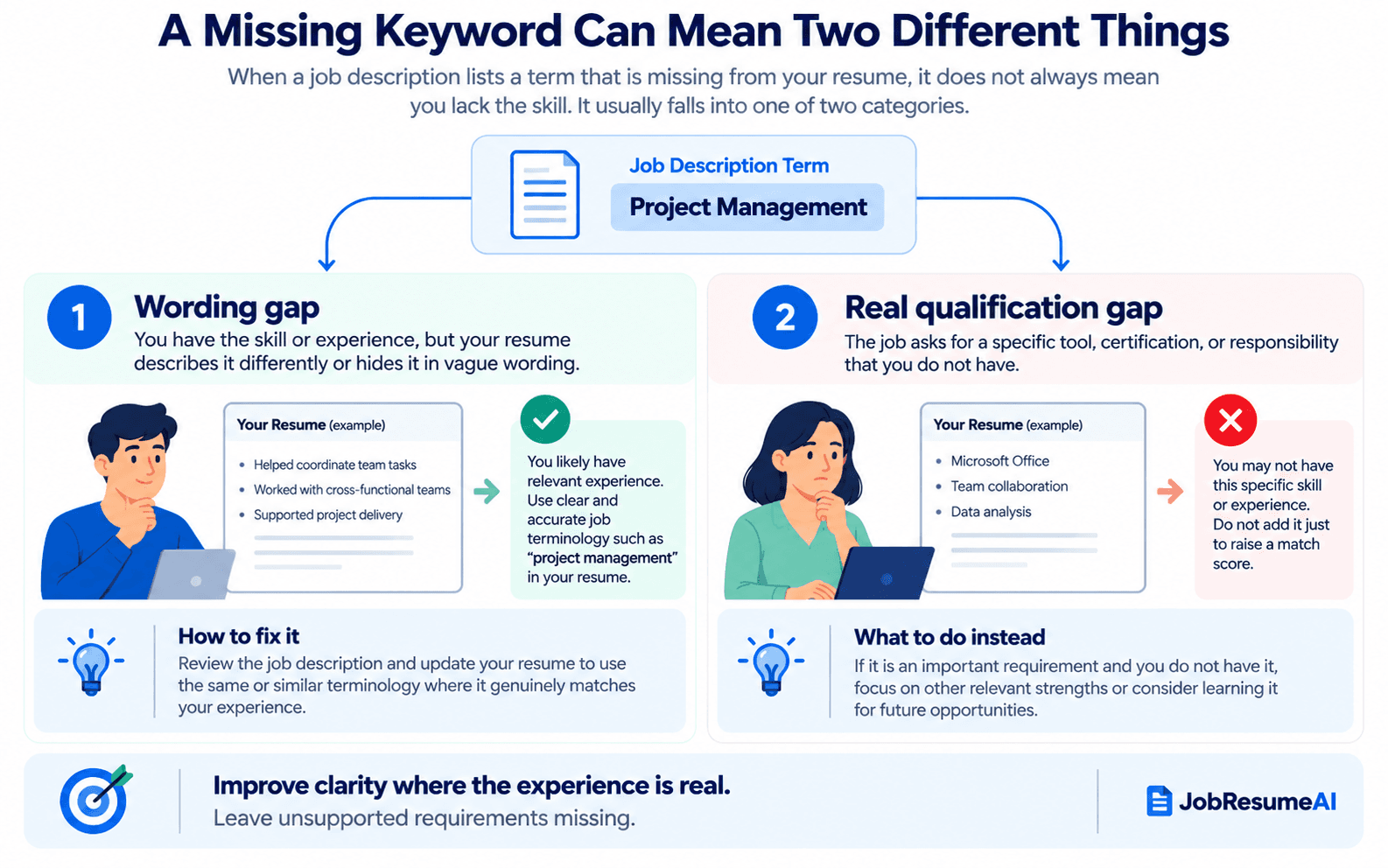
Fix wording when the experience is real. Do not add a term when the underlying skill or qualification is missing.
The same skill can be matched in one check and missing in another
A useful pattern appears when we look at the terms recorded in JobResumeAI's Matched and Missing fields. Python, Java, Docker, AWS, Power BI, Tableau, SQL, Git, and other technical terms appeared on both sides of the comparison across different checks.
That is expected. A keyword is not good or bad on its own. It depends on the target job and the candidate's background. Python was recorded as matched 182 times and missing 24 times. Docker appeared as matched 36 times and missing 26 times. AWS appeared as matched 34 times and missing 21 times.
The sample also contains many software and data terms, so it would be misleading to turn this into a universal list of the skills employers want most. The counts below describe this sample only. They do not represent unique employers, unique jobs, or the whole labor market.
- Frequently matched term
- Python
- Matched occurrences
- 182
- Frequently missing term
- Docker
- Missing occurrences
- 26
- Frequently matched term
- JavaScript
- Matched occurrences
- 142
- Frequently missing term
- Python
- Missing occurrences
- 24
- Frequently matched term
- SQL
- Matched occurrences
- 134
- Frequently missing term
- CI/CD
- Missing occurrences
- 22
- Frequently matched term
- Git
- Matched occurrences
- 111
- Frequently missing term
- React Native
- Missing occurrences
- 21
- Frequently matched term
- React.js
- Matched occurrences
- 87
- Frequently missing term
- AWS
- Missing occurrences
- 21
- Frequently matched term
- React
- Matched occurrences
- 73
- Frequently missing term
- Kubernetes
- Missing occurrences
- 21
- Frequently matched term
- Java
- Matched occurrences
- 73
- Frequently missing term
- Tailwind CSS
- Missing occurrences
- 17
- Frequently matched term
- TypeScript
- Matched occurrences
- 68
- Frequently missing term
- Go
- Missing occurrences
- 16
- Frequently matched term
- Agile
- Matched occurrences
- 66
- Frequently missing term
- Tableau
- Missing occurrences
- 16
- Frequently matched term
- Node.js
- Matched occurrences
- 65
- Frequently missing term
- Redis
- Missing occurrences
- 15
| Frequently matched term | Matched occurrences | Frequently missing term | Missing occurrences |
|---|---|---|---|
| Python | 182 | Docker | 26 |
| JavaScript | 142 | Python | 24 |
| SQL | 134 | CI/CD | 22 |
| Git | 111 | React Native | 21 |
| React.js | 87 | AWS | 21 |
| React | 73 | Kubernetes | 21 |
| Java | 73 | Tailwind CSS | 17 |
| TypeScript | 68 | Go | 16 |
| Agile | 66 | Tableau | 16 |
| Node.js | 65 | Redis | 15 |
Why accurate keywords can still matter in applicant tracking systems
Keyword advice is often oversimplified into a claim that an ATS looks for a fixed list of words and rejects anything that misses them. Real recruiting systems are more varied.
Greenhouse currently supports full-text and Boolean candidate searches. Its talent-filtering workflow can search applications for job titles, skills, locations, and other keywords, with preferred and required terms. Greenhouse also offers Talent Matching features that compare candidate resumes with job criteria. Workday describes ATS workflows that can include resume parsing, filtering, search, and candidate matching.
This does not create a universal keyword formula. It does explain why clear, accurate terminology can help. If your resume genuinely contains a required skill or credential, naming it in recognizable language makes that information easier for software and people to find.
How to improve resume match without keyword stuffing
A low match result is most useful when it leads to a better review process, not a longer keyword list.
Start with the posting. Identify the responsibilities and qualifications that are central to the role. Then compare those requirements with evidence you actually have. If the evidence exists but the resume hides it, rewrite for clarity. If the evidence does not exist, leave the requirement out.
- 1
Read the job description for meaning
Separate required qualifications and central responsibilities from company language, benefits, and low-priority details.
- 2
Review the missing terms
Decide which items are wording gaps, evidence gaps, or genuine qualification gaps.
- 3
Use exact names where accuracy matters
Tools, certifications, systems, methods, and established job functions should use recognizable names when those names truthfully match your background.
- 4
Put important terms next to evidence
A keyword inside a relevant experience or project bullet is usually more informative than the same word sitting alone in a long skills list.
- 5
Rewrite vague bullets
Clarify the action, context, responsibility, and outcome when you know it. Do not invent metrics.
- 6
Check the final resume again
Use the new comparison to find anything still unclear, but stop when further changes would make the resume repetitive or less truthful.
Why a 100% resume keyword match should not be the goal
A job description can ask for more than one candidate realistically has. It may include preferred skills, a specific technology stack, industry experience, certifications, management scope, or responsibilities that are genuinely outside your background.
Trying to force every term into the resume creates two problems. First, it can produce unsupported claims. Second, it can make the document repetitive and hard to read.
A truthful 60% match can be more useful than an artificial 95% match if the higher number was created by copying terms the candidate cannot defend. The score is only helpful when the resume remains accurate.
- Do not add software you have never used.
- Do not add a certification you do not hold.
- Do not turn coursework into professional experience.
- Do not rename a job title to imply work you did not perform.
- Do not copy entire responsibilities from the posting.
- Do not repeat the same phrase only to increase keyword frequency.
Resume keyword match is not the same as resume quality
Two resumes can receive similar match percentages and still differ a lot in quality. One may have strong evidence, clear bullets, readable structure, and accurate credentials. The other may simply repeat more job-description terminology.
That is why a keyword comparison should sit alongside other checks. Formatting, experience relevance, bullet quality, quantified impact, grammar, section structure, and credibility still matter.
Our broader analysis of 2,226 JobResumeAI checks found that formatting warnings were uncommon compared with job-alignment gaps. This narrower 639-check study adds detail to the alignment side of that story, but it still does not make keyword match the only thing worth fixing.
A practical way to use a job description keyword finder and resume checker
The two tools answer different questions. A job description keyword finder helps organize what the employer is asking for. A resume checker helps compare that request with what your resume currently shows.
Use the keyword finder first when the posting is long or unclear. Review the important responsibilities, skills, tools, credentials, and role terms. Then compare the resume with the same posting. That makes it easier to tell whether a missing item is important, supported, and worth addressing.
- 1
Extract the job requirements
Review the posting before editing the resume.
- 2
Mark the requirements you genuinely meet
Keep evidence from work, projects, education, training, or credentials separate and accurate.
- 3
Compare the resume with the job
Look for important requirements that are missing or weakly represented.
- 4
Edit only where the evidence supports the change
Improve wording, placement, or detail without adding qualifications you do not have.
- 5
Review the final document as a person would
The resume should still sound natural and make sense outside a scoring tool.
Limitations of this study
- The dataset contains 639 checks, not 639 verified unique candidates, resumes, employers, or jobs.
- The 639 checks contained 516 unique exact job-description texts, so some job descriptions were repeated.
- Repeat resume checks may be present.
- The sample is self-selected from people who used JobResumeAI.
- The sample contains many software and data terms, so skill-frequency results should not be generalized to the full labor market.
- JobResumeAI's keyword-match percentage and Missing list reflect JobResumeAI's own analysis rules.
- One check did not have a usable keyword-match percentage, so match-score statistics use 638 checks.
- A missing item can represent either a real qualification gap or a wording gap. The dataset does not automatically distinguish every case.
- We do not have employer ATS configurations, recruiter decisions, application outcomes, interview outcomes, or hiring outcomes for these checks.
- The study does not establish a universal good ATS score, keyword density, or hiring threshold.
How to cite or reuse this research
Writers, career educators, universities, researchers, and journalists may cite the aggregate findings in this report. Link to the original study when possible so readers can review the methodology and limitations behind the numbers.
When referencing a statistic, describe the sample accurately. Say 639 JobResumeAI resume-to-job checks, not 639 unique job seekers or 639 employers.
- Use case
- Article or newsletter
- Suggested attribution
- According to JobResumeAI's 2026 analysis of 639 resume-to-job checks...
- Use case
- Formal citation
- Suggested attribution
- Ahmed, Abid. "Resume Keyword Match in 2026: What 639 Resume-to-Job Checks Found." JobResumeAI, 2026.
- Use case
- Chart or presentation
- Suggested attribution
- Source: JobResumeAI, Resume Keyword Match Study 2026
| Use case | Suggested attribution |
|---|---|
| Article or newsletter | According to JobResumeAI's 2026 analysis of 639 resume-to-job checks... |
| Formal citation | Ahmed, Abid. "Resume Keyword Match in 2026: What 639 Resume-to-Job Checks Found." JobResumeAI, 2026. |
| Chart or presentation | Source: JobResumeAI, Resume Keyword Match Study 2026 |
Common questions about resume keyword match
What is a good resume keyword match percentage?
There is no universal percentage that applies across employers or resume tools. In this JobResumeAI sample, the median was 40%, but that is a descriptive statistic, not a recommended target. Review the requirements behind the score instead of treating the number as a hiring cutoff.
What percentage should a resume match a job description?
There is no evidence for one percentage that every candidate should reach. The better goal is to represent the important requirements you genuinely meet and leave unsupported requirements out.
Is an 80% resume match good?
An 80% JobResumeAI match means the resume showed substantial overlap under JobResumeAI's comparison, but it does not guarantee an interview or predict an employer's ATS decision. In this sample, 14.3% of usable checks were at 80% or higher.
Is a 50% resume match too low?
Not automatically. 56.3% of usable checks in this sample were below 50%. A low result is a prompt to inspect the gaps. Some may be fixable wording problems, while others may be qualifications you genuinely do not have.
Should I add every missing resume keyword?
No. Add a term only when it truthfully describes your experience, skill, training, project, credential, or responsibility. Leave a requirement missing when you cannot support it.
Do ATS systems use keywords?
Some recruiting systems support keyword search, Boolean search, filters, and matching features. The exact workflow depends on the platform and employer. That is why accurate terminology can matter, but there is no universal keyword formula.
Can I improve a match score without changing my experience?
Yes, when the issue is wording or placement. You can clarify a vague bullet, use the accurate name of a tool, move relevant evidence higher, or make a qualification easier to find. You should not create new experience or credentials to increase the score.
Resume-to-job match checklist before you apply
- Did you identify the role's required qualifications and central responsibilities?
- Can every important keyword on your resume be supported by real evidence?
- Did you separate wording gaps from genuine qualification gaps?
- Are important tools, systems, and certifications named accurately?
- Do the strongest job-relevant skills appear in context, not only in a skills list?
- Did you rewrite vague bullets where the experience is real?
- Did you leave unsupported requirements out?
- Is the resume still readable and natural after tailoring?
- Did you avoid chasing a universal ATS score or keyword density?
- Can you explain every important claim in an interview?
Published by JobResumeAI
Further reading
Sources and references
These references were reviewed while preparing this guide. JobResumeAI may interpret or organize the guidance differently; the links below let you check the underlying advice yourself.